
To use Growing Degree Days (GDD) for pest timing, start by tracking daily temperatures—using your local weather data—and calculate GDD with the formula: (max + min)/2 minus the base temperature. Keep a running total of GDD throughout the season. When the total reaches a known threshold for a pest’s developmental stage, you can time your control measures effectively. Stay with us to discover how to apply GDD data for ideal pest management.
Key Takeaways
- Calculate daily GDD using average temperature minus the pest’s base temperature to monitor pest development stages.
- Track cumulative GDD throughout the season to predict when pests will reach vulnerable lifecycle stages.
- Use GDD thresholds to time pesticide applications just before pest emergence for maximum effectiveness.
- Integrate GDD data into crop management plans to optimize planting, irrigation, and harvest schedules.
- Utilize weather stations or online tools for accurate, real-time GDD monitoring to inform proactive pest control decisions.
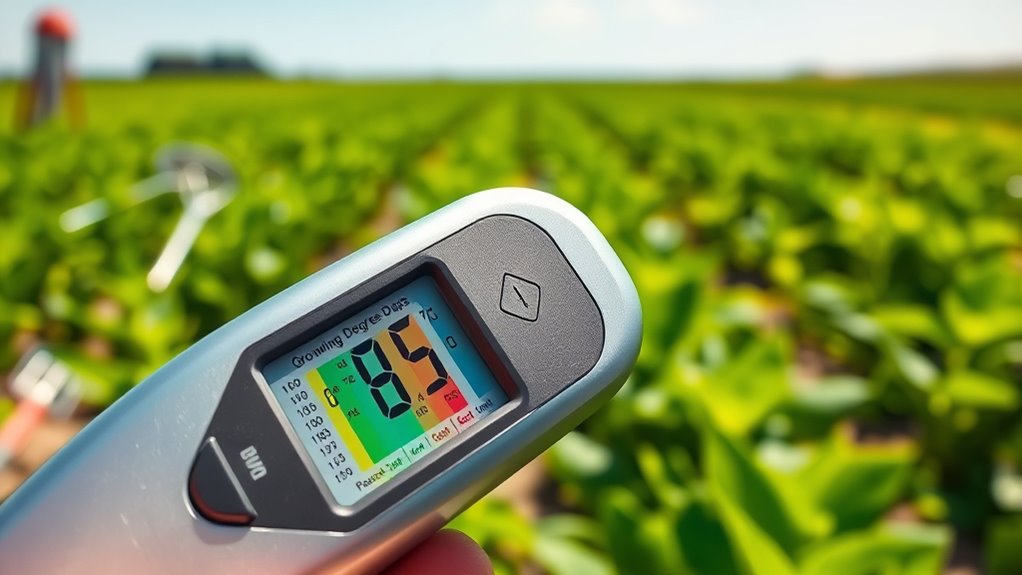
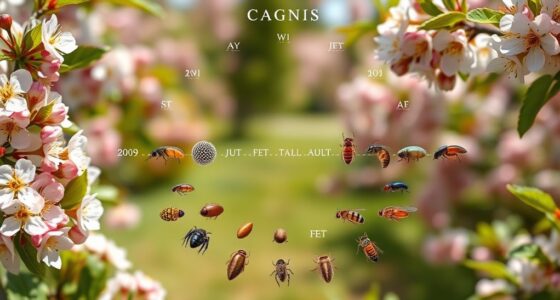
Understanding when pests become active is crucial for effective management, and Growing Degree Days (GDD) provide a reliable way to predict their emergence. GDD is a measure of heat accumulation used to forecast the stages of pest lifecycle development, which directly impacts crop management strategies. By tracking GDD, you can anticipate pest activity before they cause considerable damage, allowing you to time interventions precisely and reduce unnecessary pesticide use. This approach helps optimize your pest control efforts, making them more targeted and environmentally friendly.
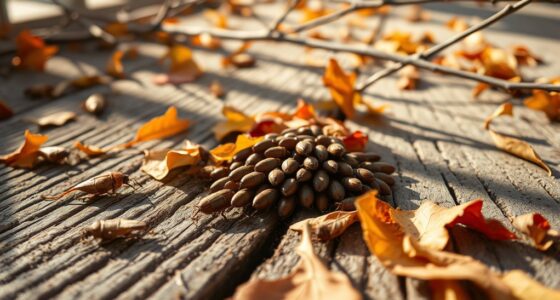
To use GDD effectively, you need to understand the relationship between temperature and pest development. Pests develop through various lifecycle stages—egg, larva, pupa, and adult—and each stage requires a specific amount of accumulated heat. GDD calculations typically start from a base temperature, below which pests do not develop, and involve daily temperature readings. When the accumulated GDD reaches a certain threshold, it signals that pests are entering a particular lifecycle stage, such as egg hatch or adult emergence. This information is invaluable for crop management because it allows you to plan pest control measures in advance, rather than reacting after damage occurs.
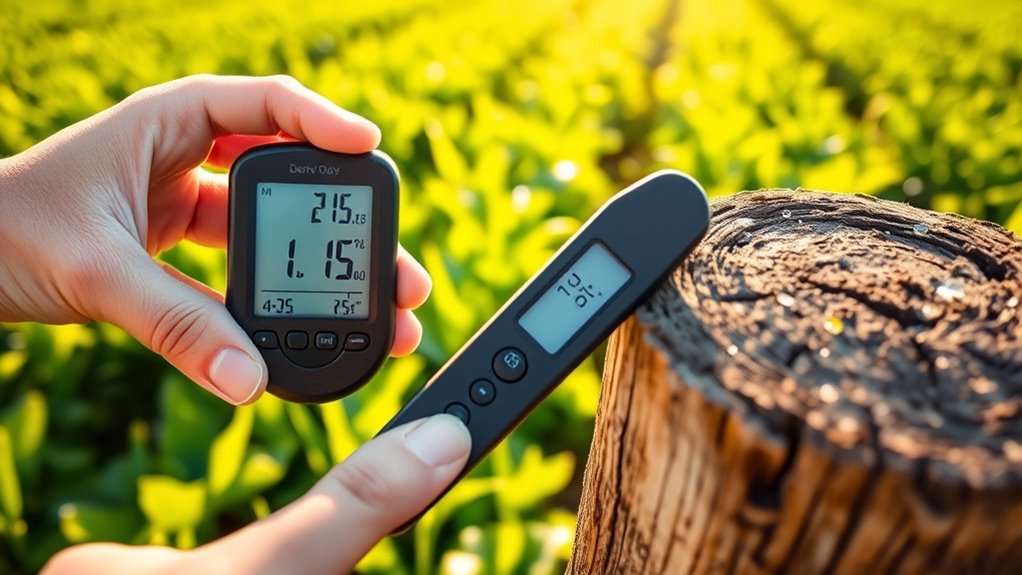
Monitoring local weather data is essential for accurate GDD calculations. You can use online tools, weather stations, or apps designed for agricultural purposes to track daily temperatures. Input the daily minimum and maximum temperatures into the GDD formula, which often takes the average temperature minus the base temperature. Keep a running total of GDD throughout the growing season. When the accumulated GDD hits the known threshold for a specific pest’s lifecycle stage—such as the emergence of adult moths or beetles—you can deploy targeted control methods. This proactive approach minimizes crop loss and reduces the need for broad-spectrum pesticides.
Monitoring weather data and tracking GDD thresholds helps target pest control effectively.
Leveraging powerful persuasive words in your communication can further enhance the effectiveness of your pest management strategies, making your messages more compelling to stakeholders. Understanding the pest lifecycle stages through GDD also helps you adapt your crop management practices. For example, timing crop sprays just before pest emergence can greatly improve their effectiveness. Additionally, GDD helps you schedule cultural practices like planting, irrigation, or harvesting to minimize pest impact. By integrating GDD data into your crop management plan, you ensure that pest control measures are both timely and efficient, reducing costs and environmental impact.

WZQH Leather Work Gloves for Men or Women.Gardening,Welding,Coffee-grey L
- Material and Design: 100% split cowhide leather with soft cotton lining
- Protection Features: High abrasion, puncture, cut, and heat resistance
- Reinforced Palm: Extra protection for hands during heavy tasks
As an affiliate, we earn on qualifying purchases.
Frequently Asked Questions
How Accurate Are GDD Models Across Different Climates?
GDD models‘ accuracy varies across different climates because climate variability impacts pest development rates. In warmer or more variable climates, the models may be less precise unless properly calibrated for local conditions. You should regularly update and calibrate your models to reflect local temperature patterns, ensuring more reliable pest timing predictions. This helps account for unique climate factors and improves the model’s effectiveness across diverse regions.
Can GDD Be Used for All Pest Species?
Growing Degree Days can’t be used for all pest species because of pest variability and species specificity. Some pests respond predictably to GDD, like certain insects, but others vary widely in their development. You might think GDD is a magic wand, but it’s more like a tailored tool that works best for specific pests. Always check whether your pest of interest has been studied with GDD before relying solely on it.
What Are the Best Tools to Track GDD?
You can track GDD effectively using weather stations and smartphone apps. Weather stations provide real-time data, ensuring accurate GDD calculations tailored to your location. Smartphone apps offer convenient, user-friendly interfaces, allowing you to input local data or sync with weather stations automatically. Both tools help you stay on top of pest development stages, enabling timely interventions and better pest management strategies. Choose a reliable weather station or a trusted app to optimize your pest control efforts.
How Often Should I Update GDD Calculations?
You should update GDD calculations daily to guarantee accurate phenology prediction and optimize your crop scheduling. Relying on infrequent updates might cause you to miss critical pest emergence periods. Regular updates keep your pest timing precise, allowing you to make timely interventions. Staying current with GDD data helps you anticipate pest activity effectively, ensuring healthier crops and better yields. Don’t underestimate the importance of frequent updates for successful pest management.
Are There Limitations to Using GDD for Pest Management?
You should be aware that climate variability can affect GDD accuracy, leading to potential mis-timing of pest control. GDD doesn’t account for unexpected weather changes or microclimates, which can cause pests to develop differently. Additionally, over-reliance on GDD might encourage pest resistance if interventions are applied too uniformly or prematurely. So, always combine GDD data with local observations and other scouting methods for more effective pest management.

COOLJOB 2 Pairs Gardening Gloves for Women Ladies, Breathable Rubber Coated for Yard Garden, Outdoor Indoor Protective Work with Grip, Medium Size, Red & Green
- Designed for Women: Lightweight, breathable, comfortable fit
- Enhanced Hand Protection: Thickened fingertips for nail and hand safety
- Long, Flexible Cuffs: Keeps dirt and debris out
As an affiliate, we earn on qualifying purchases.
Conclusion
Understanding growing degree days helps you predict pest emergence more accurately. Did you know that certain pests can develop from egg to adult in as few as 300 GDD? That means you can time your treatments precisely, saving time and resources. By tracking GDD, you stay ahead of pests and protect your crops effectively. So, start monitoring today — your plants will thank you for it!

HTR Gardening Gloves For women, Garden Yard Work With Grip, Weeding, Medium
- Breathable Seamless Knit: Lightweight, flexible, and breathable polyester liner
- Secure Latex Foam Grip: Coated palm and fingers for enhanced grip
- Ergonomic and Flexible Fit: Supports natural hand movement and dexterity
As an affiliate, we earn on qualifying purchases.
COOLJOB 6 Pairs Gardening Gloves for Women Ladies, Breathable Rubber Coated for Yard Garden, Outdoor Indoor Protective Work with Grip, Medium Size, Red & Green
- Designed for Women: Lightweight, breathable, comfortable fit
- Enhanced Hand Protection: Thickened fingertips for nail and hand safety
- Long, Flexible Cuffs: Keeps dirt and debris out
As an affiliate, we earn on qualifying purchases.