
The best soil moisture meters make it easier to judge when plants need water without relying on a fixed schedule. My best overall pick is the ECOWITT WH0291B for shoppers who want a digital reading, while the XLUX 2-Pack Long-Probe stands out for simple, battery-free checks across several pots. For gardeners who want more than moisture information, the SONKIR MS02 adds pH and light readings. The main tradeoff is between a straightforward moisture-only tool and a multifunction meter with more data but more to interpret. Read on for the full comparison and guidance on choosing a meter that suits your plants and routine.

Get garden gear delivered free with Prime
- Fast, free delivery on millions of items
- Prime Video, Amazon Music and more included
- Member-only deals all year
Complete the kit


Key Takeaways
- Digital and analog tools serve different routines: the ECOWITT WH0291B offers a digital readout, while the XLUX long-probe pair keeps checking simple and battery-free.
- A longer probe can help with larger or deeper pots: it lets you sample soil below the surface, where a quick finger check may miss moisture.
- Extra readings are useful only when you will act on them: pH, temperature, light, and humidity features add breadth but can complicate a basic watering decision.
- Wireless models trade simplicity for remote visibility: receiver-based options suit gardeners who want readings away from the plant, but add setup and battery considerations.
- Specialty probes are a different kind of purchase: the Vegetronix VG-METER-200 is aimed at buyers prioritizing digital soil-moisture measurement over a general-purpose plant-care tool.
| ECOWITT WH0291B Digital Soil Moisture Meter |  | Best for Custom Calibration | Model: WH0291B | Measurement time: About 72 seconds | Display: Digital LCD with flower pot moisture-level icon | VIEW LATEST PRICE | See Our Full Breakdown |
| 4-in-1 Digital Soil Meter for Moisture, pH, Temperature, and Sunlight |  | Best for Multi-Reading Soil Checks | Brand and model: YAMRON CTY | Functions: Soil moisture, pH, temperature, and sunlight | Display: Backlit LCD with adjustable 0°–45° head | VIEW LATEST PRICE | See Our Full Breakdown |
| apine Soil Moisture Meter for Indoor and Outdoor Plants, Green |  | Best Simple Battery-Free Pick | Model: SMM-GR-A001 | Measurement depth: 2–4 inches | Power: No battery required | VIEW LATEST PRICE | See Our Full Breakdown |
| XLUX 2-Pack Long-Probe, Battery-Free Soil Moisture Meter | 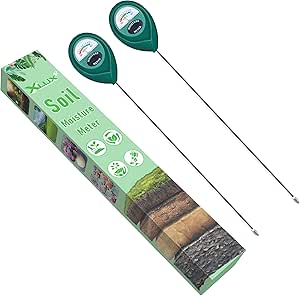 | Best for Deeper Pots | Model: T9178#2 | Quantity: 2 meters | Probe length: 5.5 inches (14 cm) | VIEW LATEST PRICE | See Our Full Breakdown |
| XLUX Soil Moisture Meter, Orange, 2-Pack |  | Best for Quick Two-Plant Checks | Brand and model: XLUX T10-OR#2 | Quantity: 2 meters | Power: Battery-free | VIEW LATEST PRICE | See Our Full Breakdown |
| 2-in-1 Soil Moisture and pH Meter for Plants |  | Best Battery-Free Moisture-and-pH Pick | Measurements: Soil moisture and pH | Display: Dual dial | Power: Battery-free | VIEW LATEST PRICE | See Our Full Breakdown |
| SONKIR MS02 3-in-1 Soil Moisture, pH, and Light Meter |  | Best for Three Basic Soil and Light Checks | Model: MS02 | Measurements: Soil moisture, pH, and sunlight | Power: No batteries required | VIEW LATEST PRICE | See Our Full Breakdown |
| EDGEVEIL 4-in-1 Wireless Soil Moisture Meter with Large Screen |  | Best for Remote, Multi-Plant Monitoring | Measurements: Soil moisture, temperature, light level, and time | Wireless range: Up to 328 feet | Sensor capacity: Up to 12 sensors per display | VIEW LATEST PRICE | See Our Full Breakdown |
| Blumat Soil Moisture Meter with Cap |  | Best for Basic Irrigation Checks | Measurement: Soil moisture | Model: IG15462 | Part number: 6276 | VIEW LATEST PRICE | See Our Full Breakdown |
| HSLGOVE 7-in-1 Soil Test Kit with Temperature and Humidity Display |  | Best for Broad Soil and Air Readings | Measurements: Soil moisture, pH, fertility, light, soil temperature, air temperature, and humidity | Probe length: About 6.8 inches | Insertion depth: More than 3 inches | VIEW LATEST PRICE | See Our Full Breakdown |
| Buladeke 7-in-1 Digital Soil Tester and Moisture Meter |  | Best for Broad Plant-Care Checks | Functions: Moisture, pH, temperature, light intensity, fertility, EC, and TDS | Display: Large LCD with white backlight and low-battery alert | Power: Four 1.5V AAA batteries, not included | VIEW LATEST PRICE | See Our Full Breakdown |
| Vegetronix VG-METER-200 Digital Soil Moisture Meter with Dielectric Probe |  | Best for Consistent VWC Readings | Model: VG-METER-200 | Moisture range: 0–100% VWC | Probe type: Non-metallic dielectric probe | VIEW LATEST PRICE | See Our Full Breakdown |
| Dr.meter Soil Moisture Meter for Plants |  | Best Battery-Free Pick | Model: S10 | Measurement: Soil moisture | Display: Ten scales with red, green, and blue color coding | VIEW LATEST PRICE | See Our Full Breakdown |
| Wireless Soil Moisture Meter with LCD Receiver – 3-Probe 3-in-1 Sensor |  | Best for Multi-Zone Remote Monitoring | Sensor readings: Moisture, temperature, and light | Monitoring capacity: Up to 12 zones | Probe technology: TDR-based triple probes | VIEW LATEST PRICE | See Our Full Breakdown |
| Jxikatx 7-in-1 Soil Test Kit with Dual Display |  | Best for Angled Screen Viewing | Measurements: Soil moisture, pH, fertility, light intensity, soil temperature, air humidity, and ambient temperature | Display: Dual display with upper dial and LCD screen | Probe: Single multi-metal probe | VIEW LATEST PRICE | See Our Full Breakdown |
| soil moisture meter | Power | Display |
|---|---|---|
| ECOWITT WH0291B Digital Soil M | 2 AA batteries, not included | Digital LCD with flower pot moisture-level icon |
| 4-in-1 Digital Soil Meter for | 4 AAA batteries, not included | Backlit LCD with adjustable 0°–45° head |
| apine Soil Moisture Meter for | No battery required | — |
| XLUX 2-Pack Long-Probe | Battery-free | Large dial with 3 zones and 10 scales |
| XLUX Soil Moisture Meter | Battery-free | Large dial with three zones and ten scales |
| 2-in-1 Soil Moisture and pH Me | Battery-free | Dual dial |
| SONKIR MS02 3-in-1 Soil Moistu | No batteries required | — |
| EDGEVEIL 4-in-1 Wireless Soil | Two AAA batteries, included | — |
| Blumat Soil Moisture Meter wit | — | — |
| HSLGOVE 7-in-1 Soil Test Kit w | Three batteries | 1.6-inch LCD |
| Buladeke 7-in-1 Digital Soil T | Four 1.5V AAA batteries, not included | Large LCD with white backlight and low-battery alert |
| Vegetronix VG-METER-200 Digita | — | — |
| Dr.meter Soil Moisture Meter f | No batteries required | Ten scales with red, green, and blue color coding |
| Wireless Soil Moisture Meter w | Two AA and four AAA alkaline batteries included | — |
| Jxikatx 7-in-1 Soil Test Kit w | — | Dual display with upper dial and LCD screen |
More Details on Our Top Picks
ECOWITT WH0291B Digital Soil Moisture Meter
The ECOWITT WH0291B suits plant owners who want a digital moisture reading they can adjust to their own soil conditions. Its custom low and high calibration gives it an edge over the simpler dial-based apine Soil Moisture Meter, whose reading is easier to get at a glance but offers no calibration settings. The LCD’s flower pot icon makes the result accessible without interpreting several dial scales, and indoor/outdoor use covers houseplants as well as garden beds.
The tradeoff is speed: a reading takes about 72 seconds, compared with roughly 10 seconds for the YAMRON 4-in-1. It also needs two AA batteries, not included. This is a better fit for deliberate spot checks than for someone who wants an instant, battery-free tool.
Pros:- Custom low and high moisture calibration can suit different soil conditions.
- LCD uses a flower pot icon to make moisture status easy to read.
- Designed for indoor and outdoor plants, lawns, and gardens.
- Includes a 12/24-hour clock display.
Cons:- Takes about 72 seconds to measure moisture.
- Requires two AA batteries, which are not included.
Best for: Plant owners who want a digital moisture display and the ability to set low and high thresholds for different soil conditions.
Not ideal for: Gardeners who want instant readings or a battery-free meter; the roughly 72-second measurement and need for two AA batteries may be inconvenient.
- Model:WH0291B
- Measurement time:About 72 seconds
- Display:Digital LCD with flower pot moisture-level icon
- Calibration:Custom low and high moisture values
- Use:Indoor and outdoor
- Clock display:12/24-hour
- Power:2 AA batteries, not included
- Dimensions:5.91 in W × 1.18 in H
Our verdict“Choose the ECOWITT if adjustable digital moisture thresholds matter more to you than fast readings or battery-free operation.”
4-in-1 Digital Soil Meter for Moisture, pH, Temperature, and Sunlight
The YAMRON CTY 4-in-1 is the broadest-check option in this group: it reads soil moisture, pH, temperature, and sunlight, so one tool can help investigate several plant conditions. Its backlit LCD and adjustable head make readings easier to view than the dial on the XLUX Soil Moisture Meter, Orange, 2-Pack. It also returns a reading in about 10 seconds, far quicker than the ECOWITT WH0291B’s stated 72-second measurement.
That versatility brings extra setup and limits. It needs four AAA batteries, cannot be used on liquids, and should not go into dry, hard soil. Moisture and pH checks also call for readings at at least five locations to produce an average, so this is less convenient for a quick single-spot check than a basic analog meter.
Pros:- Measures moisture, pH, temperature, and sunlight in one device.
- Backlit LCD has an adjustable 0°–45° head for easier viewing.
- Reading time is about 10 seconds.
- Suitable for indoor and outdoor use.
Cons:- Requires four AAA batteries, which are not included.
- Should not be used for liquids or inserted into dry, hard soil.
- Moisture and pH averages require readings from at least five locations.
Best for: Indoor and outdoor growers who want to check moisture alongside soil pH, temperature, and sunlight with one digital device.
Not ideal for: People who want a simple one-point moisture check, need to test liquids, or routinely work with very dry, hard soil.
- Brand and model:YAMRON CTY
- Functions:Soil moisture, pH, temperature, and sunlight
- Display:Backlit LCD with adjustable 0°–45° head
- Probe depth:About 4 in (10 cm)
- Reading time:About 10 seconds
- Temperature range and accuracy:32–122 °F; 1.8 °F accuracy
- Power:4 AAA batteries, not included
- Dimensions and weight:2.36 in W × 12.6 in H; 120 g
Our verdict“Pick the YAMRON if you want several kinds of soil and plant readings in one tool and are willing to take multiple readings for an average.”
apine Soil Moisture Meter for Indoor and Outdoor Plants, Green
The apine Soil Moisture Meter keeps moisture checks simple: push its single probe 2–4 inches into soil and read the dial after a few seconds. It needs no batteries, making it a more straightforward basic tool than the digital ECOWITT WH0291B, which adds custom calibration and a display but takes about 72 seconds per reading. The single-needle design is intended to reduce disturbance around roots, and the included cloth gives you a way to wipe the probe after use.
Its simplicity also sets a firm boundary: this is a soil-only meter, not a multi-function tester like the YAMRON 4-in-1. The supplied details also rule it out for fluffy soil and liquids, so it is not the right choice for every potting mix or watering setup. Choose it for quick, uncomplicated checks in suitable soil, not for extra readings or digital features.
Pros:- Battery-free design requires no cells or charging.
- Dial provides a quick moisture reading after insertion.
- Single-needle probe is designed to reduce root disturbance.
- Includes a cloth for wiping the probe.
Cons:- Designed for soil only and cannot test water or other liquids.
- Not suitable for fluffy soil.
- Provides moisture readings only, unlike the YAMRON 4-in-1.
Best for: Houseplant owners and gardeners who want quick, battery-free moisture checks in ordinary, firm soil.
Not ideal for: Growers using fluffy soil or anyone who wants to test water, read additional soil conditions, or get a digital display.
- Model:SMM-GR-A001
- Measurement depth:2–4 inches
- Power:No battery required
- Probe design:Single needle
- Reading:Dial reading after a few seconds
- Use:Soil only; not suitable for water, liquids, or fluffy soil
- Included accessory:Probe wiping cloth
- Dimensions and weight:10.24 × 2.28 × 1.5 in; 0.32 oz
Our verdict“Choose the apine for quick, no-battery moisture checks in suitable soil, and skip it if you need digital or multi-function readings.”
XLUX 2-Pack Long-Probe, Battery-Free Soil Moisture Meter
The XLUX 2-Pack Long-Probe stands out for reaching moisture farther down in deeper pots: each meter has a 5.5-inch probe and a large dial with three zones and ten scales. That extra reach makes it a more specific choice than the standard apine meter, whose probe is intended for insertion at 2–4 inches. Two meters also let a plant owner check separate pots without moving a single tool between them. Like the orange XLUX 2-pack, this model works without batteries and gives an immediate reading.
The longer probe does not make it a leave-in sensor. The manufacturer advises removing it within five minutes and wiping it clean to help prevent corrosion. It is also unsuitable for very hard soil and liquids. Compared with the digital ECOWITT, it offers less tailored information, but avoids batteries and the wait for a timed reading.
Pros:- Two meters allow checks in separate pots or growing areas.
- 5.5-inch probe reaches deeper into pots than shorter styles.
- Large dial shows three moisture zones across ten scales.
- Battery-free design provides an immediate reading.
Cons:- Should be removed within five minutes and wiped clean to help prevent corrosion.
- Not suitable for very hard soil or for testing water and other liquids.
Best for: People caring for multiple deep pots who want immediate, battery-free moisture readings below the surface.
Not ideal for: Growers who want a continuous in-soil monitor, need to test liquids, or have very hard soil that resists probe insertion.
- Model:T9178#2
- Quantity:2 meters
- Probe length:5.5 inches (14 cm)
- Probe material:304 stainless steel
- Display:Large dial with 3 zones and 10 scales
- Power:Battery-free
- Reading:Immediate
- Item weight:0.32 oz
Our verdict“Choose this XLUX set for deeper pots and multiple plants, provided you can remove and clean the probes after each check.”
XLUX Soil Moisture Meter, Orange, 2-Pack
The XLUX Orange 2-Pack is the straightforward choice for checking two plants without buying into digital features or keeping spare batteries on hand. Each meter gives an immediate reading on a large dial, with dry, moist, and wet zones across ten scales. Compared with the longer-probe XLUX T9178#2, this listing does not specify an extended 5.5-inch probe, so the long-probe version is the clearer pick for unusually deep pots. For routine checks across houseplants or garden soil, the orange pair keeps the process simple.
These are spot-check tools, not sensors to leave in a planter. The stainless-steel probe should be wiped clean and removed within five minutes to help prevent corrosion. They also cannot test liquids and may not suit very hard soil. Unlike the digital YAMRON, they only measure moisture, but they avoid its batteries and multi-reading routine.
Pros:- Two meters make it practical to check separate plants or locations.
- Large dial shows dry, moist, and wet zones across ten scales.
- Battery-free design provides immediate moisture readings.
- Single probe is designed to reduce root and soil disturbance.
Cons:- Probe should be removed within five minutes and wiped clean to help prevent corrosion.
- Not suitable for very hard soil or for testing liquids.
- Measures moisture only and does not list an extended probe length.
Best for: Plant owners who want two battery-free meters for quick moisture checks across separate pots or garden spots.
Not ideal for: People who need pH, temperature, or light readings, want a meter that stays in the soil, or need a specified extended probe for deep pots.
- Brand and model:XLUX T10-OR#2
- Quantity:2 meters
- Power:Battery-free
- Display:Large dial with three zones and ten scales
- Probe:Single 304 stainless-steel probe
- Reading:Immediate
- Color:Orange
- Care:Wipe clean and remove within five minutes to help prevent corrosion
Our verdict“Choose the orange XLUX pair for quick moisture spot checks across multiple plants; pick the long-probe XLUX instead for deeper pots.”
2-in-1 Soil Moisture and pH Meter for Plants
The Aenncci 2-in-1 is a straightforward choice for gardeners who want soil moisture and pH readings together without managing batteries. Its dual dial lets you view both measurements at once, unlike the SONKIR MS02, which adds a sunlight reading but uses a switchable function button. That makes this Aenncci a simpler fit when pH is more useful to you than light data. The single probe is intended to limit root disturbance, but the required insertion depth—more than 4 inches—can be awkward in small pots or shallow planters. It tests soil only, not water or other liquids, and the supplied details do not specify a measurement range. I’d choose it for basic paired soil checks, not for broader plant monitoring.
Pros:- Measures soil moisture and pH at the same time
- Battery-free operation
- Dual dial shows both readings together
- Single probe is designed to reduce root disturbance
Cons:- Requires insertion more than 4 inches into soil
- Cannot test water or other liquids
- No measurement range is provided in the product details
Best for: Indoor and outdoor gardeners who want simultaneous moisture and pH readings from a battery-free meter and have pots deep enough for the probe.
Not ideal for: People with shallow containers, or growers who need sunlight readings, liquid testing, or a stated measurement range.
- Measurements:Soil moisture and pH
- Display:Dual dial
- Power:Battery-free
- Probe:Single probe
- Minimum insertion depth:More than 4 inches
- Use:Indoor and outdoor soil
- Weight:4.6 ounces
Our verdict“Choose this for simultaneous, battery-free moisture and pH checks if your pots can accommodate its deep probe.”
SONKIR MS02 3-in-1 Soil Moisture, pH, and Light Meter
The SONKIR MS02 suits gardeners who want moisture, pH, and sunlight readings from one battery-free tool. Its switchable function button makes it less glanceable than the Aenncci 2-in-1, whose dual dial displays moisture and pH together, but the SONKIR adds a sunlight measurement that can help when deciding where to place a plant. It is designed for indoor and outdoor use, from houseplant care to garden beds. Its limits matter: it cannot test liquid pH, and very dry soil may need watering before a reading can be taken. That makes it less convenient for checking already-dry soil than a meter intended for direct moisture monitoring. I’d pick it when the extra light function earns its place; skip it if moisture alone is the priority.
Pros:- Measures soil moisture, pH, and sunlight
- Requires no batteries
- Designed for indoor and outdoor use
- Compact, lightweight form is easy to move between planting areas
Cons:- Dry soil may need watering before testing
- Cannot measure pH in liquids
- A switchable function button means readings are not all shown at once
Best for: Plant owners who want a battery-free meter for checking soil moisture, pH, and sunlight while choosing locations for indoor or outdoor plants.
Not ideal for: Gardeners who mainly need quick moisture checks in dry soil, or anyone seeking liquid pH testing or simultaneous readings for every function.
- Model:MS02
- Measurements:Soil moisture, pH, and sunlight
- Power:No batteries required
- Use:Indoor and outdoor
- Dimensions:11.5 x 2 x 1.5 inches
- Weight:2.89 ounces
- Manufacturer:Sonkir
Our verdict“Pick the SONKIR when sunlight data is as useful as moisture and pH, and you can accept switching between readings.”
EDGEVEIL 4-in-1 Wireless Soil Moisture Meter with Large Screen
The EDGEVEIL HG01 is the most monitoring-focused pick here: its large screen reports soil moisture, temperature, light, and time, while a wireless connection reaches up to 328 feet. That separates it from the SONKIR MS02, which is a portable manual tester with no remote display, and from the Blumat meter, whose supplied details offer fewer display specifics. One receiver can connect to as many as 12 sensors, making this setup better suited to tracking several plants from one spot than moving a probe from pot to pot. The tradeoff is that each additional monitored location needs another sensor, and the display uses two AAA batteries. Its continuous probe can remain in soil, but this is a more involved system than a simple insertion-based meter.
Pros:- Shows soil moisture, temperature, light, and time on a large display
- Wireless range reaches up to 328 feet
- One display supports up to 12 sensors
- Probe can stay in the soil for continuous monitoring
Cons:- Additional sensors are needed to monitor more planting locations
- Display requires two AAA batteries
- More involved setup than a basic insertion-based meter
Best for: Plant owners monitoring several pots, beds, or greenhouse areas who want remote readings and ongoing moisture alerts from one display.
Not ideal for: Buyers who want a simple, battery-free handheld tester or who only need occasional readings from one plant.
- Measurements:Soil moisture, temperature, light level, and time
- Wireless range:Up to 328 feet
- Sensor capacity:Up to 12 sensors per display
- Sensor technology:Triple-probe TDR
- Probe:Waterproof, corrosion-resistant
- Power:Two AAA batteries, included
- Weight:9.1 ounces
Our verdict“Choose EDGEVEIL for remote, ongoing checks across multiple plants, but not for a simple one-pot moisture test.”
Blumat Soil Moisture Meter with Cap
The Blumat Soil Moisture Meter is a restrained option for gardeners who need to check soil moisture while adjusting an irrigation routine. It uses a simple insert-and-read approach, so it has less setup than the EDGEVEIL HG01 wireless system, which is designed for ongoing remote monitoring across multiple sensors. The Blumat’s cap is a practical inclusion for storing the meter between checks. Its main limitation is the lack of detail supplied about the display and measurement range; buyers have less information to judge how readings are presented than they do with the large-screen EDGEVEIL. It also needs a CR2032 lithium battery, unlike battery-free options such as the SONKIR MS02. I’d choose it for uncomplicated irrigation spot-checks, but not if documented measurement details or remote alerts are priorities.
Pros:- Simple insertion-based moisture checks
- Can help monitor soil moisture while calibrating irrigation
- Includes a cap for storage
- More straightforward than a multi-sensor wireless setup
Cons:- Requires a CR2032 lithium battery
- Product details do not specify the measurement range
- Display details are not provided
Best for: Gardeners who want a basic insertion-based moisture check to help tune watering or irrigation schedules.
Not ideal for: Buyers who need a specified measurement range, clearly described display, battery-free operation, or remote monitoring.
- Measurement:Soil moisture
- Model:IG15462
- Part number:6276
- Battery:CR2032 lithium
- Operating humidity:10–100%
- Color:Grey
- Included item:Cap
Our verdict“Choose Blumat for simple irrigation spot-checks if its limited published measurement details meet your needs.”
HSLGOVE 7-in-1 Soil Test Kit with Temperature and Humidity Display
The HSLGOVE 7-in-1 goes beyond moisture checks by combining soil moisture, pH, fertility, light, and soil temperature with air temperature and humidity on a 1.6-inch LCD. That breadth makes it a different proposition from the Aenncci 2-in-1, which focuses on moisture and pH and needs no batteries. HSLGOVE is better for growers who want several environmental readings from one tool, while its 6.8-inch probe is intended for medium and large pots and reaches more than 3 inches into soil. The cost of that broader data is a longer wait: readings take about 3–5 minutes, and the unit needs three batteries, which should be replaced or installed together. It cannot test liquids. I’d favor it when the extra measurements matter more than fast, battery-free moisture checks.
Pros:- Combines seven soil and air measurements
- LCD presents soil temperature, air temperature, and humidity
- Single probe is designed to reduce root disturbance
- Probe is suited to medium and large pots
Cons:- Readings take about 3–5 minutes
- Requires three batteries, which should be installed or replaced together
- Cannot test liquids
Best for: Plant growers with medium or large pots who want soil moisture alongside pH, fertility, light, soil temperature, and air conditions.
Not ideal for: People with small or shallow pots, anyone needing a quick reading, or buyers who prefer a battery-free moisture-only tool.
- Measurements:Soil moisture, pH, fertility, light, soil temperature, air temperature, and humidity
- Probe length:About 6.8 inches
- Insertion depth:More than 3 inches
- Display:1.6-inch LCD
- Power:Three batteries
- Reading time:About 3–5 minutes
- Weight:4.8 ounces
Our verdict“Choose HSLGOVE when you want broad soil and air data and can accept a slower, battery-powered test.”
Buladeke 7-in-1 Digital Soil Tester and Moisture Meter
The Buladeke 7-in-1 is a fit for plant owners who want moisture readings alongside pH, temperature, light, fertility, EC, and TDS checks. That breadth makes it more versatile than the Dr.meter S10, which focuses on moisture alone, but it also means more functions to interpret when a simple watering check is all you need. Its backlit LCD helps with visibility in dim corners and outdoors, and readings take about 10 seconds after inserting the probe roughly 10 cm into soil. The tradeoff is battery dependence: it needs four AAA batteries, which are not included. I would also skip it for liquid testing or hard, dry ground, since the probe should not be forced into either.
Pros:- Measures moisture, pH, temperature, light, fertility, EC, and TDS
- Backlit LCD supports reading in dim conditions
- Works with indoor and outdoor plants
- Displays readings after about 10 seconds
Cons:- Requires four AAA batteries, which are not included
- Must not be used directly in liquids
- Probe should not be forced into hard or very dry soil
Best for: Indoor and outdoor gardeners who want one handheld tool for moisture plus several soil and light measurements.
Not ideal for: Plant owners who only need a quick moisture check, or who regularly test compacted, very dry soil or liquids.
- Functions:Moisture, pH, temperature, light intensity, fertility, EC, and TDS
- Display:Large LCD with white backlight and low-battery alert
- Power:Four 1.5V AAA batteries, not included
- Probe depth:About 10 cm
- Reading time:About 10 seconds
- Weight:5.6 ounces
- Suitable use:Indoor and outdoor gardens, beds, potted plants, and succulents
Our verdict“Choose the Buladeke if you want a broad set of plant-care readings in one device and can work around its battery and soil-condition limits.”
Vegetronix VG-METER-200 Digital Soil Moisture Meter with Dielectric Probe
The Vegetronix VG-METER-200 stands apart from simpler moisture meters with a stated 0–100% VWC range and a dielectric probe designed to resist corrosion and interference from soil salts, fertilizers, and pH. That makes it a more specialized choice than the battery-free Dr.meter S10, whose color scale is easier to read quickly but does not provide a VWC range. The Vegetronix also adds air-temperature and light readings, while its four-foot cable lets you check the display without bending over the probe. Its single, slender probe is intended to limit root disturbance. The tradeoffs are two AA batteries and a light sensor capped at 150 lux, so this is not a wide-range light meter or a battery-free option.
Pros:- Measures moisture across a 0–100% VWC range
- Dielectric probe is designed to resist corrosion and soil-salt interference
- Four-foot cable allows remote viewing of the handheld display
- Backlit screen also shows air temperature and light
Cons:- Requires two AA batteries
- Light measurement is limited to 0–150 lux
- Does not measure soil pH or the wider set of conditions covered by the Buladeke 7-in-1
Best for: Gardeners who want numerical VWC readings and a probe suited to soils with fertilizer or salt content.
Not ideal for: Buyers seeking a battery-free meter, broad light measurements, or a multi-function soil tester with pH readings.
- Model:VG-METER-200
- Moisture range:0–100% VWC
- Probe type:Non-metallic dielectric probe
- Probe length:4 inches
- Cable length:4 feet (1.2 meters)
- Additional readings:Ambient air temperature and light, 0–150 lux
- Display and power:Backlit graphical display; two AA batteries
- Dimensions and weight:6 × 3 × 1 inches; 6.7 ounces
Our verdict“Pick the Vegetronix for VWC-focused readings and a cable-connected probe, but choose the Dr.meter if battery-free simplicity matters more.”
Dr.meter Soil Moisture Meter for Plants
The Dr.meter S10 keeps soil-moisture checks simple: insert its single probe and read a ten-scale, color-coded display without batteries, charging, or digital menus. Compared with the Vegetronix VG-METER-200, it gives less detailed information—the Vegetronix provides a VWC range and extra temperature and light readings—but the S10 is lighter and easier to keep ready for occasional checks. Its red, green, and blue zones help translate the reading into a quick watering decision, though they do not offer the same numerical detail as a digital display. It suits houseplants as well as lawns and garden beds. The probe needs careful handling around rocks and hard soil, and cleaning it after each use adds a small but regular task.
Pros:- Operates without batteries
- Ten-scale display uses red, green, and blue zones
- Single probe is designed to limit root disturbance
- Portable for houseplants, gardens, lawns, and farms
Cons:- Measures soil moisture only
- Probe can be damaged by rocks or extremely hard soil
- Probe should be cleaned after each use
Best for: Houseplant owners and gardeners who want a lightweight, battery-free moisture check with an easy-to-read scale.
Not ideal for: Buyers who need numerical moisture percentages, pH or temperature readings, or a probe built for rocky, compacted soil.
- Model:S10
- Measurement:Soil moisture
- Display:Ten scales with red, green, and blue color coding
- Probe design:Single probe
- Power:No batteries required
- Dimensions:2.02 inches wide × 1.6 inches high
- Weight:2.72 ounces
- Upper temperature range:40 °C
Our verdict“Choose the Dr.meter for straightforward, battery-free watering checks; choose the Vegetronix if you need more detailed readings.”
Wireless Soil Moisture Meter with LCD Receiver – 3-Probe 3-in-1 Sensor
The NexusLab wireless soil meter is the lineup’s clearest choice for checking several garden areas from indoors. Its receiver can monitor up to 12 zones, while the sensors report moisture, temperature, and light over a stated 230-foot open-area RF range. That setup is a different proposition from the handheld Vegetronix VG-METER-200: the Vegetronix offers a cable-linked display for one probe, while NexusLab is built for remote checks across multiple locations. TDR-based triple probes and IPX5-rated sensors suit outdoor monitoring, and the listed battery life is up to 12 months. The limitations matter: walls can cut wireless range, and the sensors may not work well in loose media such as perlite, coco coir, or gravel. Its multi-sensor setup is more involved than a basic meter.
Pros:- One receiver supports monitoring across up to 12 zones
- Sensors measure moisture, temperature, and light
- Stated RF range reaches 230 feet in open areas
- IPX5 sensors are designed for outdoor use
Cons:- Walls and other obstacles can reduce wireless range
- Sensors may not work well in perlite, coco coir, or gravel
- Multi-zone setup is more involved than a single handheld meter such as the Dr.meter S10
Best for: Gardeners monitoring several soil-based beds or plant zones who want readings on a shared indoor receiver.
Not ideal for: Growers using loose, soilless media or buyers who need a simple single-probe meter unaffected by indoor walls.
- Sensor readings:Moisture, temperature, and light
- Monitoring capacity:Up to 12 zones
- Probe technology:TDR-based triple probes
- RF range:230 feet in open area
- Water resistance:IPX5 sensors
- Power:Two AA and four AAA alkaline batteries included
- Temperature accuracy:±0.5 °C
- Upper temperature range:60 °C
Our verdict“Choose NexusLab when remote monitoring across several soil-based garden zones matters more than simplicity or compatibility with loose media.”
Jxikatx 7-in-1 Soil Test Kit with Dual Display
The Jxikatx 7-in-1 combines soil moisture, pH, fertility, light, soil temperature, air humidity, and ambient temperature, then presents readings on a dual display with a head that rotates through six viewing angles. That adjustable head is its clearest distinction from the Buladeke 7-in-1, which also covers seven measurements but uses a backlit LCD and specifies a shallower insertion depth of about 10 cm. Jxikatx calls for at least five inches of probe insertion into moist soil, so it may suit deeper pots and beds better when that depth is available. The tradeoff is a narrower set of handling conditions: avoid water, stones, and very loose soil, and do not leave the probe in place for extended periods. It is a poor match for quick checks in shallow containers.
Pros:- Measures seven soil and environmental conditions
- Dual display presents readings at a glance
- Rotating head offers six viewing angles
- Single probe is designed to limit root disturbance
Cons:- Requires at least five inches of insertion into moist soil for optimal accuracy
- Should not be used in water, rocky soil, or very loose media
- Should not be left in soil for extended periods
Best for: Gardeners with deeper pots or beds who want multiple soil and air readings and an adjustable screen angle.
Not ideal for: People checking shallow planters, testing liquids, or working mainly with loose media or rocky soil.
- Measurements:Soil moisture, pH, fertility, light intensity, soil temperature, air humidity, and ambient temperature
- Display:Dual display with upper dial and LCD screen
- Probe:Single multi-metal probe
- Viewing head:90° rotation with six adjustable angles
- Recommended insertion depth:At least 5 inches
- Dimensions:11.34 × 2.87 × 1.46 inches
- Weight:5.6 ounces
Our verdict“Choose Jxikatx if its rotating dual display and deeper insertion requirement fit your plants; the Buladeke is a better fit for shallower checks.”

How We Picked
I ranked these meters around the job buyers are trying to solve: checking soil moisture accurately enough to make a better watering decision, with minimal fuss. I weighed probe design and reach, readability, power requirements, portability, and whether extra measurements such as pH, light, temperature, or humidity have a clear use. I also considered upkeep and the practical risk of choosing a feature-heavy device when a simple moisture check would do.
The order reflects the balance of usefulness and ease of use for a broad range of plant owners, not the number of features on a box. The ECOWITT WH0291B and XLUX long-probe pair lead for distinct reasons: one favors a digital display, the other favors uncomplicated, battery-free checks. Multifunction and wireless models can make more sense for buyers with specific monitoring needs, while specialist instruments sit lower for general plant care because their focus is narrower. Product names and stated capabilities are used to distinguish the options; I do not treat additional functions as proof of greater measurement accuracy.
Factors to Consider When Choosing Best Soil Moisture Meters
Before choosing a meter, decide what uncertainty you want it to remove. A basic probe can help you check whether soil is still damp below the surface; a digital or connected system may suit a more involved monitoring routine. These broader factors can help prevent common mismatches between a tool’s features and the way you actually care for plants.
Match Probe Reach to Pot Depth
Surface soil often dries faster than the root zone, so a shallow reading can give the wrong impression about whether a plant needs water. For small pots, a standard probe may be manageable; tall planters and deep garden beds call for more reach. Check the usable probe length rather than judging by the meter’s total size. A long probe is not automatically better for every plant: forcing a rigid sensor into compacted soil can damage roots or bend the probe. Insert it gently at more than one spot when a pot has uneven moisture, and avoid repeatedly probing the same root cluster.
Choose the Display You Will Actually Use
An analog scale is quick to read and avoids charging or battery changes, while a digital display can present a number that some buyers find easier to compare over time. Neither format removes the need to interpret the reading in context. Plant type, pot size, soil mix, and recent watering all affect what a useful reading looks like. If you care for many plants, a clear display may make repeated checks less tedious; if you only need occasional guidance, a simpler meter may be easier to keep at hand. Avoid treating a single reading as an automatic watering command.
Decide Whether Extra Measurements Earn Their Place
Multifunction meters may add pH, light, temperature, or humidity readings, but each extra measurement is helpful only if it changes what you do. Light readings can prompt a location change, while pH readings may help diagnose a persistent growing problem; neither directly tells you whether a particular plant needs water now. Buyers who mainly want to avoid overwatering may be better served by a dedicated moisture check. Before paying for additional functions, ask whether you know how to interpret them and have a practical response to the result. More readings can mean more to learn, not necessarily a better watering decision.
Think Through Power and Remote Monitoring
Battery-free meters keep the routine straightforward, but digital screens and wireless receivers require power and may need occasional maintenance. A remote receiver can be useful when sensors sit in a greenhouse, a garden bed, or somewhere inconvenient to reach. For a few indoor pots within arm’s reach, that distance may add little value. Wireless systems also create more points to check: sensor placement, connection, display, and battery condition. Choose remote monitoring because it fits your layout or schedule, not simply because it sounds more advanced.
Check Soil and Plant Compatibility
Soil texture and composition can affect how a probe interacts with the growing medium, so a reading from one pot should not automatically be compared with a reading from another. Loose potting mix, dense garden soil, and soilless media retain water differently. Some meters are intended for soil rather than water or very dry, hard ground, so follow the maker’s instructions for use and cleaning. A probe can also disturb delicate roots, especially in small containers where there is little room to insert it safely. For sensitive plants, sample near the pot edge and use the meter alongside cues such as pot weight and drainage.
Set Expectations for What a Meter Can Tell You
A moisture meter is a guide to conditions at the probe location, not a complete diagnosis of plant health. It cannot by itself explain poor drainage, root damage, or why a plant is wilting despite damp soil. Readings can vary across a single container, so checking two locations can be more informative than repeatedly measuring one spot. Learn how the device’s scale or display maps to its own guidance rather than assuming all meters use interchangeable readings. If a plant’s condition conflicts with the meter, inspect the soil and roots and review the watering routine instead of relying on the instrument alone.
Frequently Asked Questions
Should I choose a digital moisture meter or a battery-free analog one?
Choose digital if a screen and numeric-style readout fit the way you compare readings across plants. A battery-free analog model suits buyers who want a quick check without charging or replacing batteries. Neither format guarantees a more accurate result by itself, so look at probe design, instructions, and how clearly the meter communicates its reading. If you manage several pots, consistency in where and how you measure matters more than the display style. For occasional checks, the simpler tool may be easier to maintain.
Can one meter work for both houseplants and an outdoor garden?
It can, provided its probe is suitable for the soil and its construction is intended for the conditions where you plan to use it. Indoor pots and outdoor beds differ in depth, soil texture, and exposure to water and weather. A portable meter may be convenient across both, but check the product’s care instructions before leaving any sensor outdoors. For a large garden, a longer probe or wireless monitoring may save effort; for a few pots, those features may be unnecessary. Take readings at several representative spots rather than treating one location as a garden-wide result.
Are pH and light readings worth paying attention to if I mainly need watering help?
Usually, they are not necessary for a basic watering routine. Moisture readings address the immediate question of how damp the soil is, while pH and light readings help with different growing decisions. Those extra functions can be useful if you are diagnosing a recurring plant problem or adjusting a growing location. They add little if you do not plan to act on the information or understand what the reading means for a particular plant. If watering is your only concern, prioritize probe reach and ease of reading.
Why might a moisture reading disagree with how my plant looks?
A probe samples a small area, while roots may experience different moisture levels elsewhere in the pot. The plant may also be affected by drainage, root condition, light, temperature, or a watering pattern that a moisture meter does not measure. Check another spot and compare the result with pot weight, soil feel, and the plant’s recent care. Make sure the probe is inserted as directed and used in a suitable growing medium. Treat the meter as one clue rather than a final diagnosis.
Do I need a wireless receiver or multi-probe system for ordinary plant care?
Most owners of a few nearby houseplants can check a handheld meter directly and may not benefit from a remote receiver. Wireless or multi-probe systems make more sense when plants are spread across a greenhouse, garden, or other area that is inconvenient to visit. They can reduce repeated walks, but introduce setup, power, and sensor-placement tasks. Think about how often you will check readings and whether remote access would change your routine. If it would not, a simpler meter keeps the process easier.
Conclusion
For most buyers, I would start with the ECOWITT WH0291B as the best overall choice for a digital moisture check. The XLUX 2-Pack Long-Probe is my best value-style pick for simple, battery-free checks across several plants, while the 4-in-1 Digital Soil Meter is better suited to buyers who will use its added readings. Beginners who want a no-frills starting point may prefer the apine Soil Moisture Meter; gardeners who need remote visibility should look at the wireless receiver options. For a more specialist digital measurement focus, consider the Vegetronix VG-METER-200. Choose the simplest model that fits your pot depth and monitoring habits, then treat its readings as guidance alongside what you observe in the soil and plant.
Black Friday Picks

Weber Original Kettle Charcoal Grill, 22-Inch, Black
As an affiliate, we earn on qualifying purchases.