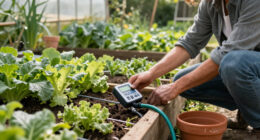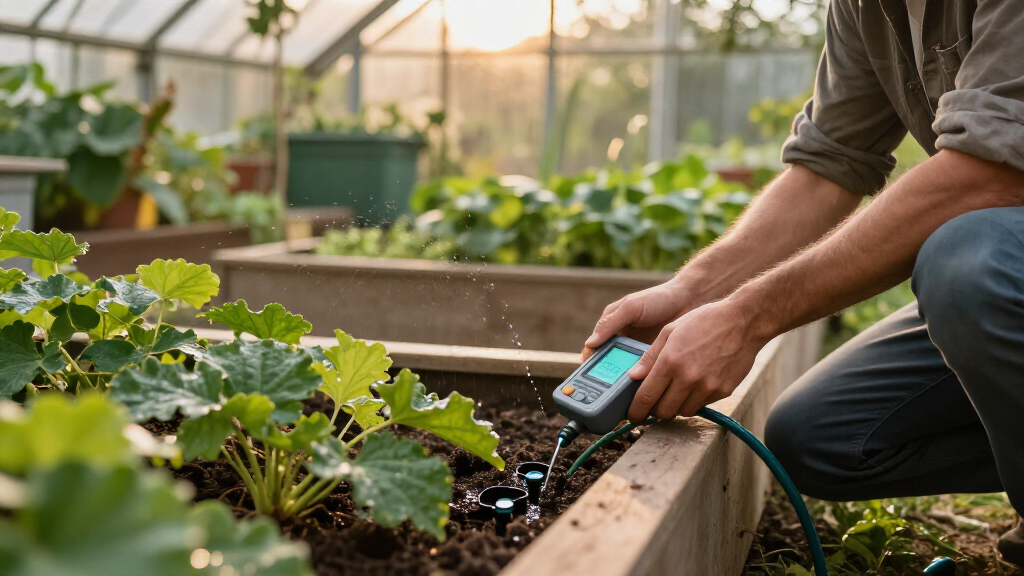
Smart garden irrigation usually means one of two different purchases: a Wi-Fi sprinkler controller that replaces the timer for an installed irrigation system, or a smart hose timer that attaches to an outdoor faucet and operates a hose or drip line. They are compared because both can schedule watering from an app and reduce manual watering, but they solve different scale problems. The sprinkler controller is the stronger choice for a lawn or established landscape with several irrigation zones; the hose timer is usually the simpler, cheaper fit for containers, raised beds, and small gardens.

Get garden gear delivered free with Prime
- Fast, free delivery on millions of items
- Prime Video, Amazon Music and more included
- Member-only deals all year

Aiper IrriSense 2 Smart Irrigation System for Lawns up to 4,800 sq. ft.
- ✔ Maximum coverage: Up to 4,800 sq. ft.
- ✔ Custom irrigation maps: Up to 10
- ✔ Setup time: Stated 15 minutes

Melnor AquaTimer 4-Zone Programmable Digital Watering Timer
- ✔ Zones: 4
- ✔ Scheduling: Hourly to weekly
- ✔ Watering duration: 1 minute to 6 hours

Thiswing 100 ft Drip Irrigation System with Timer and 18 Adjustable Nozzles
- ✔ Tubing length: 100 ft
- ✔ Tubing diameter: 1/4 in.
- ✔ Nozzle count: 18
The central tradeoff is control and coverage versus cost and simplicity. A controller can coordinate more zones and often offers richer scheduling tools, but it may require wiring, a compatible valve system, and more setup. A hose timer is easier to install and buy, but its coverage and flexibility depend on the faucet, hose layout, water pressure, and number of outlets. The best choice follows the irrigation equipment you already have—not the word “smart” on the box.
At a Glance
| Criteria | Wi-Fi sprinkler controller | Smart hose timer | Winner |
|---|---|---|---|
| Best fit and coverage | Built-in sprinkler systems and larger landscapes with multiple valve zones | Hose-fed gardens, raised beds, containers, and small lawns | Depends |
| Installation | May need controller replacement, low-voltage wiring, and system compatibility checks | Usually attaches to a faucet; requires compatible fittings and a suitable water source | B |
| Scheduling and zone control | Typically controls multiple zones with separate schedules | Typically schedules one or a few hose outlets, with less extensive zone management | A |
| Weather-aware automation | Often supports local weather data or sensor-based adjustments; features vary by model | May offer rain or soil-sensor links, but capabilities vary and are less extensive on basic models | A |
| App and connectivity | Usually app-based Wi-Fi control; remote access depends on network and service support | May use Wi-Fi, Bluetooth, or a hub; remote access and range depend on design | Depends |
| Cost and value | Higher upfront cost, worthwhile when it manages an existing multi-zone system | Lower upfront cost, strong value for small areas without built-in irrigation | B |
Aiper IrriSense 2 Smart Irrigation System for Lawns up to 4,800 sq. ft.
Aiper IrriSense 2 earns the top spot because it combines several jobs in one lawn-focused system. Its sprinkler, controller, electric valve, and nutrient feeder are designed to work as an integrated unit, rather than requiring us to assemble a watering plan from a standalone timer and separate components. The stated coverage reaches 4,800 square feet, and the system offers up to 10 customized irrigation maps for different plants and areas. That makes it the strongest choice here for a lawn with varied watering needs rather than one uniform patch.Its clearest advantage over the Melnor AquaTimer is automatic response to conditions: Aiper lists rain detection and weather-adaptive scheduling, while Melnor offers manual programming and a rain delay of up to seven days. Compared with Thiswing’s tubing-and-nozzle kit, Aiper is more oriented toward lawn coverage than adjusting water delivery around individual containers or planting beds. EvenRain is designed for gentle, uniform distribution, and the nutrient feeder adds a function neither alternative includes.There are limits to that all-in-one approach. The 4,800-square-foot maximum makes it a poor fit for larger lawns, and customizing maps and schedules may take app setup. A stated 15-minute setup does not mean every garden will be ready to water in that time; layout and app configuration still matter. We should pick Aiper when its coverage and lawn-oriented automation fit, not simply because it has the most features.
Pros:
- Combines a sprinkler, controller, electric valve, and nutrient feeder in one system.
- Supports up to 10 customized maps for different plants and lawn areas.
- Rain detection and weather-adaptive scheduling can help avoid unnecessary watering.
- EvenRain technology is designed for gentle, uniform distribution.
Cons:
- Stated coverage is limited to lawns up to 4,800 square feet.
- Map and schedule customization may require time in the app.
- The integrated lawn format is less suited to a garden needing flexible tubing routed plant by plant.
Best for: Lawn owners with up to 4,800 square feet who want integrated sprinkler control, weather-aware scheduling, and separate mapped areas.
Not ideal for: Owners of larger lawns, gardeners seeking a tubing-based drip layout, or anyone who prefers to avoid app-based map and schedule setup.
Bottom line: For a lawn within its stated coverage, Aiper is our strongest all-around pick because it pairs integrated hardware with mapped, weather-aware irrigation.
“For a lawn within its stated coverage, Aiper is our strongest all-around pick because it pairs integrated hardware with mapped, weather-aware irrigation.”
Melnor AquaTimer 4-Zone Programmable Digital Watering Timer
Melnor AquaTimer is the practical choice when the main problem is scheduling several existing watering zones. It independently controls four zones, with watering intervals ranging from hourly to weekly and run times from one minute to six hours. That range gives us room to set different routines for beds or other areas without buying an integrated lawn system. Manual watering is also available when a scheduled cycle is not the right fit.Compared with Aiper, Melnor is less automated in its response to weather: its rain delay can pause watering for up to seven days, but the listed features do not include Aiper’s rain detection or weather-adaptive scheduling. That makes Melnor better for gardeners who want direct control over schedules and are comfortable adjusting them when conditions change. Against Thiswing, it offers a simpler way to manage four zones, while Thiswing provides the physical tubing and adjustable nozzles for building a drip layout around plants.The tradeoff is that Melnor is primarily a programmable timer, not a complete irrigation layout. We need appropriate watering hardware and zones to connect it to; it does not provide Aiper’s sprinkler-and-controller combination or Thiswing’s tubing and nozzles. It also runs on two AA batteries, which are not included. Choose it for dependable schedule flexibility across four zones, not for app-based mapping or automatic weather decisions.
Pros:
- Controls four watering zones independently.
- Offers scheduling from hourly to weekly and durations from one minute to six hours.
- Includes manual watering and a rain delay of up to seven days.
- A seven-year limited warranty is specified.
Cons:
- Requires two AA batteries, which are not included.
- A rain delay is not the same as automatic rain detection or weather-adaptive scheduling.
- Does not include the tubing and adjustable nozzles supplied with the Thiswing kit.
Best for: Gardeners with up to four established watering zones who want flexible run times, manual watering, and a simple rain-delay control.
Not ideal for: Buyers who need an all-in-one sprinkler system, automatic weather adaptation, or a kit that includes tubing and adjustable emitters.
Bottom line: Melnor is the sensible pick when we already have four watering zones and want flexible programming without paying for a more integrated lawn system.
“Melnor is the sensible pick when we already have four watering zones and want flexible programming without paying for a more integrated lawn system.”
Thiswing 100 ft Drip Irrigation System with Timer and 18 Adjustable Nozzles
Thiswing is the most adaptable option for getting water along a garden bed rather than across a broad lawn. The kit includes 100 feet of flexible quarter-inch tubing, a programmable timer, connecting fittings, and 18 adjustable 360-degree nozzles. Those nozzles can be changed from a fine mist toward a more concentrated drip, so we can tailor delivery to different plants instead of relying on one fixed sprinkler pattern. The tubing can also be arranged around pots, beds, or greenhouse plants.Compared with Aiper, Thiswing gives us more freedom to build a plant-level layout but lacks the integrated lawn sprinkler, custom lawn maps, and listed rain detection. Compared with Melnor, it supplies the delivery hardware as well as a timer, rather than focusing on independent schedules for four established zones. That makes it the more complete choice for a new small drip layout, while Melnor is easier to understand when the connections and zones are already in place.Flexibility brings planning work. A 100-foot supply of narrow tubing does not automatically mean even coverage across a large or complicated garden; placement and the number of nozzles on a run can affect the watering result. The description calls the tubing UV- and crack-resistant, but the system’s performance still depends on arranging it to suit the area. We should choose Thiswing for adjustable, targeted watering and skip it if the priority is a mapped, weather-responsive lawn system.
Pros:
- Includes 100 feet of flexible tubing, a programmable timer, fittings, and 18 nozzles.
- Nozzles adjust through 360 degrees from fine mist to concentrated drip.
- Tubing can be arranged to fit different garden layouts.
- Tool-free assembly and UV- and crack-resistant tubing are specified.
Cons:
- The quarter-inch tubing requires careful planning for larger layouts.
- Coverage and watering consistency depend on nozzle placement and tubing arrangement.
- Does not list the rain detection or weather-adaptive scheduling offered by Aiper.
Best for: Gardeners who want to route a drip-style watering line around beds, potted plants, or greenhouse areas and adjust delivery at individual nozzles.
Not ideal for: Owners seeking broad, mapped lawn coverage, automatic weather adaptation, or a multi-zone timer for established irrigation connections.
Bottom line: Thiswing is our best fit for configurable plant-by-plant watering, provided we are willing to plan the tubing layout instead of expecting lawn-wide automation.
“Thiswing is our best fit for configurable plant-by-plant watering, provided we are willing to plan the tubing layout instead of expecting lawn-wide automation.”
As an Amazon Associate we earn from qualifying purchases.
Key Differences
The first practical question is what the garden already uses. If valves and sprinkler heads are installed in the yard, a Wi-Fi controller can make that infrastructure smarter by controlling its zones. A hose timer does not replace that controller or conveniently operate a whole built-in system. If watering comes from a faucet, however, buying a full sprinkler controller may add compatibility work and expense without solving the garden’s actual needs. For beds and pots, a timer connected to drip tubing or a soaker hose can be enough.
The second difference is how much automation and setup the owner wants. Controllers tend to offer more control over separate areas and can make weather adjustments across a larger system. Hose timers trade that breadth for easier installation and lower cost. Neither device makes poor irrigation design disappear: uneven pressure, badly placed emitters, leaks, or an unsuitable schedule can still waste water. Smart features are most useful when they help match watering to the garden, rather than simply running a fixed schedule from a phone.
For most buyers, the value decision is straightforward: pay more for a controller when it can manage an installed, multi-zone system and its extra controls will be used. For a small hose-fed garden, the hose timer is usually the better value. Check connectivity method, valve or faucet compatibility, outlet count, and any subscription or hub requirements before buying; features differ by brand and model.
Detailed Comparison
Best fit and coverage (major difference)
Winner: Depends; the systems serve different plumbing. A Wi-Fi controller wins for an established lawn or landscape divided into sprinkler zones. It operates the valves already installed for those areas and can manage watering without moving hoses. The advantage is major when the garden has several zones, because one device can coordinate the full system. A smart hose timer wins for a small garden that draws water from an outdoor tap. It can run a drip line, soaker hose, or sprinkler attached to a hose, but it cannot take over a typical built-in valve network. Choosing by garden size alone is not enough: check the water source and irrigation layout first.
Installation and compatibility (Smart hose timer wins — moderate)
Winner: Smart hose timer; moderate gap. Most hose timers attach between a faucet and hose, so setup is usually a matter of checking thread fit, batteries or power, and water flow. Some arrangements need a hub or a particular connector, so “simple” does not mean universal. A sprinkler controller may need low-voltage wiring to existing valves and confirmation that the system and wiring match the controller. If replacing an old controller, installation can be manageable for a homeowner familiar with the setup; otherwise, professional help may add cost. The hose timer is easier for renters and DIY beginners, while the controller’s extra work buys access to a much larger system.
Scheduling and zone control (Wi-Fi sprinkler controller wins — major)
Winner: Wi-Fi sprinkler controller; major for multi-zone yards. Controllers are built to manage separate irrigation zones, allowing different watering times or durations for lawn, shrubs, and beds when the system supports them. A hose timer generally handles one faucet outlet or a limited number of outlets, with fewer options for coordinating distinct areas. That is a minor difference for one raised bed, but a major limitation if several parts of the garden have different watering needs. Buyers should confirm the number of independent zones or outlets a model controls; a product’s overall schedule count does not always equal independent zone control.
Weather-aware automation (Wi-Fi sprinkler controller wins — moderate)
Winner: Wi-Fi sprinkler controller; moderate, model-dependent advantage. Many controllers can use local weather information or compatible sensors to adjust schedules, which can help avoid watering after rain or during unsuitable conditions. Some hose timers also support weather or soil-sensor features, but entry-level models may only follow a calendar and clock. The practical value depends on the specific model, sensor compatibility, local data quality, and whether the schedule is configured sensibly. Neither option should be assumed to deliver automatic water savings just because it connects to an app. Check exactly what triggers a skipped or adjusted cycle before paying extra for this feature.
App and connectivity (minor difference)
Winner: Depends; differences are often minor until remote control matters. Both options may offer app scheduling and manual control, but connection methods vary. A Wi-Fi controller typically connects through the home network, while hose timers may use Wi-Fi, Bluetooth, or a separate hub. Bluetooth can be adequate for local changes but may not provide the same away-from-home access as a connected system. A hub can improve range or enable remote access, but adds another device and potential failure point. Compare app support, network requirements, and whether basic watering continues if the internet or service is unavailable. Connectivity is a tie on paper; the model’s exact arrangement decides whether it feels convenient.
Cost and value (Smart hose timer wins — moderate)
Winner: Smart hose timer for small gardens; the controller can be better value for an existing system. Hose timers generally cost less and avoid the expense of replacing or installing a multi-zone control system. For a few beds or containers, paying more for controller features that cannot operate the faucet-fed setup is wasted money. A Wi-Fi controller costs more, but that premium can make sense when it replaces an aging controller and manages numerous installed zones. Compare total cost, including any hub, sensors, compatible hardware, installation, and ongoing fees. The value winner is the least expensive option that controls the whole area you actually need to water.
Wi-Fi sprinkler controller: Pros and Cons
Pros:
- Controls multiple zones in a built-in sprinkler system
- Can support more detailed schedules for different landscape areas
- Often offers weather-data or sensor-based schedule adjustments
- Useful as an upgrade to an existing irrigation controller
Cons:
- Higher upfront cost than a basic hose timer
- Compatibility and wiring checks can make installation more involved
- Offers little benefit if the garden is watered only from a hose
- Features and remote access vary by model and connectivity
Smart hose timer: Pros and Cons
Pros:
- Usually less expensive and simpler to attach to a faucet
- Well suited to drip lines, raised beds, containers, and small gardens
- Avoids the need to replace a built-in sprinkler controller when none is present
- Can automate routine watering without much installation
Cons:
- Does not typically control an installed multi-zone sprinkler network
- Outlet count and independent scheduling may be limited
- Some models need a hub or have limited range or remote access
- Weather-aware features may be limited or absent on basic models
Who Should Choose What
Choose Wi-Fi sprinkler controller if:
- Your yard already has an in-ground sprinkler system with several valve zones.
- You want separate schedules for lawn, planting beds, or other zones.
- You are replacing an older controller and will use app-based or weather-aware features.
- The additional cost is justified by managing a larger installed system.
Choose Smart hose timer if:
- Your garden is watered from an outdoor faucet rather than built-in sprinkler valves.
- You mainly need scheduled watering for containers, raised beds, or a drip line.
- You prefer a lower-cost device with less installation and compatibility work.
- You need a straightforward timer more than advanced multi-zone automation.
Skip both if: Skip both if you do not have a reliable water source or your garden needs a redesigned irrigation layout before automation will help. Fix leaks, pressure problems, and poorly placed watering lines first.
Value for Money
Paying more for a Wi-Fi sprinkler controller is worth it when there is an existing multi-zone system to control, particularly if separate schedules or weather adjustments will be useful. The premium can replace an old controller and bring all installed zones under one system; it is harder to justify for a small garden fed by one hose. A smart hose timer is the better-value purchase for beds, pots, and modest spaces because it automates the setup already in place without requiring a larger control system. Compare the complete cost, not just the device price: hubs, sensors, installation, and subscriptions can change the total.
Final Verdict
Choose a Wi-Fi sprinkler controller if you already have an in-ground irrigation system and need dependable control across multiple zones. For that buyer, its higher cost and more involved setup buy capabilities a hose timer cannot provide. Choose a smart hose timer if your watering starts at an outdoor faucet and serves a modest garden, raised beds, or containers; it is simpler and usually the better value. The biggest deciding factor is not which product has the longer feature list, but whether it connects to the irrigation system your garden actually uses. If neither matches that system, address the layout or water supply before buying.
Frequently Asked Questions
Can a smart hose timer replace a Wi-Fi sprinkler controller?
Usually not. A hose timer operates water from a faucet through a hose or compatible line. A sprinkler controller operates valves in an installed irrigation system. They are not interchangeable unless the garden’s setup is specifically designed around the hose timer.
Which option is better for a raised-bed garden?
A smart hose timer is generally the better fit when the beds use a faucet-connected drip line or soaker hose. Check the number of outlets, fitting compatibility, and whether the timer supports the schedule the plants need. A controller only makes more sense if the beds are already connected to its valve zones.
Do smart irrigation systems automatically save water?
Not automatically. Weather adjustments and sensible schedules can reduce unnecessary watering, but the result depends on configuration, local conditions, and how well the irrigation lines deliver water. Leaks, unsuitable schedules, and poor coverage can still waste water with either device.
Do these systems work without Wi-Fi?
That depends on the model. Some retain programmed schedules if the connection drops, while app access and remote control may stop. Bluetooth models may require a nearby phone, and hub-based products depend on their supported connection. Check offline behavior before buying if reliable scheduled watering during network outages matters.