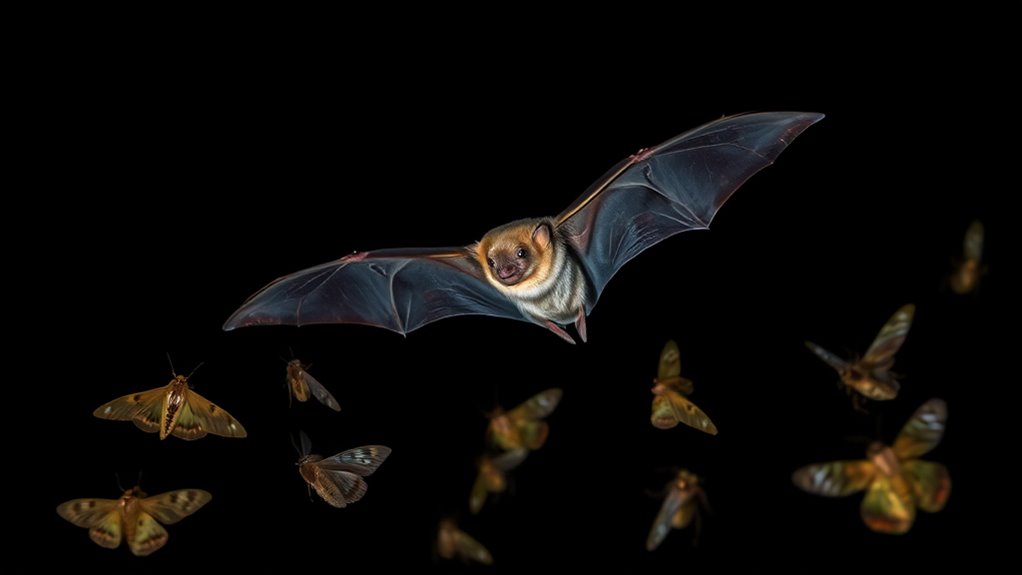

Bats rely on their advanced echolocation to effectively hunt night-flying insects, which helps keep pest populations in check. As you observe, they emit high-frequency sounds that bounce off insects and objects, allowing them to navigate and catch prey in complete darkness. This skill not only benefits the bats but also supports healthy ecosystems through insect control and pollination. If you want to discover how these nocturnal hunters master their environment, there’s more interesting information ahead.
Key Takeaways
- Bats use echolocation to detect and catch night-flying insects efficiently in complete darkness.
- Their ultrasonic calls help differentiate prey from obstacles like leaves and trees.
- Night-flying insects constitute a primary food source for many bat species during nocturnal activity.
- Bats’ hunting behavior helps control insect populations, supporting ecosystem balance.
- Echolocation enables bats to navigate and hunt at high speeds, ensuring successful insect capture.
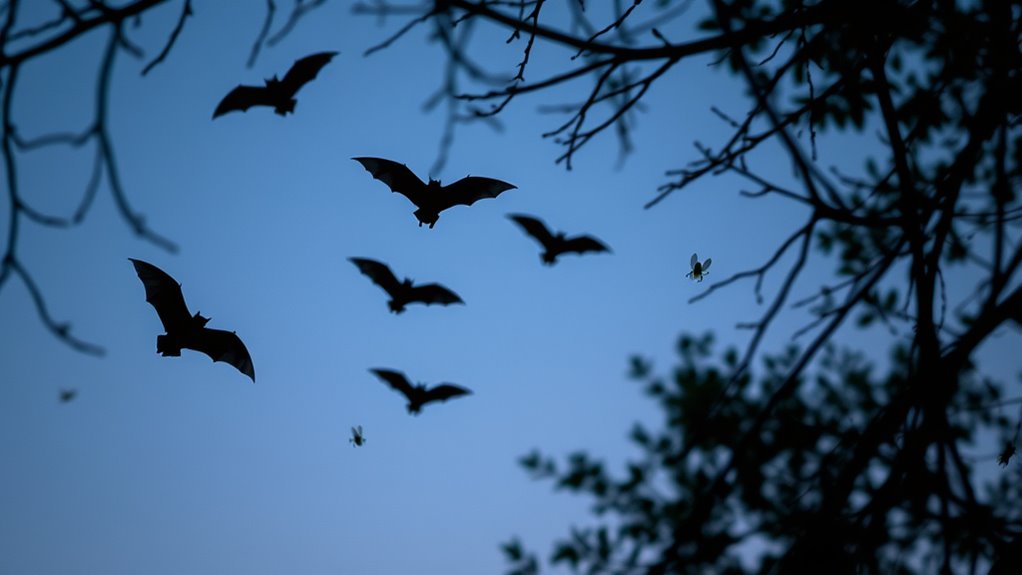
As night falls, bats become active hunters, relying on their remarkable ability to navigate and catch their prey in the dark. Their primary tool is echolocation techniques, which allow them to emit high-frequency sound waves that bounce off objects and insects. By listening to the returning echoes, you can imagine how they construct a mental map of their surroundings, pinpointing the location, size, and even the texture of their target. This sonar-like system is so precise that bats can detect tiny insects flying just a few centimeters away. As they send out these ultrasonic calls, the echoes returning to their ears provide real-time information, guiding their swift, accurate movements through the night sky. This adaptation isn’t just for catching insects; it also plays a role in nocturnal pollination. Some bats feed on nectar and, as they visit flowers, they inadvertently transfer pollen from one plant to another, facilitating plant reproduction in the dark. This nocturnal pollination is indispensable for many ecosystems, especially in tropical regions where certain plants rely solely on bats for pollination. You might not see these plants bloom at night, but they depend heavily on bats’ nightly activities to reproduce and thrive. The echolocation techniques bats use are finely tuned to distinguish between insects, trees, and even the flutter of leaves, helping them avoid obstacles while hunting. Their ability to differentiate prey from non-food objects is impressive and essential for efficient feeding. As you observe a bat catching insects, remember that their echolocation is working tirelessly in the background, providing them with constant, detailed information about their environment. This sensory system is so sophisticated that it allows them to hunt in complete darkness, where vision is limited or useless. Their nocturnal pollination behavior also plays a part in maintaining the health of many ecosystems by supporting the growth of flowering plants that bloom at night. Without bats, many of these plants would struggle to reproduce, and insect populations might become unchecked. So, as you watch bats dart through the night, you’re witnessing a complex, finely balanced relationship between predator and prey, and between plants and pollinators. Their echolocation techniques are not just about hunting but also about sustaining the intricate web of life that flourishes under the cover of darkness. It’s a tribute to how evolution has equipped these creatures with extraordinary skills, making them some of the most effective night-time navigators and pollinators in the animal kingdom.
Frequently Asked Questions
How Do Bats Navigate in Complete Darkness?
You might wonder how bats find their way in total darkness. They rely on echolocation techniques, emitting high-pitched sounds that bounce off objects and return as echoes. Their bat sensory adaptations allow them to interpret these echoes precisely, creating a mental map of their surroundings. By actively listening to these sound waves, you can see how bats navigate seamlessly through the night, avoiding obstacles and hunting efficiently.
What Specific Insects Do Bats Prefer to Eat?
You’ll find that bats prefer insects like moths, beetles, and flies, which they catch using diverse insect hunting strategies. Their bat diet diversity helps them target various prey types, optimizing energy intake. By using echolocation, you can see how they pinpoint specific insects mid-air, adapting their hunting tactics based on insect size and flight patterns. This specialization guarantees they efficiently hunt a broad range of night-flying insects.
Are All Night-Flying Insects Harmful to Humans?
Not all night-flying insects are harmful to humans. Many, like moths, pose no threat, contrary to bat myths that suggest all insects are dangerous. Some insects, however, do produce venom or cause irritation, but they rarely bite humans. You should avoid handling insects with venom or unknown effects. Bats help control these insects, making them beneficial, so there’s no need to fear them or the insects they eat.
How Do Bats Avoid Insect Swarms?
You can see that bats avoid insect swarms by relying on their echolocation abilities, which help them detect and target individual insects rather than large groups. Their feeding behaviors are highly precise, allowing them to pick off insects one by one even in crowded areas. This sophisticated navigation skill means they don’t waste energy chasing massive swarms, helping them stay efficient and safe during their nightly hunts.
Can Bats Help Control Insect Populations Naturally?
Yes, bats help control insect populations naturally. By using their bat echolocation, they detect and hunt insects efficiently, often targeting moths, beetles, and mosquitoes. Their insect predation strategies make them essential in maintaining ecological balance, reducing the need for chemical pest control. When you protect bat habitats, you support their role as natural pest controllers, benefiting agriculture and reducing insect-borne diseases.
Conclusion
As you read about bats and night-flying insects, it’s almost like nature planned it that way—you’re reminded how perfectly these creatures fit together in the quiet darkness. Maybe tonight, as you hear a distant flutter or see a shadow move, you’ll realize it’s no coincidence. It’s nature’s clever dance, a silent reminder that even in the darkness, life finds a way to thrive and connect in surprising ways.