
TL;DR

Get garden gear delivered free with Prime
- Fast, free delivery on millions of items
- Prime Video, Amazon Music and more included
- Member-only deals all year
A gas backpack leaf blower can suit a large yard when you need long work sessions, quick refueling, and enough airflow for broad areas or heavy leaf fall. Compare CFM and MPH together, then weigh harness comfort, noise, maintenance, and local restrictions; a model with lower headline numbers may be the better fit for your property.
One windy afternoon can turn a tidy half-acre lawn into a patchwork of crisp leaves, damp clumps, and blocked gutters. If a small handheld blower leaves you walking the same strip again and again, a backpack model may make the cleanup feel less like an endless chore.
A gas backpack leaf blower for large yards carries its engine and fan on a harness, leaving your hands free to guide the nozzle. That design can suit long sessions and quick refueling, but it also brings weight, noise, exhaust, and upkeep. Bigger numbers on a product page do not tell you everything about how the machine will feel or perform.
This guide explains how to compare CFM, MPH, engine size, and fit, and how to think about alternatives to a 75.6cc model listed with 912 CFM. You’ll also get a practical buying checklist, safe-use advice, and a way to decide whether gas is a better match than battery power for your yard.
Compare CFM and MPH together: CFM describes air volume, while MPH describes air speed.
A listed 63cc alternative has similar stated air speed to the 75.6cc model but lower listed airflow, so it may not be a direct match for broad cleanup.
Test harness fit, balance, controls, and loaded weight; dry weight alone does not tell you how the blower will feel during a long session.
Choose gas for the work pattern it supports, not by default: long sessions and quick refueling can favor gas, while noise and exhaust may favor battery.
Check the exact manual, local rules, and safety requirements, and wear hearing and eye protection while keeping people and pets away.
Why a Backpack Blower Can Save Time on a Large Yard
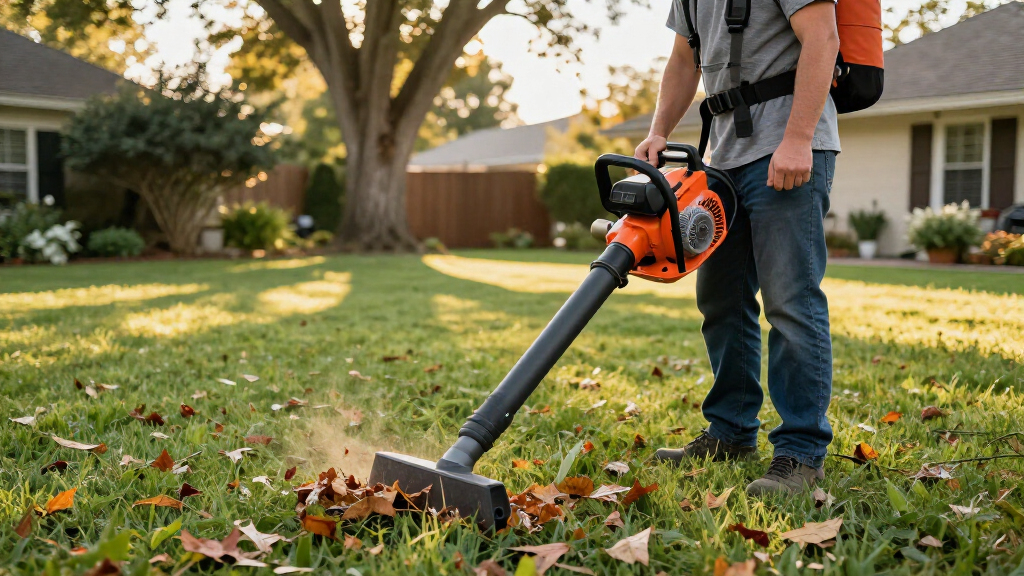
A gas backpack leaf blower for large yards puts the engine and fan on a harness, so you guide the nozzle with your hands instead of carrying the whole machine by its handle. That layout suits long passes across lawns, driveways, and leaf-covered beds, especially when a handheld blower makes your arm tire before the yard is clear.
Think of a property with a long gravel drive, mature maples, and a lawn that slopes toward a fence. With a backpack model, you can walk a steady route and direct leaves into one collection line, rather than stopping to rest your wrist every few minutes. The harness does not make the equipment weightless; it moves the load to your back and shoulders.
Fit and balance matter as much as the carrying style. A padded, adjustable harness can sit comfortably on one person and rub another. If you can, try the pack on before buying. Adjust the straps so the blower sits close to your back, then check whether you can reach the throttle and stop switch without twisting awkwardly.
Backpack blowers carry the engine behind you, but that means you need to think about how the weight feels after the tank is full. A dry-weight figure may not include fuel, and the exact weight varies by model. For example, a 20-minute cleanup around a small garden may not justify a heavy pack, while a 90-minute leaf session across a broad property can make hands-free carrying a real advantage.
The trade-off is simple: longer work and tougher cleanup favor a backpack design; short, light jobs may not. Gas models also produce exhaust and substantial noise. If your yard backs onto close neighbors, a quiet morning cleanup may not be welcome even if the machine clears leaves quickly.
As an affiliate, we earn on qualifying purchases.
How to Read CFM, MPH, and Engine Size Without Getting Misled
A gas backpack leaf blower’s CFM tells you how much air it moves, MPH describes the air’s speed, and engine displacement in cc describes engine size—not a guaranteed measure of yard performance. Compare all three alongside the nozzle, debris, and working conditions instead of picking the largest figure.
| Specification | What it tells you | Why it matters in your yard |
|---|---|---|
| CFM | Air volume moved, measured in cubic feet per minute | Helps indicate how much area or material the blower can push in a pass |
| MPH | Air speed, usually reported in miles per hour | Helps describe how forcefully air exits the nozzle |
| CC | Engine displacement, measured in cubic centimeters | Gives an engine-size reference, but does not directly predict fuel use or clearing results |
For a concrete comparison, the 75.6cc model in the source specifications is listed at 912 CFM and 206 MPH. A 63cc alternative is listed at 665 CFM and 205 MPH. Their air-speed figures are close, but their stated airflow volumes differ. That gap is one reason MPH alone cannot tell you which blower will move a wide, loose layer of leaves more efficiently.
Neither number predicts every job. Dry maple leaves on pavement move easily; wet, packed leaves tucked into grass resist the air stream. Nozzle shape and how close you hold it also change what reaches the ground. A wide nozzle may move a broad swath, while a narrower outlet can focus air on a stubborn clump.
Use specs as a shortlist, not a promise. If a manufacturer publishes test conditions, read them. When you compare models, check whether the airflow figure uses the same measurement method and nozzle setup. A demonstration on dry pavement cannot tell you how a blower will handle a soggy pile under a hedge after several rainy days.
high CFM leaf blower for large yards
As an affiliate, we earn on qualifying purchases.
As an affiliate, we earn on qualifying purchases.
Which Replacement Models Match the 75.6cc Blower Closest?
If the 75.6cc model is hard to locate, compare alternatives by the specifications that matter most to your cleanup rather than treating any one product as a perfect substitute. The figures below show where listed models overlap—and where they differ.
| Model in source list | Engine | Airflow | Air speed | Tank capacity |
|---|---|---|---|---|
| 75.6cc 2-cycle gas backpack blower | 75.6cc, 6.0 HP listed | 912 CFM | 206 MPH | 84.5 oz |
| 63cc gas backpack blower | 63cc | 665 CFM | 205 MPH | 1.7 L |
| Husqvarna 150BT | 51cc, 2.16 HP, 2-cycle | 765 CFM | 270 MPH | Not listed here |
| 52cc gas backpack blower | 52cc | 550 CFM | Not specified in the comparison data | 1 L |
The 63cc model shares the closest listed engine-size and air-speed neighborhood, and its source data includes a tank-capacity figure. Its stated airflow is lower than the 75.6cc blower’s, so it may not feel like a like-for-like choice for broad, heavy cleanup. Verify current specifications and how the manufacturer measured them before you decide.
The Husqvarna 150BT is a different kind of comparison: it is listed with a smaller 51cc engine but 765 CFM and 270 MPH. Those figures show why engine displacement alone cannot rank blowers. The 52cc option is listed at 550 CFM, making it a more modest airflow choice on paper.
These products are not guaranteed to be available everywhere, and product specifications can change. Treat the table as a starting point, then check the manufacturer’s current listing, manual, warranty terms, parts support, and local emissions rules. A spec match is useful; a good fit for your yard and your ability to service the machine matters more.
battery-powered leaf blower alternative
As an affiliate, we earn on qualifying purchases.
As an affiliate, we earn on qualifying purchases.
How to Choose a Blower That Fits Your Yard and Your Body
To choose a gas backpack leaf blower for large yards, start with the work you actually do, compare airflow and handling, and then check fuel, noise, service, and local rules. These steps keep an impressive spec sheet from distracting you from the daily experience of wearing and maintaining the machine.
- Map your cleanup. Note the lawn area, driveway length, leaf volume, slopes, and spots where debris collects. A half-acre with scattered leaves has different needs from a wooded property with wet, matted piles.
- Choose the workload you need to handle. Compare CFM and MPH together, then look for demonstrations or credible tests on similar debris. If you usually clear dry leaves, you may not need the same setup as someone moving damp oak leaves from grass.
- Check the pack and controls. Compare dry weight, harness adjustment, padding, ventilation, vibration isolation, throttle position, cruise control, and access to the stop switch. If possible, wear the pack and practice reaching the controls.
- Confirm the fuel routine. Many two-stroke models require gasoline mixed with oil in a specified ratio. Follow the exact manual; never guess at the mix. A four-stroke engine uses separate gasoline and engine oil, so its routine differs.
- Check noise, service, and rules. Look up the sound rating and local restrictions, then confirm that parts, service, and a clear warranty are available for the model you are considering.
For example, imagine you clear a large suburban yard for an hour each weekend and have a nearby neighbor’s bedroom window facing the driveway. The best choice is not automatically the highest-output blower. You may value a manageable harness, easy starting, and a workable noise schedule more than a small jump in airflow.
Do the same check for maintenance. Fresh fuel, filter inspections, spark-plug checks, and storage preparation take time. If the blower will sit for much of the year, simple access to the manual and replacement parts can matter more than a headline horsepower figure. Buy for the full season of ownership, not just the first cleanup.
As an affiliate, we earn on qualifying purchases.
When Gas Beats Battery—and When It Doesn’t
Gas often makes sense for long sessions when you want to refuel and keep working, while battery power may suit you better when exhaust, noise, or simpler starting matters more. The better choice depends on the property, the cleanup length, your tolerance for maintenance, and the battery system you already own.
A gas blower can be a practical fit for a long driveway and a leaf-heavy back lawn because you can carry fuel and refill rather than pause for a recharge. That does not mean every gas model runs for the same time: tank size, engine design, throttle use, and the specific manual all affect fuel use. A large tank is not a runtime guarantee.
Battery blowers avoid exhaust at the point of use and may be quieter, but performance and runtime vary widely by model and battery system. A homeowner with a compact property might finish with one battery. Someone clearing several acres may need spare packs, charging time, and a plan for rotating them. The batteries add weight and cost, too, so compare a complete working setup rather than the bare tool.
Gas has its own costs beyond the machine: fuel mixing for many two-stroke engines, periodic maintenance, exhaust, and engine noise. Local rules can restrict operating times or certain equipment, and those rules change by place. Check the current requirements where you live before buying; a machine that fits your yard but cannot be used at a convenient time is a poor match.
Consider a household with a long leaf season and a shed where fuel can be stored safely according to the product instructions. Gas may offer a useful rhythm: fill, work, refuel, continue. For a small yard with close neighbors, a battery model may offer a calmer routine. Compare the whole work system—runtime, charging or refueling, noise, maintenance, and regulations—not just the power source.
How to Move Wet Leaves Without Fighting the Machine
Wet leaves are harder to move than dry leaves because moisture makes them cling together and stick to grass, pavement, and one another. A powerful blower can help, but loosening the material, choosing a sensible direction, and waiting for drier conditions often save more effort than holding the throttle wide open.
Take a shaded side yard after a night of rain. The leaves may look like a flat brown carpet, pressed into the lawn. If you blast from far away, the air spreads across the top while the layer barely shifts. Start near the edge and work the nozzle low enough to get air under the leaves, then guide a small section toward a collection point.
Use the lowest effective throttle, especially near gravel, dry soil, mulch, or delicate plantings. More throttle can lift dust and throw stones; it can also scatter leaves into a neighbor’s yard rather than forming a tidy pile. If the leaves are matted, a rake can break the layer apart before you use the blower. A short pause until the surface dries may be the easiest tool of all.
Keep the nozzle away from people, pets, vehicles, roads, and windows. Do not use a blower to move material if dust or debris could create a hazard, and avoid directing debris toward neighboring properties. If you are clearing grass clippings or light outdoor debris, check that the surface and material suit the tool; a blower is not the right answer for every mess.
A useful routine is to gather leaves in manageable rows rather than trying to push the whole yard at once. On a windy day, work with the wind when possible. You’ll spend less time chasing leaves that skitter back across the driveway—and your cleanup will look more like a deliberate sweep than a brown cloud.
How to Use a Gas Backpack Blower Safely and Considerately
Use a gas backpack blower outdoors, wear hearing and eye protection, follow the owner’s manual, and keep people and pets clear of the work area. The engine is loud, the air stream can throw small debris, and the exhaust makes the machine unsuitable for indoor or enclosed use.
Before starting, put on hearing protection, safety glasses, sturdy footwear, and any other protective equipment required by the manual. Check that the harness is secure and that the throttle and stop switch work as expected. If you are working near gravel, dry soil, or garden beds, reduce throttle to the lowest level that moves the debris.
Keep children and pets indoors or at a safe distance until the work area is clear. A small stone can travel much farther than you expect, and a dog may chase the moving leaves into the nozzle’s path. Point the stream away from roads, windows, other people, and neighboring yards. Never run a gas blower in a garage, shed, or other enclosed area because engine exhaust can build up.
Noise deserves attention even when you are working in your own yard. Check the manufacturer’s sound rating and your local time or equipment rules; measurements taken at different distances or under different conditions may not compare directly. A Saturday morning cleanup can be technically allowed and still irritate the person next door trying to sleep.
Fuel handling and maintenance also require care. Use only the fuel and oil instructions specified for your exact engine, store fuel as the manual directs, and let hot parts cool before service. Wear the protective equipment the label and manual call for when handling fuels, oils, or maintenance products. If a task or product has specific label instructions, follow those instructions rather than improvising.
What to Check Before You Buy or Replace a Model
Before replacing a gas backpack blower, verify the current model details, service support, and local rules instead of assuming an older listing still describes what you can buy today. Product names, specifications, and availability can change, and a near-match on paper may have a different harness, tank, or maintenance routine.
Suppose you found a listing for a 75.6cc blower with 912 CFM, 206 MPH, a stated 6.0 HP, and an 84.5-ounce tank. Treat those figures as the specifications in that listing, not a promise about present-day stock or how every version performs. If you are considering a 63cc replacement at 665 CFM and 205 MPH, note that the air speed is similar but stated airflow is lower. That is a meaningful difference for a broad cleanup route.
Check these points before you commit:
- Current specifications: Confirm the exact engine, airflow, speed, tank capacity, and dry weight with the current manufacturer information.
- Fuel and manual: Find the correct fuel type, mixture instructions if applicable, starting procedure, and maintenance schedule.
- Parts and service: Ask how you can obtain filters, plugs, harness parts, and repair support.
- Warranty: Read the terms and note what maintenance records or conditions apply.
- Local requirements: Check current noise, emissions, and equipment restrictions in your city or region.
That last step matters because rules vary and can change. A product page may not tell you whether your local area restricts gas equipment or operating hours. A quick check with your municipal guidance before purchase can save you from owning a powerful machine you cannot use when you planned.
The practical rule is to compare verified details, not just similar product names. If a retailer listing and manufacturer manual disagree, ask the seller or manufacturer to confirm the specification for the exact model number. Good replacement shopping is careful matching, not blind substitution.
Frequently Asked Questions
How powerful should a blower be for a large yard?
There is no single CFM or MPH number that suits every large yard. Leaf volume, wetness, terrain, and the area you need to clear all change the workload. Compare CFM and MPH together, then look for a credible demonstration with debris similar to yours.
Is a backpack blower better than a handheld blower?
A backpack blower can be more comfortable for long sessions and heavier cleanup because a harness carries the engine and fan. A handheld model may be easier to store and control for a short job, such as clearing a small patio. Your task length and how the tool fits your body matter more than the category name.
Can a leaf blower move wet leaves?
Yes, but wet or matted leaves are harder to shift than dry ones. Loosen the layer with a rake, work from its edge, or wait for drier conditions when you can. Use only enough throttle to move the leaves without lifting dust or throwing gravel.
What fuel does a gas backpack blower use?
Fuel requirements depend on the engine. Many two-stroke models use gasoline mixed with oil at the ratio stated in the owner’s manual, while four-stroke models use separate gasoline and engine oil. Follow the instructions for your exact model; the wrong mixture can damage the engine.
Are gas leaf blowers banned where I live?
Rules differ by city, state, and country, and they can change. Check current local requirements for equipment, noise, and operating hours before buying or using a gas blower. Do not rely on a general national summary to determine what applies to your address.
Conclusion
Choose a blower by matching its airflow, handling, runtime, and noise to the work your yard actually demands. If you are replacing a 75.6cc model, compare current specifications carefully: a similar MPH figure does not guarantee similar air volume or clearing performance.
Before you buy, check the harness, manual, service support, and local rules. Then clear one small test area with a steady, low-to-high approach—not a full-throttle blast. The best blower is the one that leaves your yard tidy without leaving you exhausted, your neighbors annoyed, or your leaves airborne again.
Fall yard work Picks
leaf blowers
As an affiliate, we earn on qualifying purchases.