
Boomless nozzles work well when you need wide, even coverage over large or irregular surfaces, especially in open terrains or hard-to-reach areas, reducing equipment complexity and waste. However, they can miss the target if wind is strong, terrain is uneven, or if the nozzle isn’t properly calibrated, leading to drift or uneven application. To guarantee effective use, understanding their strengths and limitations will help you decide when they’re the best option or when to look for alternative solutions.
Key Takeaways
- Boomless nozzles excel in covering irregular surfaces and hard-to-reach areas without the need for traditional booms.
- They perform best on open, flat terrains with minimal wind, ensuring accurate and uniform spray application.
- Environmental factors like high wind or complex landscapes can cause drift and reduce targeting precision.
- Proper calibration, maintenance, and matching nozzle type to terrain are essential for optimal results.
- They may be less effective in dense vegetation or uneven terrains where precise control is critical.
What Are Boomless Nozzles and How Do They Work?
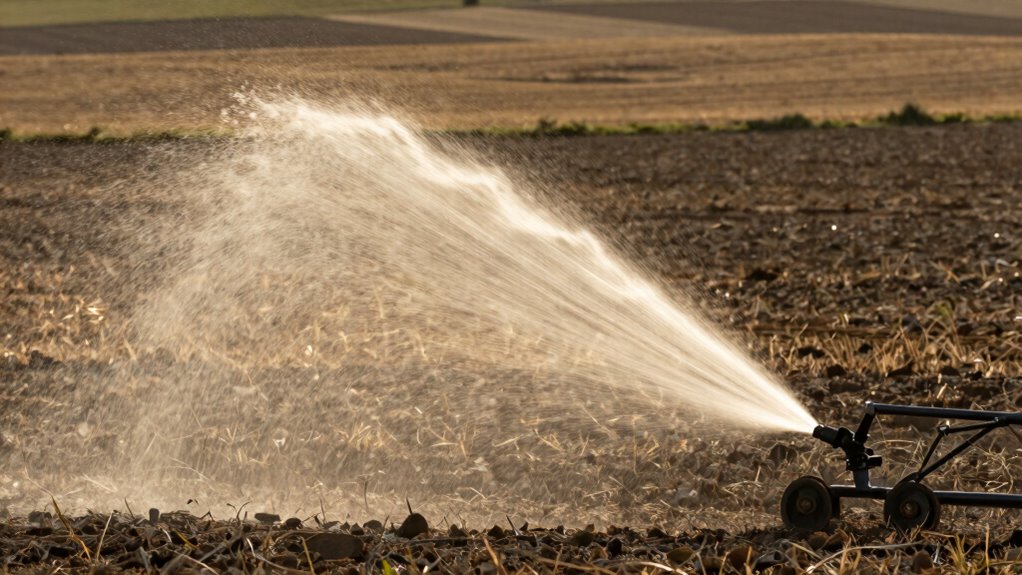
Have you ever wondered how boomless nozzles spray evenly over large areas without the need for a traditional boom? These nozzles operate by dispersing spray in a wide, fan-shaped pattern, allowing you to cover extensive ground efficiently. To keep them working properly, nozzle maintenance is essential—cleaning nozzles regularly prevents clogs and ensures even spray distribution. Proper application timing also plays a crucial role; spraying at the right moment maximizes coverage and reduces waste. Unlike boom systems, boomless nozzles avoid overlaps and gaps, making them ideal for uneven terrain or obstacles. Additionally, using energy-efficient models can further enhance sustainability and reduce operational costs. By maintaining your nozzles and timing your application precisely, you guarantee uniform coverage, minimize chemical waste, and improve overall effectiveness in your spraying tasks. Incorporating nozzle calibration into your routine helps optimize spray patterns and ensures consistent performance over time.
What Are the Benefits of Using Boomless Nozzles?
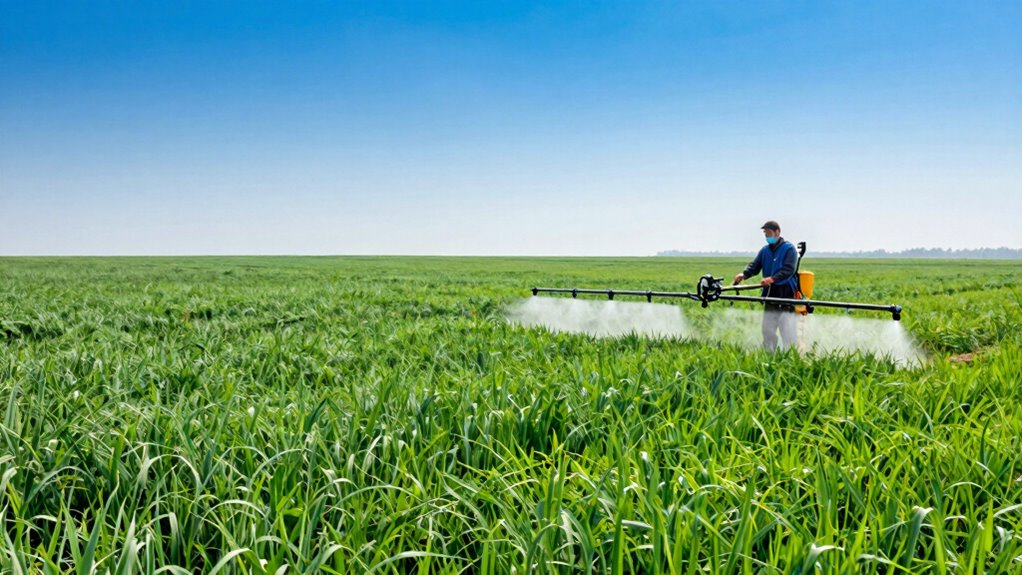
Using boomless nozzles gives you versatile spray coverage, so you can reach areas a traditional boom might miss. They also help reduce drift and waste by controlling where the spray goes. Overall, these nozzles can make your application more efficient and effective. Additionally, they are well-suited for free floating systems, allowing for greater flexibility in various backyard and landscaping setups. Since the design and functionality of these nozzles contribute to application precision, they are ideal for targeted spraying tasks. Moreover, their ability to adapt to different terrains enhances application accuracy, ensuring better coverage and resource use. Understanding spray pattern control can further optimize your use of boomless nozzles for specific projects.
Versatile Spray Coverage
Boomless nozzles offer exceptional versatility in spray coverage, allowing you to target hard-to-reach areas and irregularly shaped surfaces with ease. This flexibility helps you adapt to different terrains without switching equipment, making applications more efficient. You’ll notice improved spray uniformity across uneven surfaces, ensuring consistent coverage and better results. Because there’s no boom arms, nozzle maintenance is simpler, reducing the chances of clogs or damage caused by complex components. The wide spray pattern lets you cover large areas quickly, saving time and effort. Whether you’re spraying over obstacles or irregular terrain, boomless nozzles give you the control needed for precise, uniform application, making them a valuable tool for various agricultural or landscape tasks.
Reduced Drift and Waste
Because boomless nozzles produce a more targeted spray pattern, they substantially reduce drift and waste compared to traditional boom systems. This precision minimizes chemical loss, saving you money and preventing environmental contamination. Their improved chemical resistance means they withstand harsh solutions without corroding or clogging, maintaining consistent performance over time. Fewer drift issues also mean less overspray on non-target areas, increasing application accuracy. Additionally, with proper nozzle maintenance, you can ensure ideal spray patterns and prolong nozzle lifespan. Reduced drift and waste not only make your spraying more efficient but also promote safer, more responsible chemical use. Furthermore, understanding pinball machine weights can help when relocating or installing equipment, ensuring safety and proper handling. Overall, boomless nozzles help you achieve better coverage while conserving resources and minimizing unintended impacts.
What Limitations Should You Know About Boomless Nozzles?
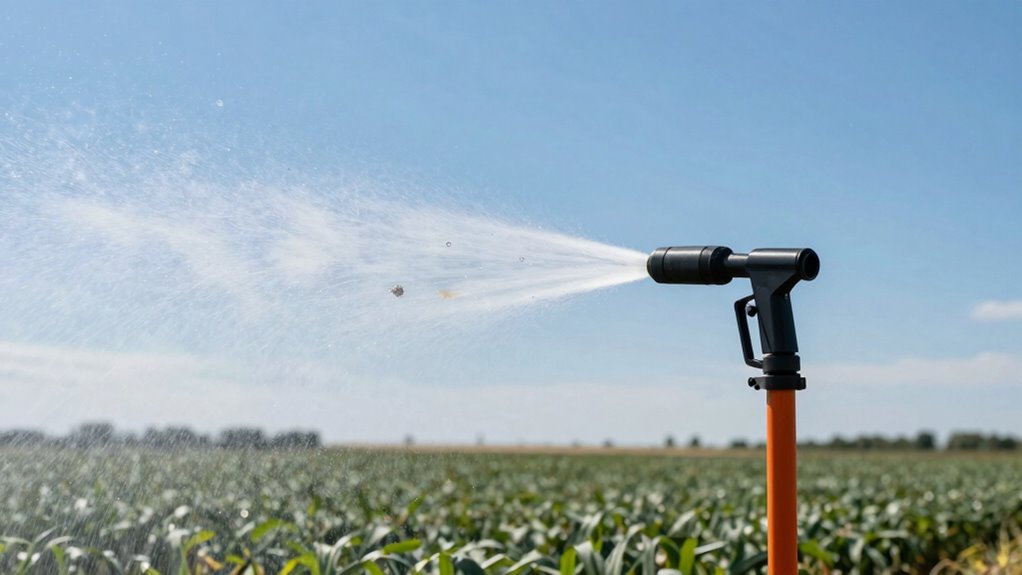
Wind drift can be be a major issue with boomless nozzles, making it harder to control where the spray lands. You might also find that spray precision is limited, especially on targeted areas. Knowing these challenges helps you plan better and avoid unwanted overspray or missed spots. Additionally, understanding operational resilience can be beneficial if you’re seeking strategies to adapt to environmental or logistical challenges in agricultural spraying. Being aware of environmental factors such as wind speed and direction is essential for optimizing spray accuracy and minimizing waste. Proper calibration and maintenance practices can also help reduce issues caused by equipment limitations, and being attentive to equipment capabilities ensures you select the right nozzle for your specific needs.
Wind Drift Challenges
Wind drift can substantially affect the effectiveness of boomless nozzles, especially during windy conditions. When wind pushes the spray off course, it reduces coverage accuracy and can lead to crop damage or environmental contamination. To minimize drift, verify nozzle maintenance is up to date; clogged or worn nozzles can worsen spray dispersion. Additionally, choosing nozzles with proper chemical compatibility helps prevent clogging and ensures consistent spray patterns, even in gusty conditions. Be mindful of wind speed and direction before spraying, and consider adjusting the spray height or using drift-reduction tools. Recognizing these limitations allows you to make better decisions, reducing waste and improving application precision despite challenging wind conditions. Using reliable and well-maintained electric bike conversion kits can also help you navigate fields more precisely, especially in variable weather.
Limited Spray Precision
While boomless nozzles offer advantages like wider coverage and flexibility, they also come with restrictions in spray precision. You might face precision challenges, especially when targeting small or specific areas. Wind and terrain can cause spray drift, reducing accuracy. Proper nozzle maintenance is essential to ensure consistent spray patterns and prevent clogging that worsens precision issues. The following table highlights key factors affecting spray precision:
| Factor | Effect | Solution |
|---|---|---|
| Wind drift | Decreases targeting accuracy | Use weather conditions wisely |
| Nozzle clogging | Leads to uneven spray patterns | Regular cleaning and maintenance |
| Nozzle wear | Alters spray distribution | Replace nozzles when worn |
| Nozzle design | Innovations are improving spray precision | Stay updated on technological advances |
Understanding these limitations helps you optimize boomless nozzle performance and mitigate precision challenges. Additionally, technological advancements in nozzle design are gradually improving spray accuracy and consistency.
Is Your Terrain and Crops Suitable for Boomless Nozzles?
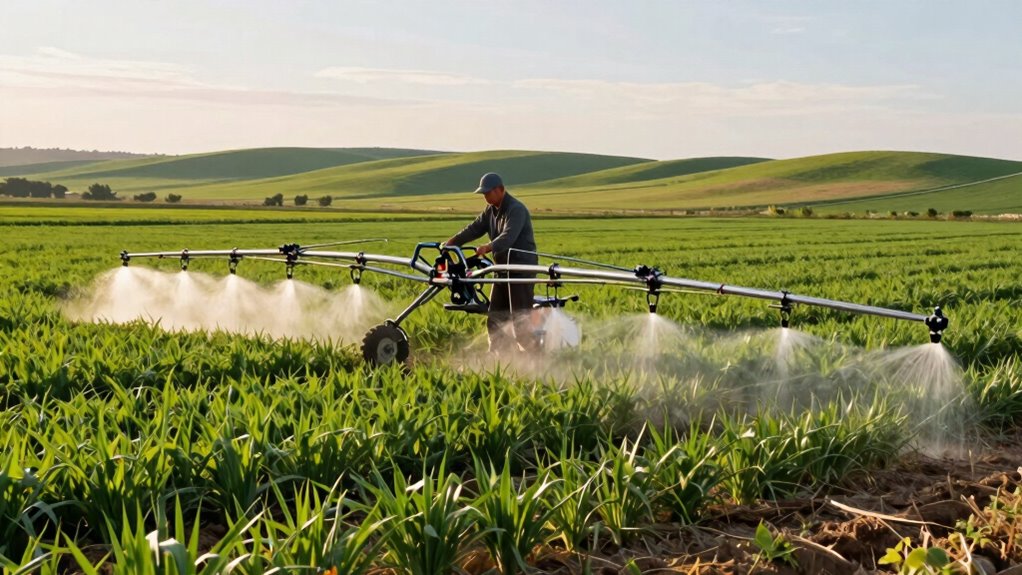
Determining if your terrain and crops are suitable for boomless nozzles is essential before making a switch. These nozzles work best on open, relatively flat fields where spray can spread evenly without obstructions. If your terrain is rugged or densely planted, the spray pattern may become inconsistent, reducing effectiveness and risking over-application. Consider your crop height and density, as boomless nozzles are less precise in tall or mixed vegetation. In precision agriculture, uniform coverage is key to optimizing pesticide safety and minimizing drift. If your terrain is uneven or crops are too tall, boomless nozzles might not deliver the control you need. Assess your field conditions carefully to ensure these nozzles enhance, rather than hinder, your overall spraying strategy. Additionally, understanding performance metrics can help determine if your equipment is delivering optimal results and maintaining consistent application. Proper spray pattern is also crucial to prevent overlaps and gaps that can compromise crop health and yield. Being aware of application efficiency can further improve your spraying outcomes and reduce waste.
How to Properly Set Up and Operate Boomless Nozzles?
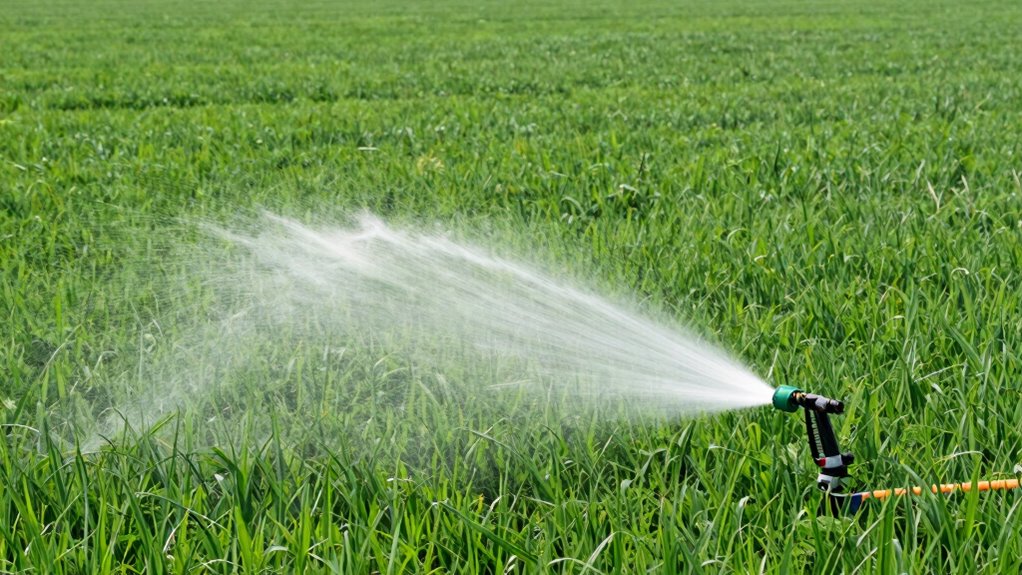
Setting up and operating boomless nozzles correctly guarantees ideal coverage and minimizes waste. Start by ensuring your nozzle’s nozzle resistance matches the chemicals you’re applying, as chemical resistance affects durability and performance. Check the nozzle’s spray angle and pressure settings to achieve even distribution without overspray. Regular nozzle maintenance is essential; clean nozzles thoroughly after each use to prevent clogging and maintain consistent spray patterns. Inspect hoses and connections for leaks or damage, replacing parts as needed. Always calibrate your equipment before operation to ensure proper flow rates. Proper setup minimizes chemical waste and guarantees safety, while attentive maintenance keeps your boomless nozzles functioning at peak performance, reducing downtime and extending their lifespan. Additionally, understanding the proper application techniques can improve coverage efficiency and prevent damage to surrounding areas. Being aware of the chemical resistance of your nozzles can also help you select the right equipment for different substances and prolong nozzle life. Moreover, staying informed about regulatory requirements ensures compliance and safe operation during spraying activities.
Comparing Boomless Nozzles to Traditional Boom Systems
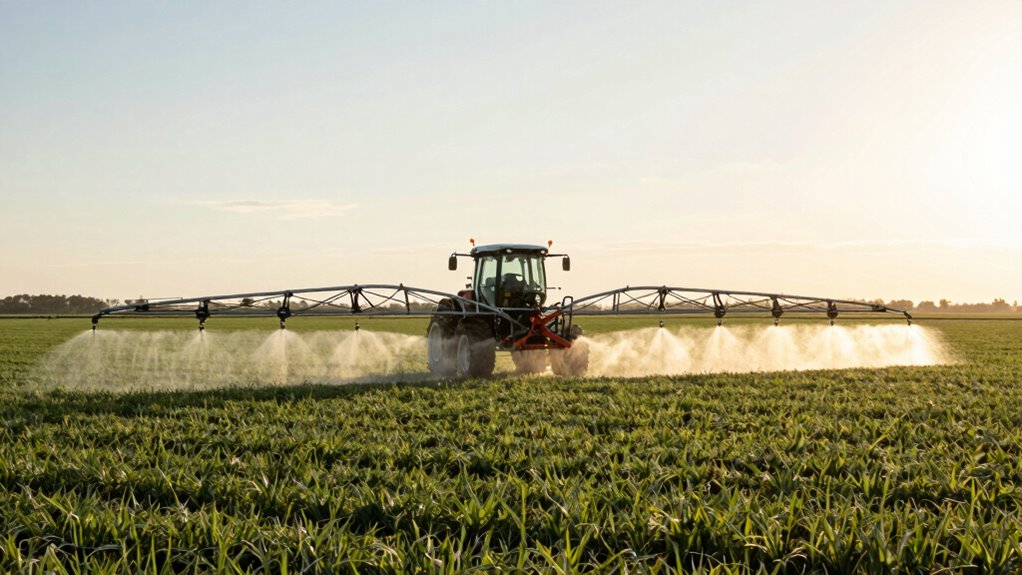
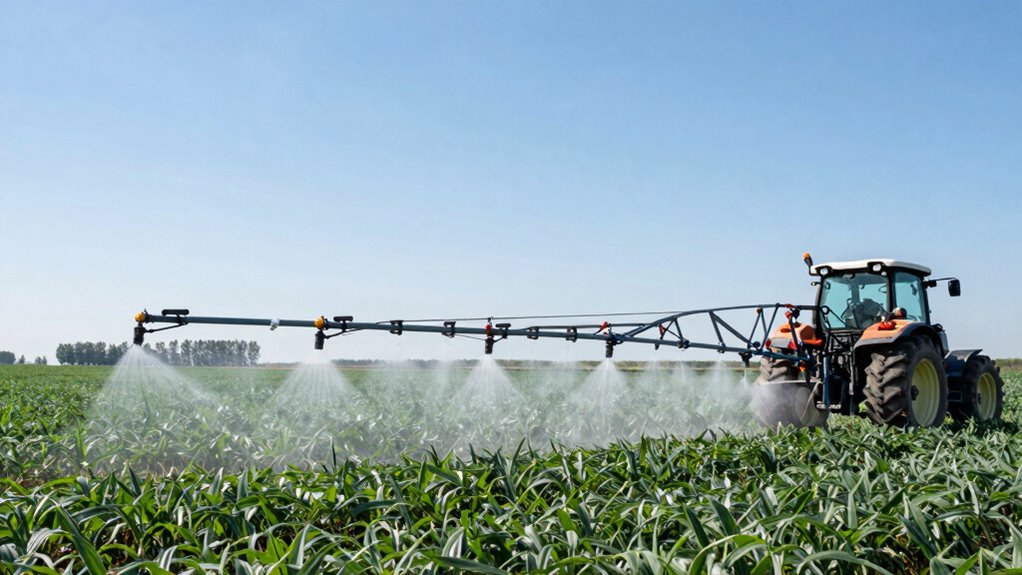
Boomless nozzles offer a flexible alternative to traditional boom systems, providing more precise and adaptable coverage. Unlike boom systems that cover wide swaths, boomless nozzles enable you to target specific areas, reducing overlap and waste. This precision benefits your efforts in precision agriculture, helping you apply chemicals accurately and efficiently. Additionally, the environmental impact decreases because you use less product and minimize runoff. Traditional boom systems can be more effective for uniform coverage over large fields, but they may cause over-application and drift in complex terrains. Boomless nozzles excel in irregular or obstacle-filled landscapes, where precision and reduced environmental footprint are priorities. By comparing both, you can choose the system that best aligns with your farm’s size, crop type, and environmental concerns.
Troubleshooting Common Issues With Boomless Nozzles?
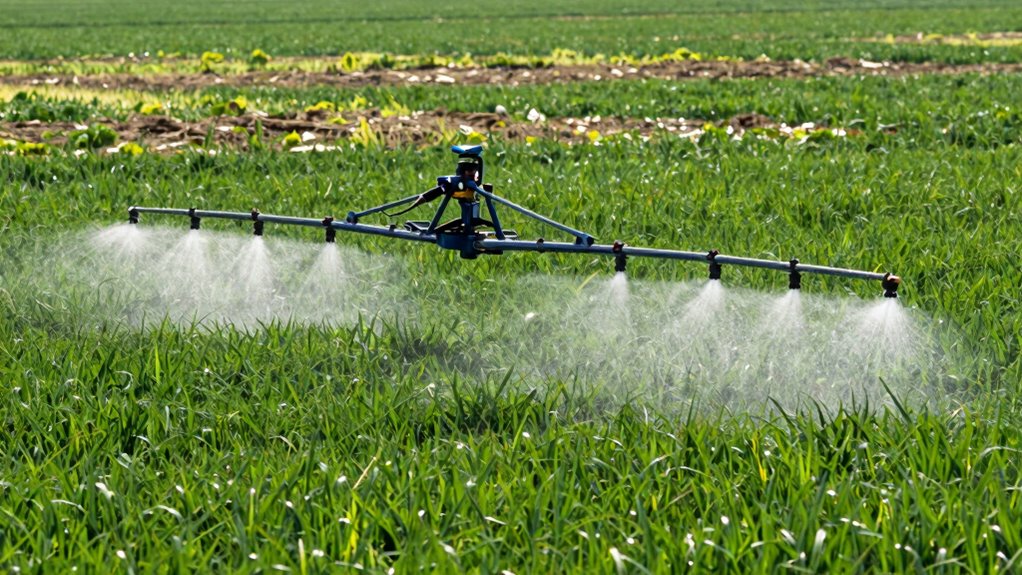
While boomless nozzles offer many advantages, like precise targeting and reduced waste, they can sometimes encounter issues that affect performance. Common problems include inconsistent spray patterns or clogging. To troubleshoot, first check chemical compatibility; using incompatible chemicals can damage the nozzle or affect spray quality. Next, verify nozzle calibration to ensure correct flow rates and spray width. Incorrect calibration leads to uneven coverage. Regular cleaning prevents clogging and maintains ideal function. Keep these factors in mind:
| Issue | Solution |
|---|---|
| Uneven spray pattern | Recalibrate the nozzle |
| Clogging | Clean and check chemical compatibility |
| Reduced spray reach | Inspect for nozzle wear or damage |
Real-World Examples of Boomless Nozzle Success
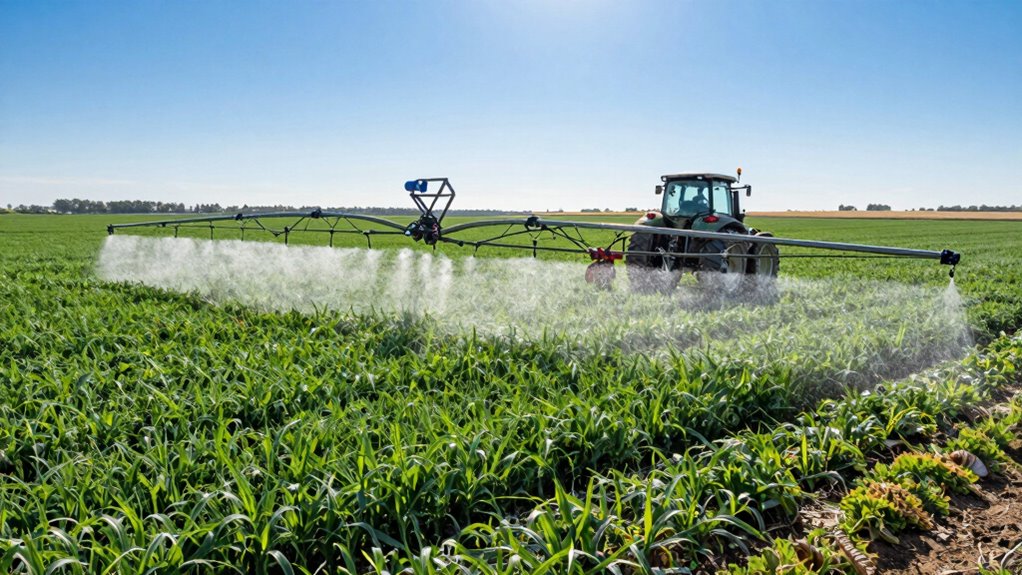
Boomless nozzles have proven highly effective in dense vegetation, allowing for broad coverage without the need for multiple passes. However, you might find them more challenging to use on uneven terrain, where spray accuracy can decrease. Understanding these real-world successes helps you determine when boomless nozzles are the right choice for your application.
Effective in Dense Vegetation
In areas with dense vegetation, traditional spray methods often struggle to reach all targeted weeds effectively. Boomless nozzles excel here by offering improved spray uniformity across thick plantings. They can cover large areas quickly, reducing missed spots and ensuring better weed control. Proper nozzle maintenance is essential to prevent clogging and maintain consistent spray patterns. For example:
| Vegetation Density | Spray Coverage | Nozzle Performance |
|---|---|---|
| Moderate | Even, thorough | Needs regular cleaning |
| Dense | Penetrates well | Maintains spray uniformity |
| Very dense | Limited reach | Requires frequent checks |
| Sparse | Over-application | Easy to manage |
This adaptability makes boomless nozzles highly effective in dense vegetation, provided you keep nozzles clean and well-maintained.
Challenging on Uneven Terrain
Uneven terrain can pose significant challenges for spray equipment, making uniform coverage difficult. Boomless nozzles offer terrain adaptability that helps address these issues, but nozzle compatibility remains essential. When working on hilly or irregular ground, selecting nozzles designed for uneven surfaces ensures better spray distribution and reduces missed spots. For example, some boomless nozzles are engineered with adjustable flow rates and wider spray angles, allowing you to adapt quickly to changing terrain contours. Proper nozzle compatibility with your equipment and target landscape enhances performance, preventing over-application in some areas and gaps in others. Real-world success stories demonstrate that with the right nozzle choice, boomless systems can effectively manage uneven terrain, delivering consistent, thorough coverage even in challenging conditions.
Should You Use Boomless Nozzles? Key Factors to Consider
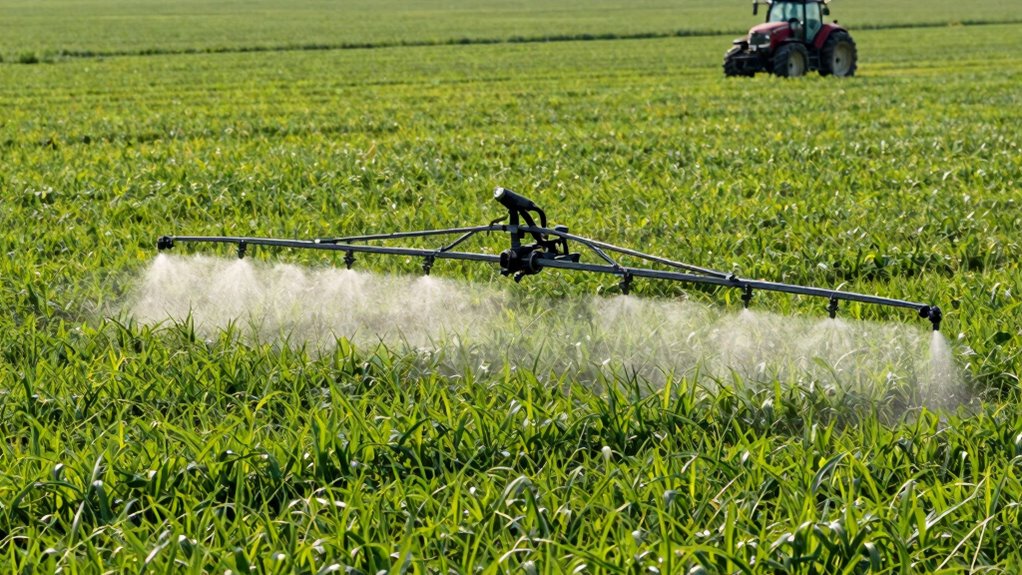
Deciding whether to use boomless nozzles depends on several important factors. One key consideration is drift reduction; these nozzles can minimize spray drift, making them ideal for sensitive areas. However, they often produce a wider spray pattern that may lead to overspray if not carefully managed. You should also think about nozzle maintenance—boomless nozzles tend to clog more easily due to their larger or specialized openings, so regular cleaning is essential for consistent performance. Evaluate your terrain and target areas: boomless nozzles work well for uneven or hard-to-reach spots but might be less precise in densely populated or delicate environments. Ultimately, weighing these factors helps determine if boomless nozzles align with your spraying needs and operational practices.
Final Tips for Choosing the Right Spraying Solution
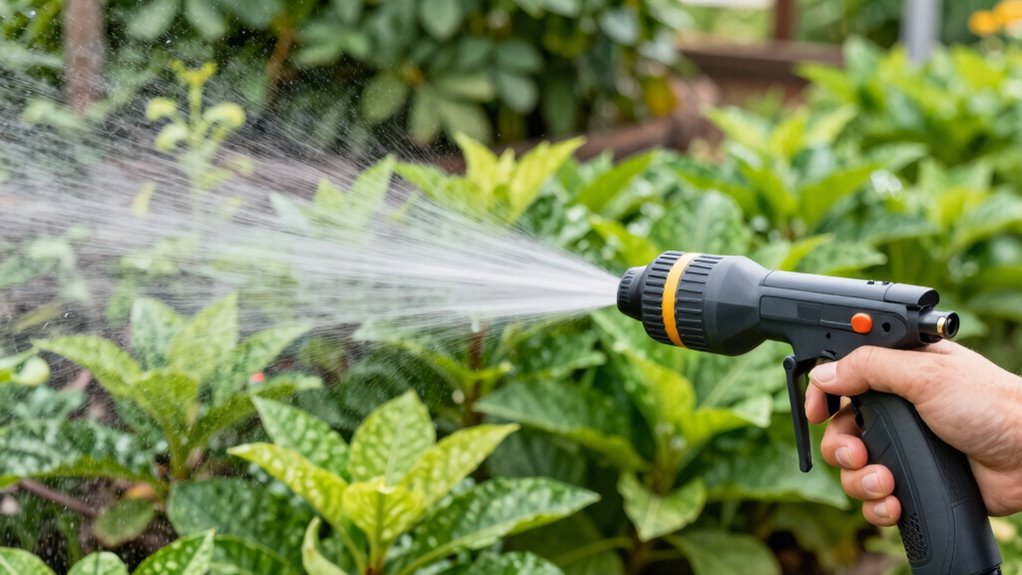
Choosing the right spraying solution involves evaluating your specific needs and operational conditions. Focus on achieving consistent spray uniformity to guarantee effective coverage and minimize waste. Consider nozzle maintenance; a well-maintained nozzle prevents clogs and ensures peak performance. Think about your terrain and application area—some solutions may excel in open fields but struggle in tight spaces. Don’t overlook the importance of matching nozzle type to your spray pattern requirements.
- Feel confident in your choice, knowing your equipment performs reliably.
- Avoid costly mistakes caused by neglecting nozzle upkeep.
- Maximize spray efficiency with a solution tailored to your environment.
- Achieve perfect spray uniformity to protect your crops or property.
Frequently Asked Questions
How Do Boomless Nozzles Impact Pesticide Drift and Environmental Safety?
Boomless nozzles help reduce drift and improve environmental safety by targeting pesticides more precisely. You’ll notice less off-target spray, which means fewer chemicals reach unintended areas, lowering environmental impact. This technology is especially useful in sensitive zones, making your spraying more efficient and eco-friendly. However, you should still monitor conditions like wind to maximize drift reduction and guarantee safe, effective pesticide application.
Can Boomless Nozzles Be Used With All Types of Pesticides and Chemicals?
You can’t use boomless nozzles with all types of pesticides and chemicals. Always check pesticide compatibility and chemical restrictions before application. Some chemicals may require specific spray patterns or pressure settings, which boomless nozzles might not provide. Misusing incompatible pesticides can lead to poor coverage or drift issues. To stay safe and effective, follow manufacturer guidelines and consult labels for compatibility and restrictions before choosing a boomless nozzle.
What Maintenance Routines Are Recommended for Optimal Boomless Nozzle Performance?
Imagine your spray system as a well-oiled machine—regular maintenance keeps it humming. To guarantee peak boomless nozzle performance, you should routinely clean nozzles to prevent clogging, inspect spray patterns for consistency, and flush systems after use. Check for debris and wear, and replace damaged parts promptly. By maintaining proper pressure and storing nozzles correctly, you’ll keep spray uniform and effective, avoiding costly downtime and uneven application.
Are Boomless Nozzles Compatible With Existing Agricultural Machinery?
Yes, boomless nozzles can be compatible with your existing agricultural machinery if they fit your tractor’s compatibility standards. You’ll want to check that the nozzle attachment is compatible with your equipment, making sure it securely attaches without causing damage. Most boomless nozzles are designed to be versatile, but verifying tractor compatibility and proper nozzle attachment guarantees maximum performance and easy integration into your current spraying setup.
How Do Weather Conditions Affect the Effectiveness of Boomless Spraying?
Weather variability acts like an unpredictable dance partner, affecting your boomless spray’s accuracy. Wind influence can carry droplets off course, causing missed spots or unintended coverage. On breezy days, your spray becomes a wandering arrow, less precise and more wasteful. To maximize effectiveness, plan treatments during calm weather, and always monitor wind conditions closely. This way, you keep your target in focus, despite nature’s unpredictable moves.
Conclusion
Considering all factors, boomless nozzles can be a game-changer for your spraying needs—saving time and covering uneven terrain. Imagine you’re spraying a hillside vineyard, and the boomless nozzle adapts seamlessly, delivering precise coverage without missing a vine or wasting product. By understanding their strengths and limitations, you can decide if they’re right for your operation. Make an informed choice, and boost your efficiency and crop health today.