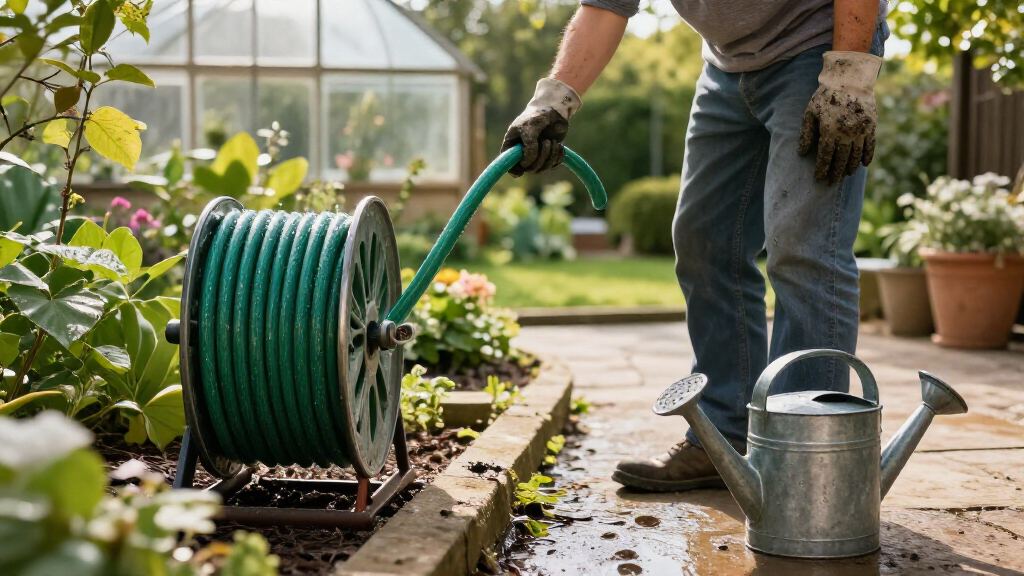
Use this guide to wind a garden hose onto its reel, remove trapped water, and store the reel so the hose stays tidy and ready to use. It is for homeowners and gardeners with a manual or wheeled hose reel. The task is beginner friendly and usually takes 10–20 minutes, depending on hose length and whether you need to move the reel.

Get garden gear delivered free with Prime
- Fast, free delivery on millions of items
- Prime Video, Amazon Music and more included
- Member-only deals all year

Suncast 225 ft Smart Tube Hose Reel Hideaway – Garden Hose Holder, Brown
- ✔ Brand: Suncast
- ✔ Model: SMW200
- ✔ Capacity: 225 ft of 5/8 in vinyl hose

Metal Garden Hose Reel Deck Box – Durable Steel Storage Cabinet with 150 ft 5/8" Capacity, Manual Rewind Hose Guide and No-Leak A…
- ✔ Brand: AQUAZILLA
- ✔ Model: AQ+150FT5/8
- ✔ Material: Galvanized steel with powder coating

Hose Hideaway Durable Resin Hose Reel Storage – 100 ft
- ✔ Installation: Freestanding
- ✔ Capacity: 100 ft
- ✔ Dimensions: 18 x 18 x 18 in
Difficulty: Beginner | Time: 10–20 minutes
What You’ll Need
Tools & Materials:
- Garden hose reel with its handle or winding mechanism
- Dry cloth or towel
- A sheltered storage spot, such as a shed, garage, or covered area
Knowledge:
- Basic use of the hose reel and its water supply connection
Check the reel’s instructions if it has a powered winding mechanism or a model-specific storage position. In freezing weather, drain the hose and reel before storing them; water left inside can freeze and damage fittings or the hose.
Suncast 225 ft Smart Tube Hose Reel Hideaway – Garden Hose Holder, Brown
The Suncast earns the top spot for gardeners who need the most storage capacity in this comparison. Its stated 225-foot capacity for standard 5/8-inch vinyl hose exceeds AQUAZILLA’s 150 feet and the compact Hideaway’s 100 feet. That extra room can help keep a long run of hose tucked away instead of coiled across a lawn or patio.Its Smart Trak guide is the main practical distinction: it guides the hose as we wind it back, helping reduce tangles and uneven piles inside the box. Like the other two, it still relies on manual rewinding, so storing a long hose can take effort. The resin housing is described as weather-resistant and UV-resistant, and its wicker texture gives it a more decorative look than AQUAZILLA’s steel cabinet.The tradeoff is its large footprint. We would choose it for a roomy lawn or patio, not a tight side path where every inch matters. AQUAZILLA offers a more metal-heavy build and aluminum connections, while the 100-foot model takes up less room. The Suncast makes the most sense when hose capacity and guided storage outweigh compactness.
Pros:
- Highest stated capacity in this group at 225 feet of 5/8-inch vinyl hose.
- Smart Trak guides hose during manual winding to help limit kinks and tangles.
- Weather-resistant resin housing is described as resisting UV exposure and fading.
- Freestanding wicker-textured design suits a visible patio or garden setting.
Cons:
- Large footprint may be difficult to place in a compact garden.
- Manual winding can take effort, especially with a long or heavy hose.
Best for: Gardeners with a larger lawn who need storage for a long 5/8-inch vinyl hose and have room for a freestanding box.
Not ideal for: Small patios, narrow paths, or anyone who wants powered retraction or a compact storage unit.
Bottom line: For a large garden where maximum hose storage matters most, the Suncast offers the strongest capacity-and-guidance combination, provided you have room for its box.
“For a large garden where maximum hose storage matters most, the Suncast offers the strongest capacity-and-guidance combination, provided you have room for its box.”
Metal Garden Hose Reel Deck Box – Durable Steel Storage Cabinet with 150 ft 5/8" Capacity, Manual Rewind Hose Guide and No-Leak A…
AQUAZILLA is the option to consider when cabinet material and connections matter more than maximum capacity. Its galvanized steel body has a powder-coated finish, and its aluminum threaded connections are described as resisting leaks and corrosion. Those details set it apart from the resin Suncast, whose advantage is holding 75 more feet of hose rather than offering a metal housing.The 150-foot capacity sits between the Suncast’s 225 feet and the compact Hideaway’s 100 feet, making it a middle-ground choice for a longer hose without moving up to the largest storage box. A manual rewind guide is included to help feed the hose evenly and reduce kinks. The openable lid provides access to the stored hose, while the 5-foot leader hose is included.At 30 pounds and roughly 22.5 by 19.5 by 20.3 inches, this is a substantial unit. That weight may help it feel planted in one spot, but it makes repositioning less convenient than the 15-pound compact model. The crank remains manual, so repeated winding still takes effort. Choose it for the steel-and-aluminum construction; choose Suncast for more capacity or the smaller Hideaway when space is the deciding factor.
Pros:
- Galvanized steel cabinet has a corrosion-resistant powder-coated finish.
- Stores up to 150 feet of 5/8-inch hose, more than the compact option.
- Aluminum threaded connections are specified instead of plastic fittings.
- Manual hose guide and included 5-foot leader support organized storage.
Cons:
- At 30 pounds, it is the heaviest option listed and less convenient to move.
- Manual crank may require effort during frequent rewinding.
- Its capacity is lower than Suncast’s 225-foot maximum.
Best for: Buyers who want a metal hose storage cabinet, aluminum threaded connections, and capacity for up to 150 feet of 5/8-inch hose.
Not ideal for: Anyone who needs the greatest capacity, expects to move the reel frequently, or wants automatic winding.
Bottom line: AQUAZILLA is the middle-capacity pick for buyers who prioritize a steel cabinet and aluminum connections over the Suncast’s greater storage volume.
“AQUAZILLA is the middle-capacity pick for buyers who prioritize a steel cabinet and aluminum connections over the Suncast’s greater storage volume.”
Hose Hideaway Durable Resin Hose Reel Storage – 100 ft
When a smaller storage box is more useful than maximum capacity, the 100-foot Hose Hideaway is the most focused choice here. Its listed dimensions are 18 inches on each side, making it more space-conscious than the larger Suncast and AQUAZILLA cabinets. The stated 100-foot capacity is suited to a shorter hose or a modest garden where a 225-foot reel would be more storage than necessary.This model arrives fully assembled and uses a side crank for manual rewinding. That simplicity may appeal to buyers who want to place the reel and start organizing a hose without putting a unit together. Its black wood-grain finish offers a different look from the Suncast’s brown wicker texture and AQUAZILLA’s dark brown steel cabinet.The compromises are clear: it stores the least hose, and no hose is included. Its description lists resin as the main housing material but also names brass and plastic among material types, so buyers seeking a fully metal construction should look instead at AQUAZILLA. The side crank is still manual, and its 15-pound weight means it is not weightless to reposition. For compact storage with low setup effort, it is the sensible choice; for a long hose, Suncast has far more room.
Pros:
- Compact listed dimensions of 18 x 18 x 18 inches.
- Stores up to 100 feet of standard 5/8-inch hose.
- Arrives fully assembled and freestanding.
- Side crank provides a straightforward manual winding method.
Cons:
- Lowest capacity in this comparison.
- Hose is not included.
- Manual operation still requires winding by hand.
Best for: Gardeners with a shorter hose and limited patio or garden space who want a freestanding reel that arrives assembled.
Not ideal for: Buyers with a long hose, anyone expecting a hose to be included, or those who specifically want a steel cabinet.
Bottom line: For a shorter hose and a tight storage spot, this ready-assembled 100-foot reel is the compact choice, as long as you supply the hose separately.
“For a shorter hose and a tight storage spot, this ready-assembled 100-foot reel is the compact choice, as long as you supply the hose separately.”
As an Amazon Associate we earn from qualifying purchases.
Before You Start
Choose a storage location before winding. A level surface makes a wheeled reel easier to control, while a wall-mounted reel should be secured to a suitable support. Keep the reel away from sharp tools, vehicle traffic, direct heat, and places where the hose could become a trip hazard. If the hose has been used with fertilizer, pesticides, or another treatment, follow that product’s label for rinsing and disposal before storing it.
Turn off the water at the tap before disconnecting the hose. Do not pull a pressurized hose onto the reel; pressure can make the hose harder to handle and may stress the connections.
Step-by-Step Instructions
Step 1: Turn off the water and release pressure
Close the outdoor tap or other water supply. Open the hose nozzle or spray gun and let the remaining pressure escape. If the nozzle has a shutoff setting, open it fully so water can drain freely.
Tip: Keep the hose end pointed away from people, electrical equipment, and areas where a brief flow of water could cause a problem.
Check: Water flow stops, and the hose no longer feels firm from water pressure.
Step 2: Disconnect the hose and drain it
Disconnect the hose from the tap if your reel design allows it. Lift the hose in sections, starting at the tap end and working toward the outlet, to move standing water toward the open end. Let the water run onto a suitable drain or garden area. Keep the hose fittings attached unless the reel’s instructions call for removal.
Tip: Avoid whipping or sharply bending the hose to force water out. Gentle lifting helps prevent kinks and protects the fittings.
Check: The hose is soft and mostly empty, with no steady stream coming from its outlet.
Step 3: Check the hose and reel
Look along the hose as you prepare to wind it. Remove dirt with a damp cloth and check for cracks, bulges, cuts, or damaged connectors. Inspect the reel for loose parts, sharp edges, or anything caught in the winding path. Set aside a hose with a serious leak or damaged fitting for repair or replacement instead of putting it away as if it were ready to use.
Tip: Wipe off mud or plant residue before it dries on the hose. Do not use solvents or cleaners unless the hose maker approves them.
Check: The hose can move freely and the reel has no visible obstruction or sharp contact point.
Step 4: Wind the hose onto the reel
Place a wheeled reel on stable ground and engage its brake or stabilizer if it has one. Feed the hose onto the drum according to the reel design. Turn the handle slowly while guiding the hose from side to side so it forms even layers across the drum. Keep the hose relaxed; do not yank it tight or force it around a kink. Stop if the hose catches, then straighten it before continuing.
Tip: If another person is available, have them guide the hose near the reel while you turn the handle. Keep hands clear of gears, pinch points, and moving parts.
Check: The hose sits in regular layers without crossed loops, sharp bends, or sections hanging near the ground.
Step 5: Secure the hose end
Leave the hose outlet and any attached nozzle in the reel’s holder or storage clip. If the reel has a strap or latch, fasten it gently to stop the loose end from unwinding. Do not tie a tight knot in the hose or crush it beneath a clamp. Keep the tap connector protected from dirt, but leave it accessible for the next setup.
Tip: Follow the reel’s instructions for where the connector should sit. Some models have a dedicated holder that keeps fittings from dragging or striking the drum.
Check: The hose end stays in place when you let go, and the fitting is not pinched or under strain.
Step 6: Move the reel to its storage spot
Roll or carry the reel to the chosen location using its frame or handles. Do not lift it by the hose. Store a portable reel on a level surface where it cannot tip over. For a wall-mounted reel, leave it mounted if it is secure and the location is sheltered. Keep the hose away from direct sunlight when possible, as prolonged ultraviolet exposure can make some hoses brittle.
Tip: For outdoor storage, use a breathable cover designed for the reel if you have one. A cover should not trap water against the hose or block any drainage points.
Check: The reel is stable, the hose is off walkways, and fittings are protected from knocks and debris.
Common Mistakes to Avoid
- Winding the hose while it is still pressurized or full of water. — Turn off the supply, release pressure at the nozzle, and drain the hose before winding.
- Pulling the hose tightly around a kink or winding it in crossed loops. — Pause, straighten the hose, and guide it into even side-to-side layers as you turn the handle.
- Leaving the reel in direct sun or exposed to freezing conditions with water inside. — Drain the hose fully and use a shaded or sheltered storage spot, especially during winter.
- Lifting a wheeled reel by the hose or letting the hose end drag. — Move the reel by its frame or handle and secure the hose end in its holder before storage.
Troubleshooting
Problem: The handle becomes hard to turn while winding.
Solution: Stop turning and check whether the hose is kinked, caught under the reel, or rubbing against the frame. Straighten or reposition it, then wind slowly. If the drum still binds, check the reel instructions for maintenance or a jammed mechanism.
Problem: Water continues to drain from the hose after you have lifted it.
Solution: Raise another section of hose and keep the outlet lower so water can flow out. Repeat along the full length. For winter storage, allow extra time for remaining water to drain before putting the reel away.
Problem: The hose will not fit evenly on the drum.
Solution: Check that the hose length and diameter are within the reel’s stated capacity. Remove crossed sections and distribute each layer across the drum. Do not force excess hose onto the reel; use a larger reel or store the remaining length separately.
Problem: The reel tips or rolls while you wind.
Solution: Move it to level ground, engage its brake or stabilizer if fitted, and keep the hose feed aligned with the drum. If it is still unstable, ask someone to steady the frame or secure the reel according to the manufacturer’s instructions.
What Success Looks Like
The hose is mostly drained and wound in even layers, with no visible kinks or crossed loops. Its outlet is secured in the reel’s holder, the fittings are not pinched, and the reel stands or mounts steadily in a sheltered location. The hose can be unwound without pulling against a trapped section.
Next Steps
Before the next use, check that the reel is stable, reconnect the hose, and turn on the water slowly. Look for leaks at the tap and hose connections. During the season, wipe dirt from the hose and check for damage when you wind it away. Before freezing weather, drain the hose and reel again; store them indoors if the manufacturer recommends it.
Frequently Asked Questions
Should I disconnect the hose from the tap before storing it?
Yes, when the reel design allows it. Turn off the water and release pressure first, then disconnect the hose and drain it. Some reels have a separate leader hose or fixed connection, so follow the model’s instructions.
Can I store a hose reel outside?
Many reels can stay outside, but shelter and shade help limit weather exposure. Check the reel and hose instructions for outdoor storage guidance, and drain the hose before freezing temperatures arrive.
Does every drop of water need to come out?
Remove as much standing water as you can, especially before winter. A small amount may remain in a hose, but pooled water can add weight and may freeze inside the hose or fittings.
How tightly should I wind the hose?
Wind it snugly enough to stay on the drum, but do not pull it taut. A relaxed, even coil is easier to unwind and puts less strain on the hose and connectors.
Fall yard work Picks

EGO POWER+ LB7654 Cordless Leaf Blower with 5.0Ah Battery
As an affiliate, we earn on qualifying purchases.