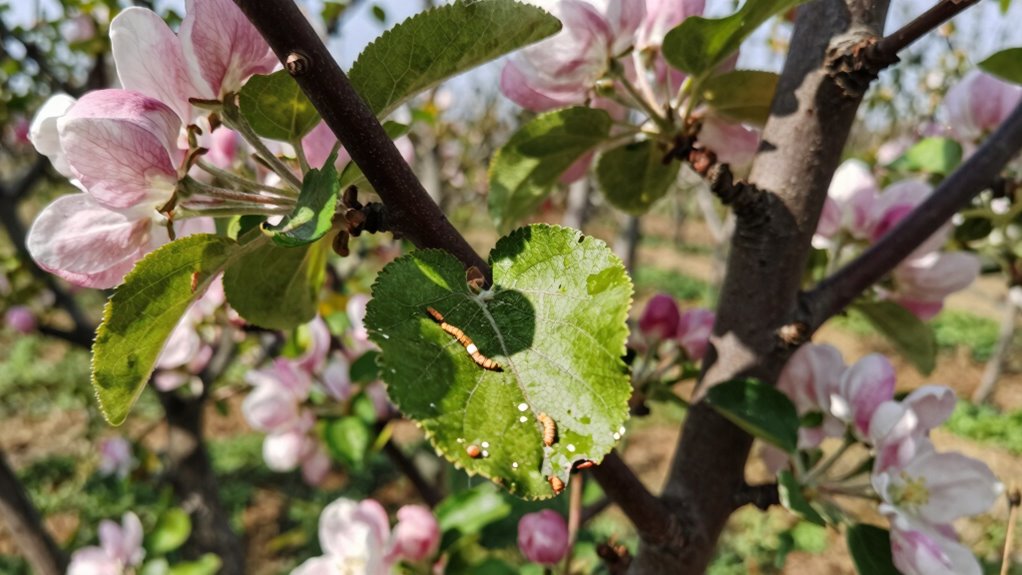

Managing codling moth timing in small orchards feels tough because you lack the extensive monitoring tools big farms use, making it hard to predict when moths will emerge. Environmental factors like temperature, humidity, and microclimates change unpredictably, further complicating schedules. Without precise cues or traps, you often guess when to treat, risking ineffective sprays. If you keep exploring, you’ll discover key strategies to better anticipate these pest patterns and improve your management efforts.

Get garden gear delivered free with Prime
- Fast, free delivery on millions of items
- Prime Video, Amazon Music and more included
- Member-only deals all year
Key Takeaways
- Limited monitoring tools in small orchards make it difficult to track moth activity accurately.
- Environmental variability causes unpredictable moth emergence, complicating timing decisions.
- Lack of consistent, localized cues leads to guesswork in pest management timing.
- Small orchards often miss the optimal window due to insufficient observation of behavioral patterns.
- Variations in microclimates and orchard practices hinder reliable prediction of moth life stages.

Understanding the timing of codling moths is essential for effective pest management in small orchards. The challenge many small orchard owners face is predicting precisely when these pests will become active and when their populations will peak. Unlike larger farms with extensive monitoring systems, small orchards often rely on simpler methods, which can make timing feel unpredictable and frustrating. You need to stay vigilant and adapt your orchard maintenance routines to stay ahead of the moths, but the variability in their life cycle can make this difficult.
Timing is key; small orchards must adapt to unpredictable moth activity for effective pest control.
One of the main reasons determining codling moth timing feels so hard is that their life cycle is influenced by several environmental factors. Temperature, humidity, and even local microclimates can cause fluctuations in when eggs are laid and larvae hatch. As a small orchard owner, you may notice that one year, the moths emerge early, while the next year, they arrive later than expected. This inconsistency complicates pest management efforts because you’re constantly adjusting your strategies without a clear, predictable schedule.
Another factor is that the timing of moth activity isn’t just about when they emerge; it’s also about understanding their behavior patterns. Codling moths tend to lay eggs on fruit or nearby surfaces, but the specific timing of these behaviors can vary based on orchard conditions. Without precise monitoring tools like pheromone traps, it’s easy to miss the critical window for effective treatments. Many small orchard owners find themselves guessing, applying sprays either too early or too late, which diminishes their efficacy and increases the risk of damage.
Your orchard maintenance routine plays a significant role here. Proper pruning, sanitation, and canopy management can help reduce the habitat favorable to moths, but even these practices require timing. If you don’t synchronize your orchard maintenance with the moth’s life cycle, you might inadvertently provide more opportunities for infestation. For example, failing to remove fallen fruit or missed pruning during vulnerable periods can give moths a chance to reproduce, making pest management more challenging. Additionally, understanding the environmental cues that trigger moth activity can help you better plan your interventions. Recognizing temperature fluctuations and other environmental signals can improve your timing and effectiveness of pest control measures. Being aware of microclimate variations within your orchard can also help target your efforts more precisely. In fact, paying attention to local climate patterns can be crucial for predicting and managing moth activity effectively. Moreover, keeping track of seasonal weather trends can further refine your pest control timing, especially in unpredictable years.
As an affiliate, we earn on qualifying purchases.
Frequently Asked Questions
How Does Weather Variability Impact Codling Moth Timing in Small Orchards?
Weather variability impacts codling moth timing in small orchards through climate unpredictability and microclimate effects. Fluctuating temperatures and irregular weather patterns make it difficult to predict moth emergence accurately. Microclimates, created by trees, topography, or nearby structures, can cause local variations in temperature and humidity, further complicating timing. As a result, you might find it challenging to schedule effective control measures, increasing the risk of infestations.
Are There Cost-Effective Methods for Monitoring Moth Development Stages?
Imagine you set a pheromone trap near your orchard’s edge, watching for moth activity. This is a cost-effective method to monitor moth development stages. Proper trap placement guarantees accurate readings, especially during high pest pressure. Regularly checking traps helps you identify peak activity times, allowing timely interventions. This simple, low-cost technique enhances your ability to manage codling moths effectively without expensive equipment, saving you money and reducing fruit damage.
What Are the Best Practices for Timing Insecticide Applications?
You should base your insecticide applications on precise timing, ideally using monitoring tools like pheromone traps or degree-day models. Organic alternatives, such as kaolin clay or botanicals, can be effective if timed correctly. Regularly track moth activity and development stages to guarantee your applications hit the best window, reducing spray frequency and improving efficacy. Accurate timing is key to managing codling moths sustainably in small orchards.
How Do Small Orchard Layouts Influence Moth Movement and Infestation?
Think of your orchard as a puzzle with scattered pieces. Small orchard layouts, with irregular tree spacing and fragmentation, make it easier for moths to move freely, increasing infestation risks. These gaps provide pathways for moths to spread quickly between trees, complicating control efforts. To minimize this, maintain consistent tree spacing and reduce fragmentation, creating a more unified landscape that hampers moth movement and helps manage infestations more effectively.
Can Natural Predators Effectively Control Codling Moth Populations?
Natural predators can effectively control codling moth populations when biological control methods are properly implemented. Predators like Trichogramma wasps target moth eggs, reducing infestations. However, their effectiveness depends on factors like timing, habitat, and predator access. In small orchards, you might see good results with integrated pest management, but relying solely on predators can be risky. Combining biological control with other methods offers the best chance for managing moth populations successfully.
small orchard pest monitoring tools
As an affiliate, we earn on qualifying purchases.
As an affiliate, we earn on qualifying purchases.
Conclusion
Understanding codling moth timing in your small orchard can feel like chasing a shadow—constantly shifting and elusive. But with careful monitoring and timely interventions, you can outmaneuver this tricky pest. Think of it as dance steps—you need to stay in sync with nature’s rhythm. When you tune into these cues, managing the moth becomes less of a game of hide-and-seek and more of a steady, confident stride toward healthy, fruit-filled trees.
fruit tree spray for codling moth
As an affiliate, we earn on qualifying purchases.
As an affiliate, we earn on qualifying purchases.
As an affiliate, we earn on qualifying purchases.
Fall yard work Picks
leaf blowers
As an affiliate, we earn on qualifying purchases.