This guide provides clear instructions for applying garden pest control sprays to protect your plants from common pests. Suitable for home gardeners with basic gardening knowledge, it covers selecting the right spray, preparation, application, and troubleshooting. Following these steps ensures healthy, pest-free plants and minimizes chemical use.

Get garden gear delivered free with Prime
- Fast, free delivery on millions of items
- Prime Video, Amazon Music and more included
- Member-only deals all year

Sevin Insect Killer Spray, Ready-to-Use, 1 Gallon
- ✔ Volume: 1 Gallon
- ✔ Application: Ready-to-use spray
- ✔ Kills: Over 700 pests

Bonide Captain Jack’s Neem Oil, 32 oz Ready-to-Use Spray
- ✔ Volume: 32 oz
- ✔ Application: Ready-to-use spray
- ✔ Use: Fungicide, insecticide, miticide

Garden Safe Insecticidal Soap Insect Killer Spray, 32 Oz
- ✔ Brand: Garden Safe
- ✔ Unit Count: 1 Count
- ✔ UPC: 072845932167
Difficulty: Intermediate | Time: 30-60 minutes
What You’ll Need
Tools & Materials:
- Garden sprayer (handheld or backpack)
- Protective gear (gloves, mask, eye protection)
- Measuring cup or spray bottles
Knowledge:
- Basic understanding of common garden pests
- Ability to identify pests and their damage
- Knowledge of safe chemical handling
Read and follow all label instructions of the pest control spray you choose. Check weather conditions—preferably apply on a calm, dry day to avoid drift and wash-off.
Sevin Insect Killer Spray, Ready-to-Use, 1 Gallon
Sevin Insect Killer Spray makes a compelling choice for gardeners needing quick, on-contact insect control across a wide range of pests. It kills over 700 pests including ants, beetles, and aphids, which makes it versatile for various infestations. Compared with Neem Oil, which has a multi-purpose role, Sevin offers rapid results but requires a waiting period before re-entry, and repeated applications for severe infestations. It’s especially effective early in pest outbreaks, but it’s less suitable for gardeners seeking organic or residual control. Its ready-to-use formula simplifies application, but the need for drying time and potential for pest resurgence are tradeoffs.
Pros:
- Effective against over 700 pests
- Kills insects on contact for quick results
- Safe for plants when used as directed
Cons:
- Requires drying time before re-entry
- May need repeated applications for severe infestations
Best for: Gardeners who need fast, broad-spectrum pest kill with minimal fuss.
Not ideal for: Organic gardeners or those seeking residual, longer-lasting pest control.
Bottom line: Ideal for quick, broad-spectrum pest control when immediate results are a priority.
“Ideal for quick, broad-spectrum pest control when immediate results are a priority.”
Bonide Captain Jack’s Neem Oil, 32 oz Ready-to-Use Spray
Neem Oil offers a natural, multi-functional approach, functioning as an insecticide, fungicide, and miticide. It’s especially appealing to organic gardeners because it’s derived from natural oils and can be used on a variety of plants. Compared to Sevin, Neem Oil requires more frequent reapplications—every 7-14 days—and thorough coverage to maintain effectiveness. While it won’t deliver the instant kill that Sevin provides, its multi-purpose nature means you’re also protecting against fungal diseases, making it a versatile choice. Its organic certification and ease of application make it a popular choice, but the need for repeated use and slower action are tradeoffs.
Pros:
- Multi-purpose protection against pests and fungi
- Suitable for organic gardening
- Convenient trigger spray application
Cons:
- Reapplication needed every 7-14 days
- May require thorough coverage for effectiveness
Best for: Organic gardeners seeking a multi-purpose, natural pest and disease solution.
Not ideal for: Gardeners needing instant pest knockdown or dealing with severe infestations that require quick action.
Bottom line: A versatile, eco-friendly choice ideal for ongoing integrated pest management and disease control.
“A versatile, eco-friendly choice ideal for ongoing integrated pest management and disease control.”
Garden Safe Insecticidal Soap Insect Killer Spray, 32 Oz
Garden Safe Insecticidal Soap is an effective contact spray that excels at knocking down pests like aphids, mites, and whiteflies quickly. Its gentle, soap-based formulation makes it safe for use on edible plants up to the day of harvest and suitable for indoor, outdoor, and greenhouse environments. Compared with Sevin, it’s less aggressive and doesn’t kill pests on contact with the same immediacy, often requiring multiple applications for persistent pests. Its safety profile and ease of use make it ideal for gardeners who want a non-toxic solution but may need patience for full control.
Pros:
- Effective against a wide range of pests including aphids and mites
- Ready-to-use, no mixing required
- Safe for edible plants and indoor use
Cons:
- Pests must be sprayed directly for effectiveness
- May require multiple applications for stubborn infestations
Best for: Gardeners seeking a gentle, immediate contact solution especially for edible or indoor plants.
Not ideal for: Severe infestations requiring rapid eradication or gardeners needing residual pest control.
Bottom line: An excellent choice for gentle, immediate pest control on edible and indoor plants, with the caveat of needing repeated applications for tough pests.
“An excellent choice for gentle, immediate pest control on edible and indoor plants, with the caveat of needing repeated applications for tough pests.”
As an Amazon Associate we earn from qualifying purchases.
Before You Start
Ensure the weather forecast predicts no rain within 24 hours of application. Wear protective gear to prevent skin and eye contact. Prepare your spray area, removing any edible plants or garden produce if necessary. Test the spray on a small section of a plant first to check for adverse reactions.
Step-by-Step Instructions
Step 1: Select an appropriate pest control spray
Identify the pests damaging your plants and choose a spray labeled for those pests. Read the label carefully to confirm compatibility with your plant type and to understand application instructions.
Tip: Use organic options like neem oil or insecticidal soap for safer, eco-friendly control. Chemical pesticides should be reserved for severe infestations and used with caution.
Check: You have a spray that targets your specific pests and is safe for your plants, as confirmed by product label.
Step 2: Gather your tools and protective gear
Assemble your garden sprayer, protective gloves, mask, and eye protection. Fill the sprayer with the prepared solution according to the manufacturer’s instructions.
Tip: Double-check that your sprayer is clean and free of residues from previous chemicals to avoid contamination.
Check: All tools are ready, protective gear is worn, and the spray solution is prepared and loaded into the sprayer.
Step 3: Prepare the spray solution
Mix the pest control solution following the product label’s instructions. Use measuring cups for accurate proportions. Mix outdoors or in a well-ventilated area.
Tip: Avoid over-concentrating the solution; excessive strength can damage plants and harm beneficial insects.
Check: The solution is evenly mixed, with the correct concentration, and ready for application.
Step 4: Test the spray on a small plant area
Spray a small section of a plant to observe for adverse reactions over 24 hours. Wait to confirm no damage or leaf discoloration before proceeding with full application.
Tip: If damage occurs, choose a different product or dilute the solution further.
Check: No negative reactions are observed; plants remain healthy after testing.
Step 5: Apply the spray evenly to affected plants
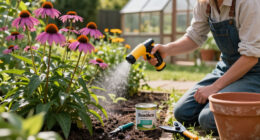
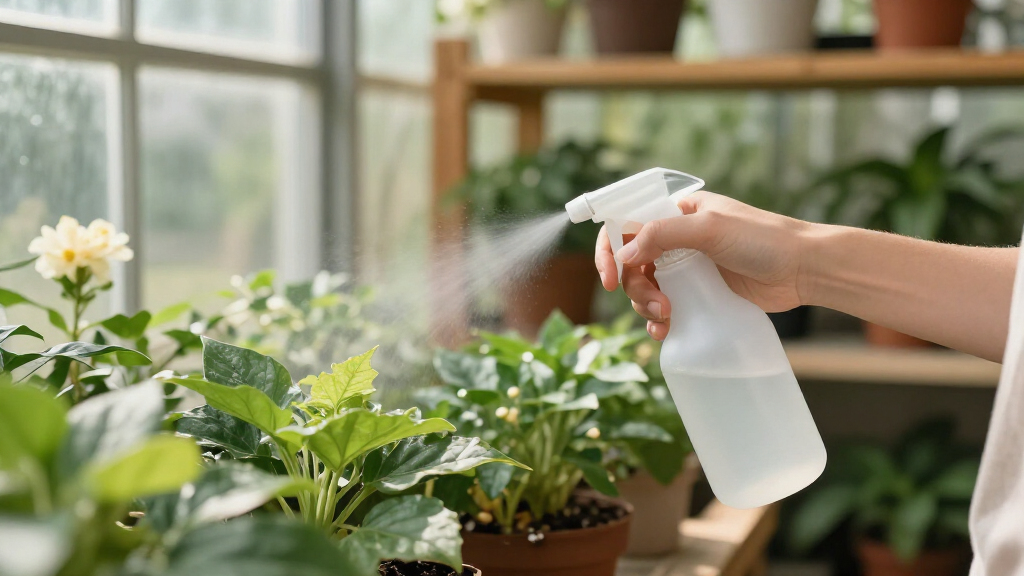
Spray all surfaces of the target plants—including undersides of leaves—until the solution drips slightly. Use broad, sweeping motions to cover all pest-prone areas.
Tip: Avoid spraying during high wind or when bees are active; early morning or late afternoon are ideal times.
Check: All targeted plants are uniformly coated, with no missed areas, and the spray appears wet but not pooling.
Step 6: Repeat application as needed
Follow the product label’s recommended interval for reapplication, typically every 7-14 days, especially after rain or heavy dew.
Tip: Monitor plants regularly for pest activity and signs of damage to determine if additional treatments are necessary.
Check: Pest activity declines and plant health improves after successive applications.
Common Mistakes to Avoid
- Applying spray during windy or rainy conditions — Check weather forecast and only spray on calm, dry days to prevent drift and wash-off.
- Over-concentrating the solution — Follow label instructions precisely; avoid exceeding recommended amounts to prevent plant damage.
- Not testing on a small area first — Always perform a patch test to prevent widespread damage or adverse effects.
- Spraying during peak pollinator activity — Apply early morning or late evening when bees and beneficial insects are less active.
Troubleshooting
Problem: Plants show leaf burn or discoloration after spraying
Solution: Dilute the spray more or switch to a milder, organic solution. Test on a small area before full application.
Problem: Pests remain after treatment
Solution: Ensure thorough coverage, reapply at recommended intervals, and consider combining with manual removal or other control methods.
Problem: Spray drips off leaves without sticking
Solution: Apply during cooler parts of the day, and ensure plants are not wet or overly dry to improve adherence.
Problem: Beneficial insects or pollinators are harmed
Solution: Use targeted, selective sprays and spray early morning or late evening when pollinators are less active.
What Success Looks Like
All targeted plants are evenly coated with the spray, show no signs of pest damage, and no adverse effects like leaf burn occur. Pests decrease within the expected timeframe, and plant health improves.
Next Steps
Continue monitoring your garden regularly for pests. Reapply sprays as recommended, and combine with cultural practices like removing pests manually, encouraging natural predators, and maintaining healthy soil. Store any remaining spray in a labeled container away from children and pets.
Frequently Asked Questions
How often should I spray my garden?
Follow the product label’s recommendation, typically every 7-14 days. Reapply after rain or heavy dew to maintain pest control.
Can I use multiple pest control sprays together?
Only if the products are compatible and labeled for combined use. Check labels and consult a gardening expert if unsure.
Is it safe to spray around edible plants?
Use only approved, food-safe organic sprays on edible plants. Follow label instructions carefully, and wash produce before harvest.
What should I do if pests come back after spraying?
Reassess pest identification, increase treatment frequency if needed, and consider integrating other pest management methods like manual removal or attracting beneficial insects.
Halloween Picks
halloween
As an affiliate, we earn on qualifying purchases.