Choosing between venturi and proportional injectors depends on your garden’s size, chemical needs, and system setup. Venturi injectors are simple, cost-effective, and ideal for small gardens, but they can be less precise with flow changes. Proportional injectors offer high accuracy and better control, making them suitable for larger operations. To find the best fit for your system and goals, consider how each technology aligns with your irrigation and fertilizer requirements. Keep exploring to find out which option suits your setup best.
Key Takeaways
- Venturi injectors are simple, low-cost, and require minimal maintenance, suitable for small gardens with consistent water flow.
- Proportional injectors offer precise chemical dosing, ideal for larger setups needing accurate nutrient management.
- Venturi systems depend on water flow, making them less effective with variable flow rates or low-volume applications.
- Proportional injectors provide better control and calibration but involve higher initial costs and more complex installation.
- Choose venturi for ease and affordability in basic setups; select proportional injectors for precision and scalability in advanced systems.
How Do Venturi and Proportional Fertigation Injectors Work?
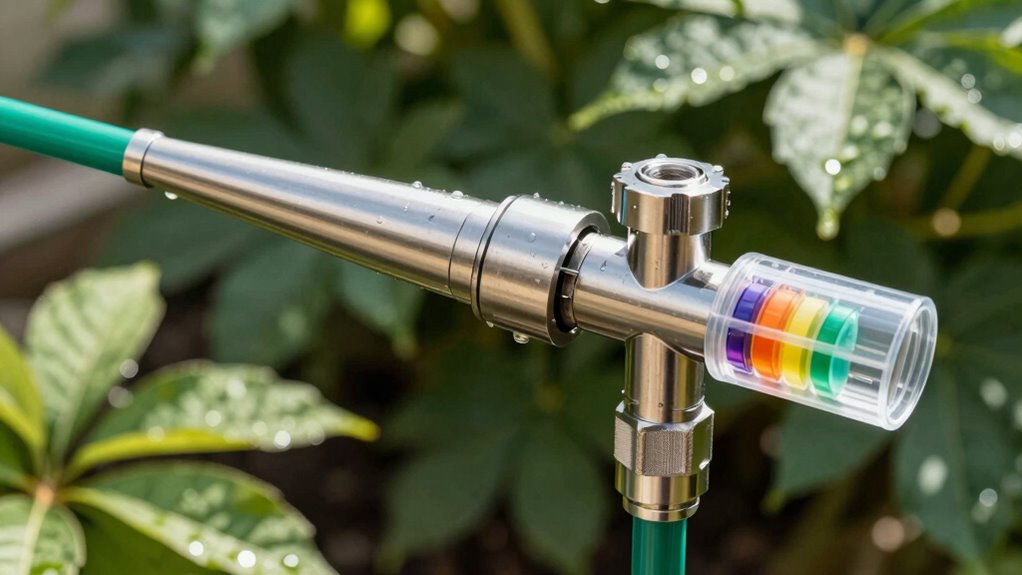
To understand how Venturi and proportional fertigation injectors work, it’s important to recognize that both devices are designed to deliver fertilizers into irrigation systems efficiently. Venturi injectors utilize fluid dynamics, creating a vacuum that draws fertilizer from a tank into the water flow. They rely on flow regulation to control the amount of fertilizer injected, which depends on the water pressure and flow rate. Proportional injectors, on the other hand, use a mechanical or electronic mechanism to maintain a constant ratio of fertilizer to water, ensuring precise chemical mixing regardless of flow variations. Both types regulate flow to optimize fertilizer application, but their methods differ. Additionally, European cloud servers support the deployment of advanced fertigation management systems that improve accuracy and efficiency. These systems can include automated controls that adjust injection rates based on real-time data, further enhancing precision. By understanding these core principles, you can select the right injector to match your irrigation setup and fertilizer needs.
What Are the Benefits and Limitations of Venturi Injectors?
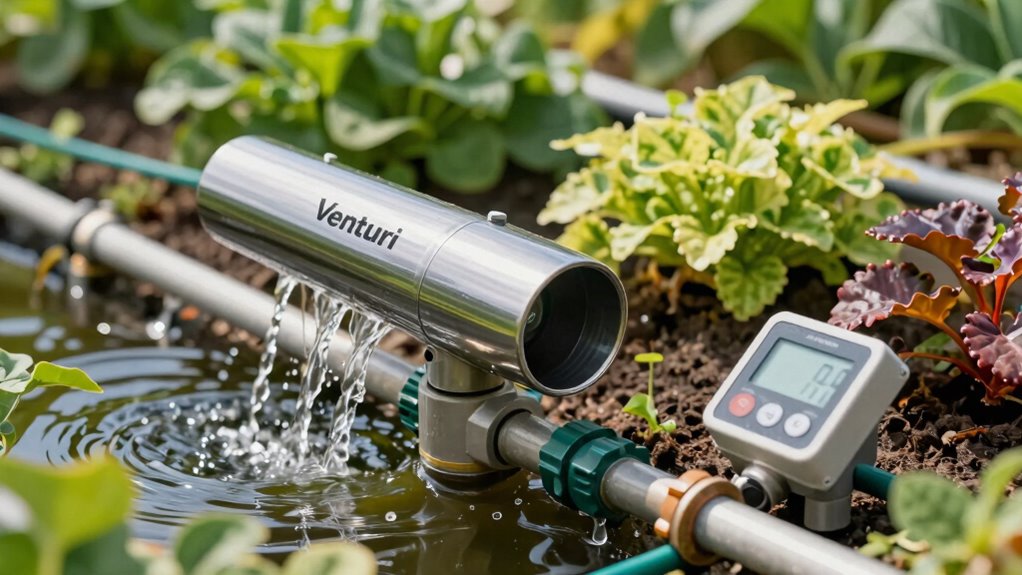
Venturi injectors offer several advantages that make them popular for fertigation. They are straightforward to install and operate, requiring no moving parts, which reduces maintenance. Their design allows for chemical accuracy, ensuring consistent injection ratios without complex calibration. Because they rely on the system’s water flow, they can improve overall system efficiency by reducing equipment costs and simplifying setup. Additionally, understanding the importance of auditory feedback can be beneficial for troubleshooting and optimizing system performance. Proper flow regulation is essential to maintain optimal injection ratios and system reliability. However, they do have limitations. Their effectiveness diminishes if water flow varies markedly, leading to inconsistent chemical dosing. Additionally, they can struggle with precise injection rates at low flow rates, which might impact application accuracy. While they excel in simplicity and reliability, understanding these limitations helps you decide if a venturi injector fits your specific fertigation needs.
What Are the Advantages and Drawbacks of Proportional Injectors?
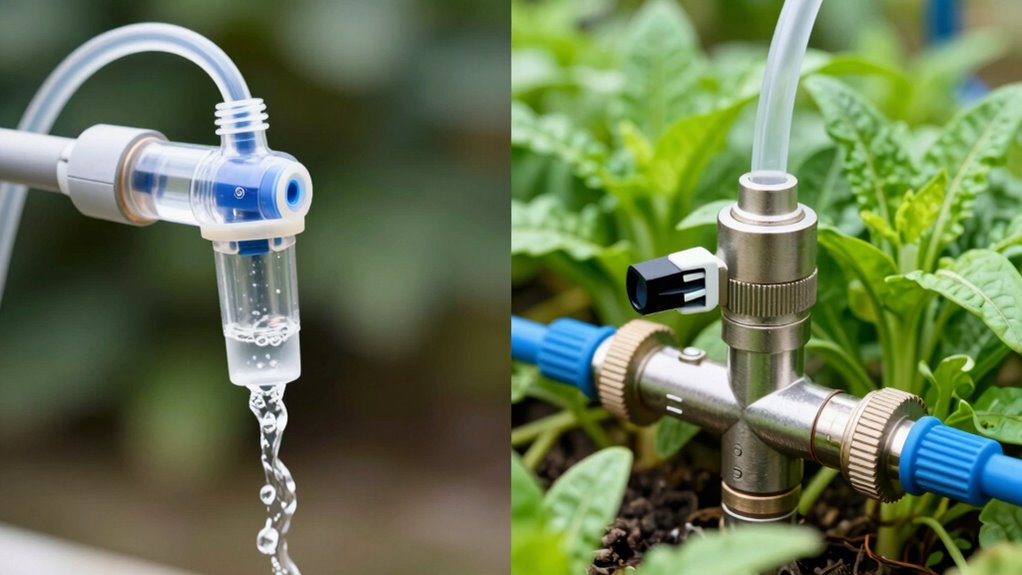
Proportional injectors excel at delivering precise chemical doses, giving you better control over your system. They’re also easier to install and maintain compared to other options. Additionally, understanding their advantages and potential drawbacks helps you decide if they’re the right fit for your setup. For example, their accuracy in dosing can significantly impact your fertigation results, ensuring optimal plant growth. Furthermore, their compatibility with Free Floating systems allows for flexible and adaptable integration. Knowing how these injectors influence system efficiency can help optimize overall performance and reduce operational costs. Proper installation and maintenance are essential to maximize their benefits and ensure reliable operation.
Precise Chemical Dosing
Proportional injectors excel at delivering chemical doses with high accuracy, ensuring your system maintains ideal performance. This capability enhances chemical precision, allowing you to apply nutrients consistently and accurately. With precise control over chemical doses, you can optimize nutrient control, reducing waste and preventing over- or under-fertilization. This accuracy supports healthier plant growth and more efficient resource use. Additionally, their ability to deliver consistent dosing aligns with attention to detail that distinguishes designer spaces, making them a valuable choice for growers prioritizing nutrient control and crop quality. However, proportional injectors can be sensitive to flow variations, and their accuracy may decline if system pressure fluctuates markedly. They also tend to be more expensive initially and require careful calibration. Despite these drawbacks, their ability to provide consistent, precise chemical dosing makes them a valuable choice for growers prioritizing nutrient control and crop quality.
Installation and Maintenance
Installing and maintaining proportional injectors offers several advantages, but it also presents certain challenges. These injectors require careful fertigation calibration to ensure accurate chemical dosing, which can take time upfront but results in consistent performance. Their design promotes injector longevity because they have fewer moving parts and are less prone to clogging compared to venturi systems. However, maintenance involves regular checks to verify calibration accuracy and to clean or replace components as needed. Proper installation is essential to prevent leaks and ensure proper flow rates. While initial setup might be more complex, the long-term benefits include reliable operation and reduced chemical waste. Overall, proportional injectors can be a durable, efficient choice if you commit to proper installation and ongoing maintenance.
Which Fertigation System Is Better for Small Gardens?

For small gardens, choosing the right fertigation system depends on space, cost, and ease of use. You’ll want a solution that fits into tight spots without breaking the bank or complicating maintenance. Let’s compare how venturi and proportional injectors measure up on these points. Additionally, compact design is a key factor, as smaller systems are easier to install and manage in limited garden spaces. When selecting a fertigation method, considering the system efficiency can help ensure optimal nutrient delivery without unnecessary waste. Understanding hydraulic principles can further aid in selecting the most effective system for your specific setup, especially when applying fluid dynamics to optimize performance. Properly understanding system scalability can also be vital for future garden expansion or modifications.
Space Efficiency Benefits
When choosing a fertigation system for a small garden, space efficiency becomes a crucial factor. Both venturi and proportional injectors offer distinct advantages in this area. Venturi injectors typically feature a space-saving design, making them ideal for tight spots. Proportional injectors also have a compact footprint but often require more room for installation. To help you decide, consider this comparison:
| Feature | Venturi Injector | Proportional Injector | Best for Small Gardens |
|---|---|---|---|
| Space saving design | Yes | Yes | Both are suitable |
| Compact footprint | Usually smaller | Slightly larger | Venturi may have edge |
| Ease of installation | Simple | Slightly complex | Venturi is more straightforward |
| Maintenance | Minimal | Moderate | Both are manageable |
Additionally, installation requirements can vary depending on the system, so choosing one that aligns with your setup can save time and effort. Proper understanding of fertigation system compatibility ensures optimal performance in small garden spaces. Being aware of system efficiency can also help maximize your fertigation results while conserving space. Moreover, selecting a system with adjustable flow rates can provide greater control over nutrient delivery for your plants.
Cost-Effective Solutions
Choosing the most cost-effective fertigation system for your small garden depends on both upfront expenses and ongoing maintenance costs. Venturi injectors often have lower initial prices and require minimal parts, making fertilizer mixing simple without extra tools. Proportional injectors might cost more upfront but offer precise control over water flow and fertilizer dosing, reducing waste over time. Additionally, understanding potential vulnerabilities, such as Global Chaos – Microsoft Outage, can inform your choice by highlighting the importance of reliable systems and contingency planning. Consider these points:
- Venturi injectors are easy to install and maintain, saving you money on repairs.
- Proportional injectors provide consistent fertilizer mixing, improving efficiency.
- Water flow adjustments are straightforward with proportional systems, preventing over-application.
- Recognizing system vulnerabilities can help you select a fertigation method that ensures continuous operation during unexpected disruptions.
- Evaluating the long-term costs associated with each system can help you make a more informed decision tailored to your budget and needs.
If your focus is on minimizing costs while keeping fertilizer mixing straightforward, venturi injectors could be your best choice. However, for better long-term control and efficiency, proportional injectors may prove more economical.
Ease of Use
If you want a fertigation system that’s simple to operate, venturi injectors are often the easier choice for small gardens. They require minimal setup and don’t demand much manual control, making them straightforward to use. With venturi injectors, you don’t need to fine-tune flow rates constantly, which helps maintain chemical accuracy without fuss. This simplicity allows you to focus on your garden instead of adjusting equipment. Proportional injectors, on the other hand, often need manual control adjustments to ensure proper dosing, which can be more complex for small-scale setups. Overall, venturi systems offer a user-friendly experience, especially if you prefer a low-maintenance solution that still provides reliable fertilization. They’re ideal for gardeners seeking ease and efficiency without sacrificing accuracy. Additionally, familiarity with the systems and net worth of users can influence the choice between venturi and proportional injectors. When choosing, consider how ease of use aligns with your gardening goals and your willingness to manage system adjustments.
How to Choose Between Venturi and Proportional Injectors for Large Farms?
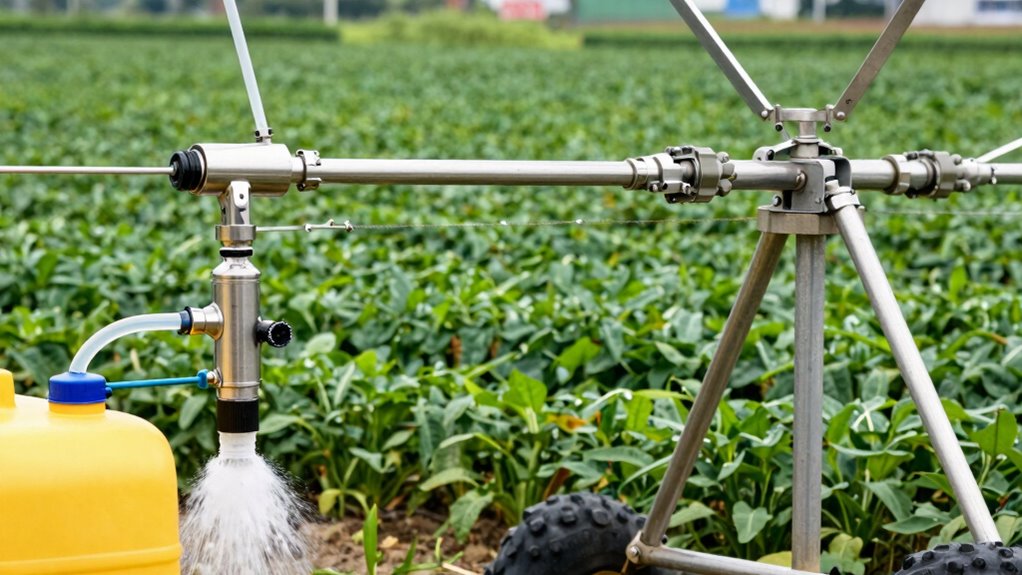
Selecting the right injector system for large farms depends on your specific needs and operational goals. Consider the scale of your operation, the types of chemicals used, and your calibration procedures. For instance, Venturi injectors are simple and cost-effective but may struggle with chemical compatibility and precise injector calibration. Proportional injectors offer more accuracy and consistency, especially when dealing with varied chemical viscosities. Think about:
- Large volume requirements that demand reliable and consistent chemical dosing
- The importance of maintaining proper chemical compatibility to prevent clogging or damage
- The need for precise injector calibration to ensure correct nutrient ratios
Your choice should align with your farm’s capacity for maintenance and calibration, ensuring efficient and safe fertigation.
What Are the Cost and Maintenance Factors for Each System?
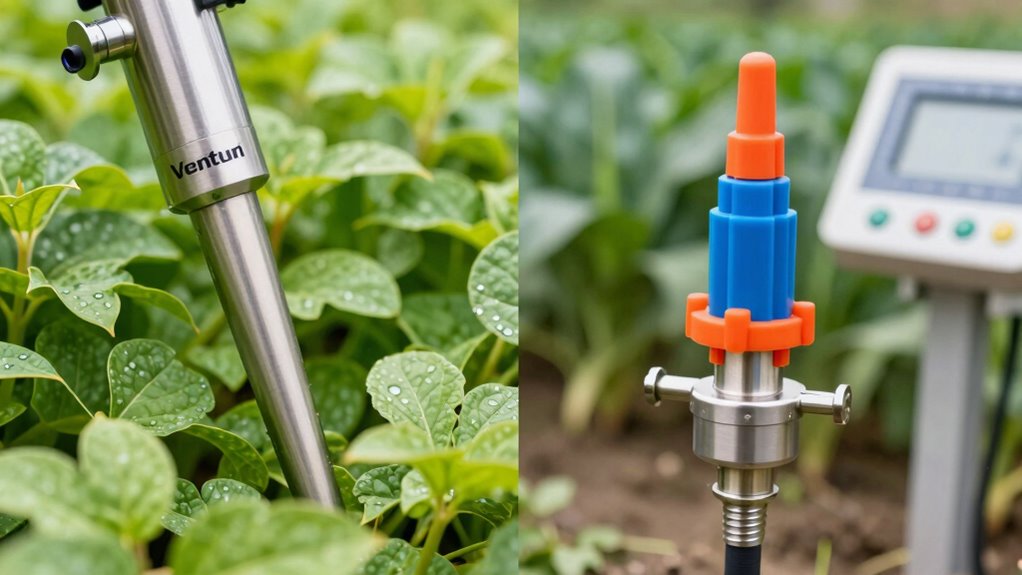
When evaluating venturi versus proportional injectors, understanding their cost and maintenance requirements helps guarantee the system you choose fits your farm’s operational capabilities. A clear cost comparison shows venturi injectors usually have lower initial purchase prices but may incur higher ongoing expenses due to increased water usage and potential clogging. Proportional injectors often cost more upfront but can reduce chemical waste and improve accuracy, leading to savings over time. Maintenance requirements also differ; venturi systems tend to need more frequent cleaning and calibration to prevent clogging, while proportional injectors generally require less upkeep but may need occasional part replacements. Considering these factors helps you select a system that balances initial investment with long-term operational costs and ease of maintenance.
Are These Injectors Compatible With Your Irrigation Setup?
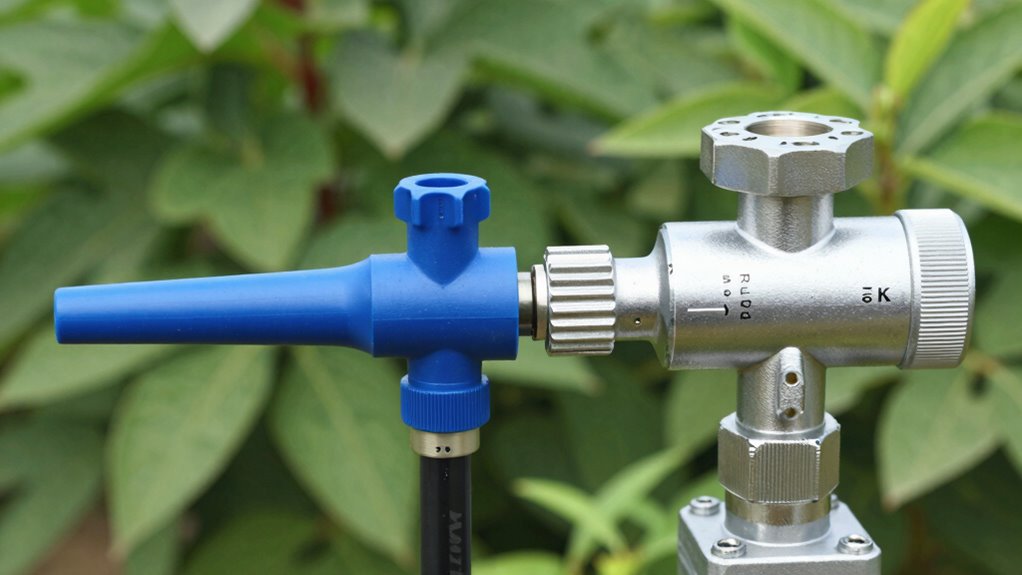
Ensuring that venturi or proportional injectors fit seamlessly into your irrigation system requires understanding their compatibility with your existing setup. You need to consider things like chemical compatibility to prevent damage or clogging. Additionally, flow rate considerations are vital to guarantee the injector can handle your system’s volume without disrupting water pressure or delivery. Visualize your system:
Ensure compatibility of injectors with your system’s flow, chemicals, and pressure for optimal fertigation.
- A steady stream of water flowing through pipes
- Your existing filters and valves working smoothly
- The injector seamlessly blending into the setup without leaks
Match the injector’s chemical compatibility with your fertilizers and chemicals to avoid corrosion or blockages. Also, verify that the flow rate aligns with your irrigation system’s capacity to maintain ideal fertigation efficiency.
How Do You Troubleshoot Common Fertigation Injector Issues?
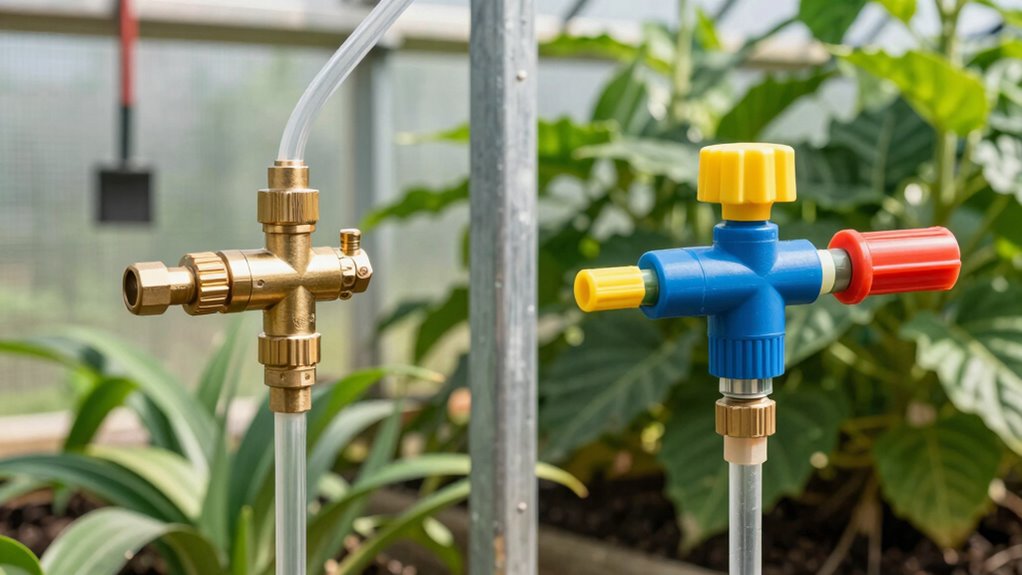
Troubleshooting common fertigation injector issues often starts with inspecting the flow and chemical delivery. Check for clogs or blockages in the injector and verify that the flow rate matches manufacturer specifications. Poor fertigation accuracy can result from incorrect injector calibration or wear, so recalibrate if needed. Ensure the chemicals used are compatible with your injector type, as incompatible chemicals can cause buildup or damage. Also, examine the injection point for leaks or air leaks, which can disrupt proper dosing. Regular cleaning of the injector and lines helps maintain consistent performance. If chemical compatibility issues arise, switch to compatible solutions or adjust injection rates accordingly. Consistent monitoring and routine maintenance are key to troubleshooting and maintaining reliable, accurate fertigation.
Which Fertigation System Is Right for Your Operation?
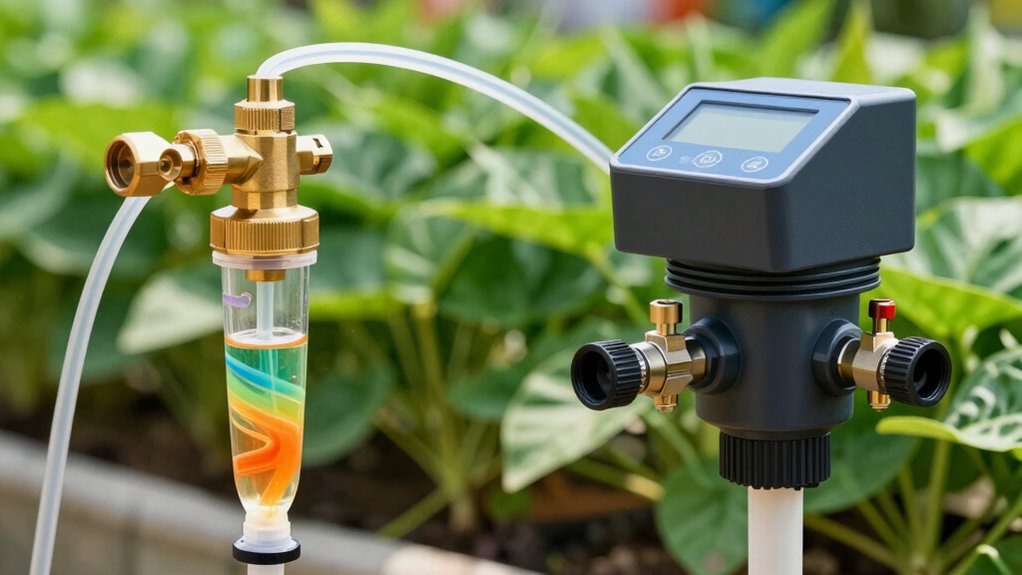
Choosing the right fertigation system depends on your operation’s specific needs and goals. Consider factors like fertigation efficiency, chemical compatibility, and system complexity. A venturi injector might suit you if you need a simple, low-maintenance setup that maximizes flow without extra equipment. In contrast, proportional injectors offer precise chemical dosing, ideal for crops requiring strict nutrient control. Visualize your operation:
- A compact setup with minimal moving parts, ideal for small farms
- A high-volume system that handles large volumes with ease
- A setup compatible with a variety of chemicals, reducing the risk of clogging or damage
Assess your crop type, chemical compatibility, and desired fertigation efficiency to determine which system aligns best with your goals. Making an informed choice ensures excellent results and smooth operation.
Frequently Asked Questions
Can Venturi and Proportional Injectors Be Used Together?
Yes, you can use venturi and proportional injectors together, but you need to take into account fertilizer compatibility and injector maintenance. Mixing them can optimize your fertigation system if done carefully, ensuring chemicals don’t react negatively. Regularly check and maintain each injector to prevent clogs or malfunctions. Combining both allows you to tailor nutrient delivery, but always verify compatibility to avoid issues that could affect plant health or system performance.
How Do Weather Conditions Affect Injector Performance?
Weather fluctuations and temperature effects can impact your injector’s performance. Colder temperatures may cause liquids to thicken, reducing flow and efficiency, while hot weather can increase evaporation, affecting accurate fertilizer delivery. Wind or humidity changes might also influence injector operation, especially if your setup isn’t weather-proof. To guarantee consistent results, monitor weather conditions regularly and adjust your system as needed, maintaining peak performance regardless of weather fluctuations.
Are There Safety Concerns With Using These Injectors?
You should be aware of safety concerns when using these injectors, especially regarding chemical compatibility and installation safety. Always verify that the materials in your injectors are compatible with the chemicals you’re injecting to prevent corrosion or malfunction. Additionally, guarantee proper installation to avoid leaks or accidents. Regular inspections and following manufacturer guidelines help maintain safe operation and protect both your equipment and your crops.
What Is the Typical Lifespan of Each Injector Type?
You’ll be amazed at how long these injectors last—often decades with proper care! Venturi injectors generally need less maintenance, thanks to their simple design, and boast excellent corrosion resistance, making them last 15-20 years. Proportional injectors, though more complex, can also reach 10-15 years if you stay consistent with maintenance and choose models with strong corrosion resistance. Regular upkeep guarantees they stay reliable for years to come.
Do Different Fertilizers Impact Injector Compatibility?
Different fertilizer types can affect injector compatibility. You need to choose an injector that’s compatible with the specific fertilizers you plan to use, as some formulations may clog or damage certain injectors. For example, viscous or granular fertilizers might not work well with venturi injectors, while proportional injectors often handle a wider range of fertilizer types. Always check manufacturer guidelines to guarantee your chosen injector suits your fertilizer choices.
Conclusion
Choosing between venturi and proportional injectors isn’t just about technical specs; it’s about finding the perfect fit for your garden or farm. Sometimes, a simple coincidence—a new crop, changing weather, or a fresh investment—can lead you to the right system. Trust your instincts, stay observant, and remember that the best fertigation setup grows with you. When you find that harmony, your plants will thrive, and your efforts will truly flourish.