The best evergreen plants for winter depend on whether you want reliable foliage, winter berries, flowers, or a compact shape. My best overall pick is the Bird’s Nest Spruce for its dense, low-growing form and year-round structure; Wintergreen Boxwood is a practical choice for a formal look, while Gaultheria brings berries and seasonal color. The main tradeoffs are cold hardiness, mature size, sunlight needs, and how much watering or pruning a plant will need. Flowering gardenias and azaleas offer more seasonal interest but are less broadly suited to cold sites than hardy conifers and shrubs. Read on for the full breakdown and guidance on matching a plant to your winter garden.

Get garden gear delivered free with Prime
- Fast, free delivery on millions of items
- Prime Video, Amazon Music and more included
- Member-only deals all year
Complete the kit


Key Takeaways
- Bird’s Nest Spruce leads for dependable winter structure: its naturally compact shape makes it a more straightforward choice for year-round form than flowering shrubs.
- Boxwood options suit different planting scales: the 3-gallon Wintergreen Boxwood can make a stronger immediate presence, while the 1-gallon plant is easier to place in smaller beds or containers.
- Gaultheria adds winter interest beyond foliage: its berries give it a distinct role, but buyers should check local growing conditions and site needs before choosing it.
- Gardenias and Encore Azalea trade broad cold-site suitability for flowers: they make sense where climate and placement support them, not as automatic substitutes for hardy evergreen structure.
- Compact conifers are not interchangeable: Bird’s Nest Spruce and Dwarf Alberta Spruce differ in shape and eventual footprint, so mature size should guide placement more than nursery-pot size.
| Gaultheria (Winterberry) Live Evergreen Plant, 5 in Tall in a 4.5 in Pot |  | Best for Winter Berry Color | Plant type: Live evergreen ground cover | Height: 5 inches tall; expected height about 8 inches | Pot size: 4.5-inch round pot | VIEW LATEST PRICE | See Our Full Breakdown |
| Bird’s Nest Spruce (Picea abies ‘Nidiformis’), 3-Gallon Pot |  | Best for a Hardy Evergreen Foundation | Plant type: Evergreen shrub | Container: 3-gallon trade pot | Mature size: 2–3 feet tall × 4–5 feet wide | VIEW LATEST PRICE | See Our Full Breakdown |
| Perfect Plants Frostproof Gardenia Live Plant, 1-Gallon Pot |  | Best for Fragrant Seasonal Flowers | Plant type: Gardenia shrub | Pot size: 1 gallon | Mature size: Up to 5 feet tall × 4 feet wide | VIEW LATEST PRICE | See Our Full Breakdown |
| Gaultheria procumbens (Wintergreen) Evergreen Plant, #1 Container |  | Best for Shady Ground Cover | Plant type: Evergreen ground cover | Container: #1 container | Mature size: 3–6 inches tall × 6–12 inches wide | VIEW LATEST PRICE | See Our Full Breakdown |
| Perfect Plants Jubilation Gardenia Live Plant, 1 Gallon |  | Best Compact Gardenia for Long Bloom Season | Plant type: Evergreen shrub | Container: 1 gallon | Mature size: 3–4 feet tall × 3–4 feet wide | VIEW LATEST PRICE | See Our Full Breakdown |
| Green Promise Farms Blue Star Juniper, Evergreen Shrub |  | Best Compact Blue Foliage | Botanical name: Juniperus squamata ‘Blue Star’ | Plant type: Evergreen shrub | Mature height: 2 ft | VIEW LATEST PRICE | See Our Full Breakdown |
| Dwarf Alberta Spruce Shrub, 1 Gallon, Green |  | Best Miniature Conifer Form | Botanical name: Picea glauca ‘Conica’ | Plant type: Evergreen shrub | Container size: 1 gallon | VIEW LATEST PRICE | See Our Full Breakdown |
| Perfect Plants Autumn Bonfire Encore Azalea, 1 Gallon Live Plant |  | Best for Winter Green with Seasonal Blooms | Plant type: Evergreen azalea shrub | Container size: 1 gallon | Flower color: Red | VIEW LATEST PRICE | See Our Full Breakdown |
| Perfect Plants Wintergreen Boxwood Live Shrub, 1 Gallon |  | Best Value for Shaped Hedges | Plant type: Live evergreen shrub | Container size: 1 gallon | Mature height: 3–4 ft | VIEW LATEST PRICE | See Our Full Breakdown |
| Wintergreen Boxwood Live Evergreen Shrub, 3-Gallon |  | Best Established Boxwood for Larger Plantings | Botanical name: Buxus microphylla ‘Wintergreen’ | Plant type: Evergreen shrub | Container size: 3 gallons | VIEW LATEST PRICE | See Our Full Breakdown |
| evergreen plants for winter | Plant type | Mature size | Sunlight |
|---|---|---|---|
| Gaultheria | Live evergreen ground cover | — | Partial sun |
| Bird’s Nest Spruce | Evergreen shrub | 2–3 feet tall × 4–5 feet wide | — |
| Perfect Plants Frostproof Gard | Gardenia shrub | Up to 5 feet tall × 4 feet wide | Full sun or partial shade |
| Gaultheria procumbens | Evergreen ground cover | 3–6 inches tall × 6–12 inches wide | Full shade to partial sun |
| Perfect Plants Jubilation Gard | Evergreen shrub | 3–4 feet tall × 3–4 feet wide | — |
| Green Promise Farms Blue Star | Evergreen shrub | — | — |
| Dwarf Alberta Spruce Shrub | Evergreen shrub | 6–8 ft high × 4–5 ft wide | — |
| Perfect Plants Autumn Bonfire | Evergreen azalea shrub | About 3 ft high × 3 ft wide | 4–6 hours; full sun |
| Perfect Plants Wintergreen Box | Live evergreen shrub | — | — |
| Wintergreen Boxwood Live Everg | Evergreen shrub | 3–4 ft high × 3–5 ft wide | Full sun to partial shade |
More Details on Our Top Picks
Gaultheria (Winterberry) Live Evergreen Plant, 5 in Tall in a 4.5 in Pot
I’d choose this low-growing winterberry when the priority is a splash of color close to the ground: its red berries appear in fall and winter above glossy evergreen leaves. At about 5 inches tall on arrival, it is better suited to a ground-cover edge or a small container than to a shrub-sized focal point. Compared with the Bird’s Nest Spruce, it offers berries rather than a broad, sculptural evergreen form; compared with the similarly named Wintergreen, the listing gives this plant more potential spread, up to 3 feet. That spread can fill space, but calls for room or occasional control. It also needs partial sun and well-drained soil, so it is not a carefree fit for every shady, wet spot.
Pros:- Glossy evergreen foliage supplies year-round ground-level greenery.
- Red berries add seasonal color in fall and winter.
- Can be grown outdoors or in an indoor pot.
- Spreading habit can cover ground over time.
Cons:- Needs well-drained soil and partial sun, limiting placement options.
- Potential spread of up to 3 feet may need space or pruning.
- Its expected height of about 8 inches will not provide substantial vertical structure.
Best for: Gardeners who want low-growing evergreen foliage and red winter berries in a partly shaded bed or container.
Not ideal for: Buyers seeking a tall screen or a plant for waterlogged, deeply shaded ground; this grows low and prefers partial sun with well-drained soil.
- Plant type:Live evergreen ground cover
- Height:5 inches tall; expected height about 8 inches
- Pot size:4.5-inch round pot
- Growth habit:Low and spreading; spreads up to 3 feet
- Winter features:Red berries in fall and winter; shiny evergreen leaves
- Sunlight:Partial sun
- Soil and water:Well-draining soil; moderate watering
- Hardiness:USDA Zones 3–8
- Growing use:Indoor or outdoor
Our verdict“Pick this winterberry for a low, partly shaded planting where red winter berries matter more than height or a formal evergreen shape.”
Bird’s Nest Spruce (Picea abies ‘Nidiformis’), 3-Gallon Pot
For winter structure rather than seasonal berries, I’d put the Bird’s Nest Spruce ahead of the smaller Gaultheria options. This slow-growing spruce arrives in a fully rooted 3-gallon pot and matures into a broad, low mound about 2–3 feet tall and 4–5 feet wide, giving a bed a persistent evergreen outline. Its Zones 3–8 hardiness and tolerance for full sun or partial shade make it a sturdier landscape choice than the Jubilation Gardenia, which is limited to Zones 7–10 and needs regular watering. The tradeoff is patience: slow growth means it will not fill a large area quickly, and the mature spread needs room. Plant it when conditions permit, not during frigid winter weather or drought.
Pros:- Cold hardy in USDA Zones 3–8.
- Fully rooted in a 3-gallon trade pot and ready to plant when weather permits.
- Broad spreading form can anchor a bed or cover ground.
- Tolerates full sun or partial shade and sandy soil.
Cons:- Slow growth makes it a poor choice for fast coverage.
- Mature spread of 4–5 feet requires substantial planting space.
- Should not be planted during frigid winter weather or drought conditions.
Best for: Gardeners in Zones 3–8 who want a cold-hardy, broad evergreen mound for a foundation bed or ground-cover role.
Not ideal for: Small-space gardeners who need a compact plant or buyers who want quick coverage, fragrant flowers, or winter berries.
- Plant type:Evergreen shrub
- Container:3-gallon trade pot
- Mature size:2–3 feet tall × 4–5 feet wide
- Growth habit:Slow-growing and spreading
- Hardiness:USDA Zones 3–8
- Sun exposure:Full sun or partial shade
- Soil:Sandy soil
- Water needs:Moderate
Our verdict“Choose this spruce for durable, cold-hardy winter structure if you can give its slow-growing mound room to spread.”
Perfect Plants Frostproof Gardenia Live Plant, 1-Gallon Pot
I’d rank this Frostproof Gardenia for gardeners who want fragrant spring and summer flowers alongside deep green foliage, not for a winter-berry display. It can reach about 5 feet tall and 4 feet wide, making it a more substantial accent or low hedge than the compact Gaultheria Wintergreen. The tradeoff is a shorter flower season: compared with the Jubilation Gardenia, which is described as blooming in multiple waves from spring through fall, Frostproof is listed for spring and summer blooms. Both add evergreen foliage, but this option’s stated outdoor use and full-sun-to-partial-shade preference make site choice important. It also cannot ship to California or Arizona, a practical limitation that may rule it out before garden planning begins.
Pros:- Fragrant white flowers accompany deep green foliage in spring and summer.
- Mature size suits borders, low hedges, and garden accents.
- Listed as deer resistant.
- Plant food is included.
Cons:- Flowers are listed for spring and summer rather than fall and winter.
- Does not ship to California or Arizona.
- Requires a planting site with full sun or partial shade.
Best for: Outdoor gardeners seeking a fragrant, medium-sized evergreen accent, border shrub, or low hedge with seasonal white flowers.
Not ideal for: Buyers focused on winter berries, year-round flowers, or orders shipping to California or Arizona.
- Plant type:Gardenia shrub
- Pot size:1 gallon
- Mature size:Up to 5 feet tall × 4 feet wide
- Flowers:Fragrant white blooms
- Blooming period:Spring and summer
- Sunlight:Full sun or partial shade
- Use:Outdoor borders, low hedges, or garden accents
- Special features:Deer resistant; plant food included
- Shipping restriction:Does not ship to California or Arizona
Our verdict“Choose Frostproof Gardenia for fragrant seasonal blooms and a larger evergreen presence, but skip it if winter berries or extended flowering are your main goals.”
Gaultheria procumbens (Wintergreen) Evergreen Plant, #1 Container
This compact wintergreen makes the most sense when a shady bed needs low evergreen coverage with berries close to the ground. It grows just 3–6 inches tall and 6–12 inches wide, so it is better for small spaces and planting edges than the Bird’s Nest Spruce, whose 4–5-foot spread creates a much larger mound. Unlike the 5-inch-pot Gaultheria, this listing specifies a #1 container and says the plant arrives fully rooted. Its ability to grow from full shade to partial sun also gives it a broader shade range than that winterberry listing. The berries are described as edible, but the plant remains a very small ground cover; buyers seeking height, rapid visual impact, or a broad evergreen mass should choose a larger shrub.
Pros:- Evergreen ground-cover foliage provides year-round low greenery.
- Persistent red berries add winter color and are described as edible.
- Grows in full shade to partial sun.
- Arrives fully rooted in a #1 container.
Cons:- Small mature size limits its impact as a standalone feature.
- Best suited to USDA Zones 3–8.
- Moderate watering is still required.
Best for: Gardeners with a small, shady bed who want low evergreen foliage and persistent red berries in Zones 3–8.
Not ideal for: Buyers who need a tall focal point or broad, fast coverage; its listed mature size is only 3–6 inches tall and 6–12 inches wide.
- Plant type:Evergreen ground cover
- Container:#1 container
- Mature size:3–6 inches tall × 6–12 inches wide
- Sunlight:Full shade to partial sun
- Hardiness:USDA Zones 3–8
- Soil:Loam
- Water needs:Moderate
- Flowers and fruit:White flowers; persistent red berries
Our verdict“Choose this wintergreen for a rooted, shade-tolerant ground cover with red berries, not for height or a large-scale planting on its own.”
Perfect Plants Jubilation Gardenia Live Plant, 1 Gallon
Among these five, the Jubilation Gardenia is the strongest fit for a compact evergreen shrub that adds fragrant flowers well beyond spring. Its stated bloom period runs from spring through fall in multiple waves, while the Frostproof Gardenia is listed for spring and summer flowering. At about 3–4 feet tall and wide, Jubilation is also smaller than Frostproof at maturity, making it easier to place in a border or smaller garden. Its glossy foliage provides year-round structure, but this is not the cold-range choice: it suits USDA Zones 7–10, unlike the Zone 3–8 wintergreen and spruce picks. Regular watering and well-drained acidic soil are part of the bargain, and shipping is unavailable to California and Arizona.
Pros:- Fragrant white flowers appear in multiple waves from spring through fall.
- Glossy dark green foliage provides year-round structure.
- Compact 3–4-foot size suits borders and smaller gardens.
- Listed as deer resistant and disease resistant, and attracts pollinators.
Cons:- Hardiness is limited to USDA Zones 7–10.
- Needs regular watering and well-drained acidic soil.
- Cannot ship to California or Arizona.
Best for: Gardeners in Zones 7–10 who want a compact evergreen shrub with fragrant flowers recurring from spring through fall.
Not ideal for: Cold-climate gardeners outside Zones 7–10 or buyers who cannot provide regular watering and well-drained acidic soil.
- Plant type:Evergreen shrub
- Container:1 gallon
- Mature size:3–4 feet tall × 3–4 feet wide
- Flowers:Fragrant white blooms
- Blooming period:Spring through fall, in multiple waves
- Hardiness:USDA Zones 7–10
- Sun exposure:Full to partial sun
- Soil and water:Well-drained acidic soil; regular watering
- Special features:Attracts pollinators; deer resistant; disease resistant
Our verdict“Pick Jubilation Gardenia for a compact, fragrant evergreen in a warm climate, but choose a hardier option if winter cold is your main challenge.”
Green Promise Farms Blue Star Juniper, Evergreen Shrub
For winter structure in a small bed or container, this Blue Star juniper offers a different look from the roundup’s green conifers and broadleaf shrubs. Its dense blue-green foliage and low, rounded form stay compact, reaching about 2 feet tall and 3–4 feet wide. Compared with the Dwarf Alberta Spruce, it grows wider and lower rather than forming a miniature cone, so it suits edging and rock gardens better than a Christmas-tree shape. It arrives rooted and includes care instructions, a useful start for buyers new to this shrub. The tradeoff is its very slow growth: it will not fill a space quickly, and it needs full sun. Check the shipping exclusions before ordering, since several western states are not served.
Pros:- Dense blue-green foliage adds color contrast to winter plantings.
- Low, rounded habit fits edging and compact landscape spaces.
- Arrives rooted and ready to plant.
- Care instructions are included.
Cons:- Very slow growth makes it a poor choice for rapid screening or filling a large area.
- Needs full sun to grow well.
- Shipping is unavailable to several states.
Best for: Gardeners in USDA Zones 4–8 who want a low, slow-growing evergreen with blue-toned foliage for a sunny border, rock garden, or outdoor container.
Not ideal for: Buyers who need quick coverage, have a shaded planting site, or live in a state excluded from shipping.
- Botanical name:Juniperus squamata ‘Blue Star’
- Plant type:Evergreen shrub
- Mature height:2 ft
- Mature spread:3–4 ft
- Foliage color:Blue-green
- Growth habit:Low and rounded
- Sun exposure:Full sun
- USDA hardiness zones:4–8
- Shipping restrictions:Does not ship to AZ, CA, HI, ID, MT, NV, OR, PR, UT, or WA
Our verdict“Choose this juniper for a sunny, compact planting where blue-green winter color matters more than fast growth.”
Dwarf Alberta Spruce Shrub, 1 Gallon, Green
The naturally tapered shape gives this Dwarf Alberta Spruce a clear role: it brings a miniature-tree silhouette to a winter container, entryway, or landscape accent. Its soft, dense green needles offer a more classic conifer look than the low, blue-toned Blue Star juniper, and its USDA Zones 2–8 hardiness spans colder regions than many broadleaf choices here. It can grow in a container or in the ground, but its eventual size—up to 6–8 feet tall and 4–5 feet wide—makes it a long-term space commitment, not a permanently tiny patio plant. Full sun to partial shade gives it some siting flexibility, though it still needs moderate watering and suitable planting care. Skip it if you want a ground-hugging shrub or minimal maintenance.
Pros:- Naturally cone-shaped form creates a defined winter focal point.
- Dense, soft green needles provide year-round evergreen texture.
- Can be grown in a container or planted in the landscape.
- Hardy across USDA Zones 2–8.
Cons:- Mature size can reach 6–8 feet tall and 4–5 feet wide.
- Needs moderate watering and careful site selection.
- Does not produce blossoms for seasonal flower color.
Best for: Gardeners in USDA Zones 2–8 seeking a cone-shaped evergreen for a focal point, outdoor container, or miniature Christmas-tree effect.
Not ideal for: Small-space gardeners who need a permanently compact shrub or buyers unable to provide regular watering and a suitable sunny to partly shaded site.
- Botanical name:Picea glauca ‘Conica’
- Plant type:Evergreen shrub
- Container size:1 gallon
- Mature size:6–8 ft high × 4–5 ft wide
- USDA hardiness zones:2–8
- Sun exposure:Full sun to partial shade
- Water needs:Moderate
- Color:Green
- Expected blossoms:None
Our verdict“Pick this spruce for a classic, upright conifer shape if you have room for it to grow beyond container size.”
Perfect Plants Autumn Bonfire Encore Azalea, 1 Gallon Live Plant
This azalea earns its place for buyers who want year-round foliage plus a long stretch of red flowers in the warmer seasons. The compact shrub grows to about 3 feet tall and wide, making it easier to fit into a mixed border than the broader Wintergreen Boxwood. Its spring-to-fall blooms attract pollinators and add color that foliage-only picks such as the Blue Star juniper do not provide. The winter case is the evergreen leaves, not winter flowering, so choose it for a green foundation that changes character through the year. In return for that seasonal display, it asks for moist, well-drained, slightly acidic soil and regular watering. It is best suited to Zones 6–10 and cannot ship to California or Arizona.
Pros:- Evergreen foliage provides year-round structure.
- Red blooms can appear from spring through fall.
- Compact 3-foot form suits accents and mass planting.
- Listed as drought-tolerant, pest resistant, and attractive to pollinators.
Cons:- Needs moist, well-drained, slightly acidic soil and regular watering.
- Hardiness is limited to USDA Zones 6–10.
- Unavailable for delivery to California and Arizona.
Best for: Gardeners in USDA Zones 6–10 who want a compact evergreen shrub with red spring-to-fall blooms and can provide acidic soil and regular water.
Not ideal for: Buyers in colder zones, gardeners seeking a low-water plant, or residents of California and Arizona.
- Plant type:Evergreen azalea shrub
- Container size:1 gallon
- Flower color:Red
- Bloom period:Spring to fall
- Mature size:About 3 ft high × 3 ft wide
- USDA hardiness zones:6–10
- Sunlight:4–6 hours; full sun
- Soil:Moist, well-drained, slightly acidic loam
- Watering:Regular watering
Our verdict“Choose this azalea if you want winter greenery with a substantial warm-season flower display and can meet its soil and watering needs.”
Perfect Plants Wintergreen Boxwood Live Shrub, 1 Gallon
For a traditional clipped hedge or border, this Wintergreen Boxwood supplies dense, dark green foliage that holds its presence through cold winters. Unlike the naturally conical Dwarf Alberta Spruce, boxwood can be pruned into a tailored edge, formal hedge, or topiary, giving it more flexibility in designed beds. It also produces creamy white spring flowers, though its main appeal is dependable foliage rather than a showy bloom season like the Autumn Bonfire Encore Azalea. This 1-gallon option includes plant food and a care guide, which can help with initial planting. Its mature width of 4–5 feet calls for more room than the azalea’s compact 3-foot spread, and the listing specifies full sun and sandy soil. Shipping excludes California and Arizona.
Pros:- Dense dark green foliage stays present through cold winters.
- Prunes well for hedges, borders, and topiary.
- Produces creamy white flowers in spring.
- Includes plant food and a care guide.
Cons:- Mature width of 4–5 feet requires generous spacing.
- Listed for full sun and sandy soil, limiting site flexibility.
- Does not ship to California or Arizona.
Best for: Gardeners who want a pruneable evergreen for a hedge, border, or topiary and have space for a shrub that may spread 4–5 feet.
Not ideal for: Buyers with narrow planting strips, those seeking showy winter flowers, or residents of California and Arizona.
- Plant type:Live evergreen shrub
- Container size:1 gallon
- Mature height:3–4 ft
- Mature width:4–5 ft
- Bloom season:Spring
- Flower color:Creamy white
- Sunlight exposure:Full sun
- Soil type:Sandy soil
- Shipping restrictions:Does not ship to California or Arizona
Our verdict“Choose this 1-gallon boxwood for a shaped evergreen border when you have the space and a suitable sunny site.”
Wintergreen Boxwood Live Evergreen Shrub, 3-Gallon
Among these five picks, this 3-gallon Wintergreen Boxwood is the choice for buyers who want a larger nursery-grown plant for a hedge, edging, or foundation planting. It shares the same useful pruning flexibility as the 1-gallon Wintergreen Boxwood, but its larger container makes it better suited to a planting plan that calls for a more substantial starting plant. The compact form and evergreen leaves provide steady winter structure, while the recommended Zones 5–8 and full sun to partial shade offer broader siting options than the full-sun 1-gallon listing. The tradeoffs are practical: it needs regular watering, has no blossoms, and its stated 3–5-foot width still requires spacing. Its shipping exclusions are extensive, so confirm your state is eligible before selecting it.
Pros:- 3-gallon container suits buyers planning a more substantial starting plant.
- Evergreen leaves provide year-round structure.
- Compact growth and pruning response suit hedges, edging, and foundation plantings.
- Tolerates full sun to partial shade.
Cons:- Requires regular watering, especially while establishing.
- No blossoms are expected.
- Shipping excludes numerous states.
Best for: Gardeners in eligible locations within USDA Zones 5–8 who want a larger-starting boxwood for a hedge, edging, border, or foundation planting.
Not ideal for: Buyers seeking flowers, low-watering upkeep, or delivery to one of the many excluded states.
- Botanical name:Buxus microphylla ‘Wintergreen’
- Plant type:Evergreen shrub
- Container size:3 gallons
- USDA hardiness zones:5–8
- Sunlight:Full sun to partial shade
- Soil:Moist, well-drained
- Mature size:3–4 ft high × 3–5 ft wide
- Watering:Regular watering
- Shipping restrictions:Cannot ship to AK, AZ, CA, CO, HI, ID, MT, NM, NV, OR, UT, WA, or WY
Our verdict“Choose this larger-container boxwood for a shaped planting in Zones 5–8 if regular watering and shipping eligibility work for your garden.”
How We Picked
I ranked these plants by how well they meet the winter-focused goal: keeping useful structure or foliage through the cold season, while offering a realistic fit for home gardens. I weighed the type of winter interest—evergreen form, berries, or flowers—alongside container size, likely placement, care demands, and the need to match each plant to suitable local conditions. A plant’s name or small shipping pot does not establish its hardiness in every region, so climate fit and mature dimensions matter in the comparison.
The order favors options with a clear, practical role for winter landscapes and comparatively broad utility, then distinguishes plants that serve narrower needs such as berries, flowers, or compact specimen planting. The Bird’s Nest Spruce ranks first for dependable structure; boxwood and junipers follow for versatile foliage and shape. Flowering selections rank lower because their winter performance depends more heavily on climate and site, while the two Gaultheria entries stand out for seasonal berries rather than broad screening or formal structure.
| evergreen plants for winter | Plant type |
|---|---|
| Gaultheria | Live evergreen ground cover |
| Bird’s Nest Spruce | Evergreen shrub |
| Perfect Plants Frostproof Gard | Gardenia shrub |
| Gaultheria procumbens | Evergreen ground cover |
| Perfect Plants Jubilation Gard | Evergreen shrub |
| Green Promise Farms Blue Star | Evergreen shrub |
| Dwarf Alberta Spruce Shrub | Evergreen shrub |
| Perfect Plants Autumn Bonfire | Evergreen azalea shrub |
| Perfect Plants Wintergreen Box | Live evergreen shrub |
| Wintergreen Boxwood Live Everg | Evergreen shrub |
Factors to Consider When Choosing Best Evergreen Plants For Winter
Before choosing from this list, decide what you want the garden to look like in its least colorful season. A plant that holds a neat silhouette may be more useful than one with flowers that appear only during a limited window. These broader checks can help prevent a winter-interest purchase from becoming a poor fit for your site.
Match hardiness to your actual winter conditions
Plant labels can describe a species without accounting for the exposure in your yard, and local winter conditions can vary sharply across a small area. Check the plant’s hardiness guidance against your region, then factor in wind, reflected heat, drainage, and snow cover at the planting spot. A sheltered courtyard may support a choice that struggles in an open, cold bed. Avoid choosing a flowering evergreen solely for its blooms if the site is too cold or exposed for reliable growth. When climate fit is uncertain, ask a local nursery or extension service before planting.
Plan for mature width, not the pot it arrives in
A one-gallon plant may look small at purchase, but its eventual spread determines whether it crowds a path, window, or neighboring shrub. Look up mature height and width for the specific cultivar, and leave room for airflow and maintenance access. Closely spaced shrubs can compete for water and light, then require repeated pruning that changes their natural shape. Compact conifers still need enough space to keep their intended form. If you need an instant screen, a larger container may save time, but it does not remove the need to plan for full-grown dimensions.
Choose the kind of winter interest you will notice
Evergreen foliage, berries, and flowers solve different design problems. Dense conifers and boxwood keep visible structure when nearby perennials disappear, while berrying plants add color and can draw attention to a smaller area. Flowering shrubs may provide a striking seasonal display, but bloom timing and reliability depend on climate and conditions. Mixing types can make a garden feel less repetitive, though too many competing focal points can weaken the overall layout. For a simple plan, use one structural plant as an anchor and add seasonal color where it will be visible.
Check light, soil, and drainage before ordering
Winter survival is not only about low temperatures; a plant can struggle if its basic growing conditions are wrong. Record how much direct sun the site gets, whether water drains after rain, and whether nearby paving makes the soil unusually dry or warm. Compare those conditions with the plant’s growing requirements rather than assuming all evergreens prefer the same setting. Poor drainage can be especially damaging to roots, while shade can reduce vigor in plants that need brighter conditions. Correcting the site or selecting a better-matched plant is often easier than trying to compensate after planting.
Account for watering and winter exposure
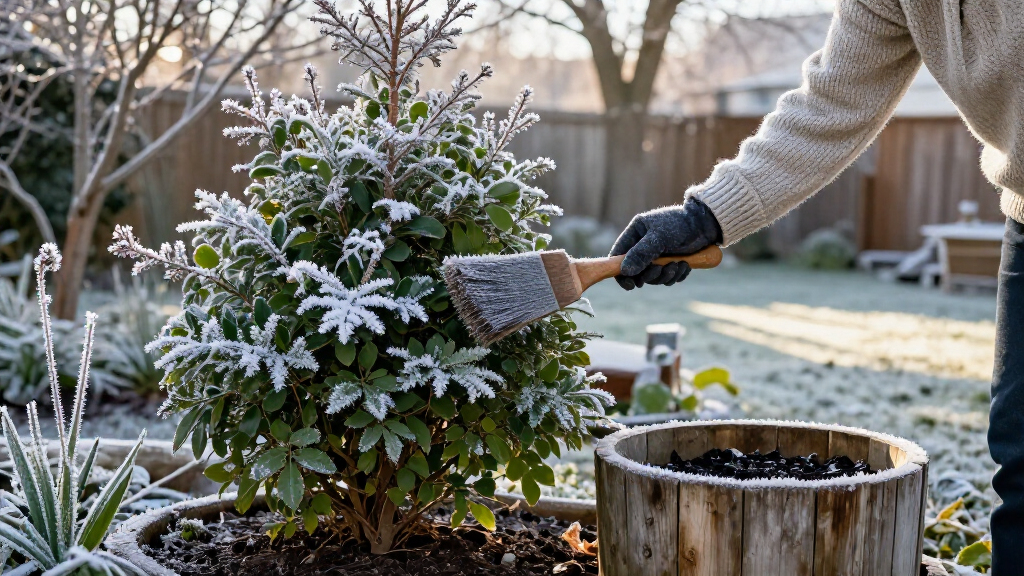
Evergreen leaves continue to lose moisture, so newly planted shrubs may need attention even when growth has slowed. Water thoroughly after planting and monitor soil moisture during dry spells, especially before the ground freezes. Wind and winter sun can increase moisture loss, while waterlogged soil creates a different risk. Mulch can help moderate soil temperature, but it should not be piled against stems or trunks. Buyers who want low-maintenance planting should still plan for establishment care during the first seasons.
Decide when a larger plant is worth choosing
A larger container can provide more immediate presence and may suit a focal point where a small plant would look lost. It also tends to take up more space during delivery and can be heavier to handle and plant. A smaller plant is easier to position and may establish well when given proper care, but it takes longer to fill a bed. Compare the plant’s current size with its mature form rather than treating container volume as a guarantee of garden impact. Pay more for size when immediate coverage matters; choose smaller stock when patience, placement flexibility, or several planting points matter more.
Frequently Asked Questions
Which of these plants is the safest choice for a winter garden in a cold region?
There is no single safest choice without knowing your local hardiness conditions and the planting site. The Bird’s Nest Spruce and Dwarf Alberta Spruce are the clearest structural conifer options in this group, but buyers should still confirm cultivar hardiness and exposure suitability locally. Gardenias and Encore Azalea are more dependent on climate and placement, so they are less reliable as default choices for a severe-winter site. Check local guidance and avoid planting in exposed, poorly drained ground simply because a listing uses the word “wintergreen.”
Should I choose the 1-gallon or 3-gallon Wintergreen Boxwood?
Choose the 3-gallon plant if you want a more substantial starting point for a focal spot or a developing hedge. The 1-gallon option is easier to position in a smaller bed and can be a sensible choice when you are planting several shrubs or have time to wait for growth. Neither container size tells you the plant’s eventual dimensions, so compare mature width and height before setting spacing. Also check that the planting location suits boxwood and offers adequate drainage.
Are the two Gaultheria plants better for berries or year-round screening?
These Gaultheria selections are better considered for compact seasonal interest, including berries, than for screening a boundary. Their smaller presentation and distinct berry appeal give them a different role from the larger-form shrubs and conifers in this roundup. If you need a visual barrier, choose a plant based on its mature height and density rather than berry display. Confirm the growing requirements for the exact listing, since product names and container formats do not replace local planting guidance.
Can I grow gardenia outdoors through winter?
That depends on your climate, the specific gardenia, and the protection offered by the planting site. The Frostproof and Jubilation Gardenia listings indicate different selections, but their names alone should not be treated as a promise that either will tolerate every winter. Check the seller’s hardiness information against local extension or nursery advice before planting outdoors. In colder areas, a protected location or container that can be moved may be more suitable, though container growing adds watering and winter-protection tasks.
Which plant should I choose if I want winter color rather than just green foliage?
Gaultheria is the most direct choice in this group for berry color, while the Autumn Bonfire Encore Azalea and gardenias offer flowers when conditions and bloom timing cooperate. Berries and flowers are seasonal effects, so they will not provide the same consistent structure as a spruce or boxwood. Think about when you want color to appear and whether it will be visible from the house or a walkway. For a balanced planting, pair one colorful selection with a dependable evergreen form rather than expecting a single plant to provide every kind of winter interest.
Conclusion
For a dependable anchor, I recommend the Bird’s Nest Spruce as best overall; its compact structure gives it a clear winter role without relying on flowers or berries. The 1-gallon Wintergreen Boxwood is my best value-style choice for buyers who can wait for a smaller shrub to fill out, while the 3-gallon Boxwood is the stronger premium pick when a larger starting plant matters. Beginners should favor a site-matched, structurally simple option such as the Bird’s Nest Spruce, after checking local hardiness and drainage. Choose Gaultheria for berry interest, or consider the gardenias and Encore Azalea only when your climate and site support flowering shrubs. Match mature size and growing conditions first, then choose the winter feature you most want to see.