The best lawn mower blade sharpeners balance a consistent cutting edge with enough control to avoid removing too much metal. My best overall pick is the Oregon Economy Lawn Mower Blade Sharpener and Grinder for its adjustable grinding setup, while the VEVOR 1 HP sharpener stands out for buyers who want a more powerful benchtop option with a balancer. For occasional touch-ups, the Cenoz drill-mounted five-pack offers a simpler alternative to dedicated machines. The main tradeoff is between low-cost, portable tools that depend more on hand control and powered sharpeners that take up space but can make repeat work easier. Read on for the full breakdown, buying advice, and recommendations by user type.

Get garden gear delivered free with Prime
- Fast, free delivery on millions of items
- Prime Video, Amazon Music and more included
- Member-only deals all year
Complete the kit


Key Takeaways
- Adjustability is a key separator: Dedicated grinders such as the Oregon and VEVOR models are better suited to repeatable sharpening than handheld tools, provided they can be set to match the blade’s bevel.
- Motor power alone does not determine fit: A 1 HP machine can make sense for frequent sharpening, but occasional homeowners may get more practical value from a drill attachment or compact sharpener.
- Balancing belongs in the decision: Options packaged with a blade balancer make it easier to check for uneven material removal; a sharp edge is not the only part of the job.
- Portable tools trade precision for convenience: Drill-mounted, handheld, and cordless picks are easier to store, but they leave more responsibility for maintaining a consistent angle and even sharpening.
- Replacement abrasives and workflow matter: Discs, grinding wheels, guards, and included accessories affect upkeep and usability, so buyers should check consumable compatibility before choosing a machine.
| Cenoz Lawn Mower Blade Sharpeners for Power Drills, 5-Pack |  | Best Budget-Friendly Drill Attachment Set | Material: Corundum | Compatibility: Most power drills | Uses: Lawn mower blades, lawn tractors, rototillers, drill blades, and sickle bar cutters | VIEW LATEST PRICE | See Our Full Breakdown |
| Lawn Mower Blade Sharpener Kit with Blade Balancer |  | Best for Adjustable, Guided Sharpening | Blade compatibility: 1.69–3.54 in wide, up to 0.28 in thick, and up to 30 in long | Adjustable angle: 15°–45° | Guide arm material: High-strength aluminum | VIEW LATEST PRICE | See Our Full Breakdown |
| Oregon Economy Lawn Mower Blade Sharpener and Grinder, 1/3 HP, Adjustable (88-025) |  | Best Dedicated Bench Grinder | Model: 88-025 | Motor power: 1/3 HP (0.33 hp) | Motor speed: 1750 RPM | VIEW LATEST PRICE | See Our Full Breakdown |
| Adjustable Lawn Mower Blade Sharpener |  | Best Compact Angle-Grinder Jig | Model: LMBS-JY | Sharpening angle: 15°–45° adjustable | Blade width: 1.65–3.60 in | VIEW LATEST PRICE | See Our Full Breakdown |
| VEVOR 1 HP Lawn Mower Blade Sharpener with 9-Inch Ceramic Wheel and Balancer |  | Best for High-Power, Multi-Type Sharpening | Power: 1 HP | Grinding wheel: 9-inch ceramic | Blade sharpening angles: 30° and 40° | VIEW LATEST PRICE | See Our Full Breakdown |
| SporGain Adjustable Lawn Mower Blade Sharpener Jig |  | Best Adjustable Jig | Blade width compatibility: 1.65–3.60 inches | Adjustable angle: 15°–45° | Compatible blades: Straight, mulching, and high-lift | VIEW LATEST PRICE | See Our Full Breakdown |
| RBG 7-Inch Professional Fast Grind Lawn Mower Blade Sharpener, Model 712 |  | Best for Repeatable Shop Sharpening | Brand: RBG Grinders | Model: 712 | Sharpener size: 7 inches | VIEW LATEST PRICE | See Our Full Breakdown |
| SporGain Lawn Mower Blade Sharpener with Brushless Motor |  | Best Powered Option for Multiple Blade Types | Motor: Brushless | Maximum speed: 3000 RPM | Included sanding discs: 10 × 60-grit; 60 × 180-grit | VIEW LATEST PRICE | See Our Full Breakdown |
| Smith’s Handheld Lawn Mower Blade Sharpener with Safety Guard and Cleaning Brush |  | Best Handheld for Simple Touch-Ups | Brand: Smith’s | Model: 50603 | Material: Plastic | VIEW LATEST PRICE | See Our Full Breakdown |
| Diamond Lawn Mower Blade Sharpener, 120 Grit |  | Best Compact Drill Attachment | Grit: 120 | Construction: All-metal with diamond grinding wheel | Handle diameter: 5 mm | VIEW LATEST PRICE | See Our Full Breakdown |
| JLD20-9 Lawn Mower Blade Sharpener with 9-Inch Ceramic Grinding Wheel |  | Best for Stable, Angle-Controlled Grinding | Model: JLD10-9 | Motor power: 750W (1 HP) | Motor speed: 1,700 RPM | VIEW LATEST PRICE | See Our Full Breakdown |
| SHARPAL 103N All-in-One Knife and Garden Tool Sharpener | 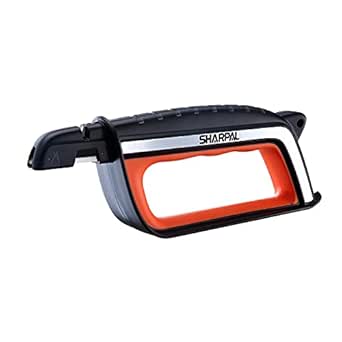 | Best for Multi-Tool Households | Brand: SHARPAL | Model: 103N | Materials: Ceramic and tungsten carbide | VIEW LATEST PRICE | See Our Full Breakdown |
| Sharp Pebble Cordless Lawn Mower Blade Sharpener, Green |  | Best for Quick Residential Touch-Ups | Model: LMSG | Power: Cordless | Adjustable angle: 20°–40° | VIEW LATEST PRICE | See Our Full Breakdown |
| SporGain Lawn Mower Blade Sharpener, 550W, with 20 Sandpaper Discs |  | Best for Coarse-to-Fine Sharpening | Model: DDLMBS | Power: 550W (2/3 HP) | Disc size: 7 inches | VIEW LATEST PRICE | See Our Full Breakdown |
| Goldsand 1 HP Lawn Mower Blade Sharpener with 9-Inch Ceramic Grinding Wheel |  | Best for a Heavy-Duty Fixed Bench Setup | Model: GD-YMJ-9H | Power: 1 HP | Output: 750W | VIEW LATEST PRICE | See Our Full Breakdown |
| lawn mower blade sharpener | Model | Dimensions | Weight |
|---|---|---|---|
| Cenoz Lawn Mower Blade Sharpen | — | — | — |
| Lawn Mower Blade Sharpener Kit | M-4.5 | — | — |
| Oregon Economy Lawn Mower Blad | 88-025 | 21 × 14.8 × 18.8 in | 41.1 lb |
| Adjustable Lawn Mower Blade Sh | LMBS-JY | 2.76 × 11.26 × 4.53 in | 2.38 lb |
| VEVOR 1 HP Lawn Mower Blade Sh | — | 12.4 × 15.71 × 9.4 in (D × W × H) | — |
| SporGain Adjustable Lawn Mower | LMBS10Black | 13.5 × 9 × 3.4 inches | 2.95 pounds |
| RBG 7-Inch Professional Fast G | 712 | — | — |
| SporGain Lawn Mower Blade Shar | — | 10.91 × 7.68 × 13.58 inches | 15.77 pounds |
| Smith’s Handheld Lawn Mower Bl | 50603 | 7.34 × 2.15 × 2.77 inches | — |
| Diamond Lawn Mower Blade Sharp | RZLM002 | 2 × 2 × 2 inches | 6.7 ounces |
| JLD20-9 Lawn Mower Blade Sharp | JLD10-9 | 16.93 x 12.6 x 9.65 inches | 36.9 pounds |
| SHARPAL 103N All-in-One Knife | 103N | 8.46 x 2.95 x 1.34 inches | 176 g |
| Sharp Pebble Cordless Lawn Mow | LMSG | 2 x 2 x 4 inches | 2 pounds |
| SporGain Lawn Mower Blade Shar | DDLMBS | 13.39 x 11.85 x 18.82 inches | 33.1 pounds |
| Goldsand 1 HP Lawn Mower Blade | GD-YMJ-9H | 16.9 x 12.6 x 9.6 inches | 43.4 pounds |
More Details on Our Top Picks
Cenoz Lawn Mower Blade Sharpeners for Power Drills, 5-Pack
The Cenoz set keeps sharpening simple: attach a corundum sharpener to a compatible power drill and work on the blade without setting up a dedicated grinder. Five pieces make it a practical pick for a shed where these attachments may see use on mower blades as well as rototillers or sickle bar cutters. Compared with the Adjustable Lawn Mower Blade Sharpener, Cenoz requires less dedicated bench setup, but it offers less control over the sharpening angle and blade positioning. It is also a different kind of tool from the Oregon 88-025, which has its own motor and grinding stone. The tradeoff is dependence on a drill and on the user’s ability to keep a steady angle; the listing also notes it may not fit every drill.
Pros:- Works with most power drills, avoiding the need for a separate bench grinder.
- Five sharpeners provide spares or attachments for different compatible tools.
- Corundum construction is designed to reduce base wear.
- Can be used on mower blades and several other listed cutting tools.
Cons:- Not compatible with every power drill.
- A drill attachment provides less built-in angle and blade-position control than a guided jig.
- Small dimensions may make it less suited to users who prefer a larger, dedicated sharpening setup.
Best for: Homeowners who already own a compatible power drill and want a small set of attachments for occasional mower and garden-tool blade touch-ups.
Not ideal for: Buyers who want a fixed sharpening guide, a dedicated powered grinder, or confirmed compatibility with a particular drill model.
- Material:Corundum
- Compatibility:Most power drills
- Uses:Lawn mower blades, lawn tractors, rototillers, drill blades, and sickle bar cutters
- Sharpener size:50 × 47 mm (1.97 × 1.85 in)
- Quantity:5
- Item weight:13.4 oz
- Color:Blue
Our verdict“Choose Cenoz for occasional sharpening with a drill you already own, but pick a guided jig or dedicated grinder for more controlled, repeatable work.”
Lawn Mower Blade Sharpener Kit with Blade Balancer
This kit suits buyers who want more control than a basic drill attachment without moving to a standalone motorized grinder. Its 15°–45° adjustable angle can be set to match a blade’s bevel, while the widened holder and ball-bearing guide arm are designed to keep the blade steadier during grinding. A blade balancer is included, adding a way to check the blade after sharpening rather than treating edge work as the only step. Compared with the similarly adjustable LMBS-JY jig, this kit adds a balancer and is specified for blades up to 30 inches long; the LMBS-JY is lighter and simpler. The main compromise is setup: this model bolts to a workbench, and it only fits blades within its stated width and thickness range.
Pros:- Adjustable 15°–45° angle helps match different factory bevels.
- Widened holder and ball-bearing guide arm are designed to limit wobble.
- Includes a blade balancer for checking blade balance after sharpening.
- Fits standard, mulching, and high-lift blades within the listed dimensions.
Cons:- Requires bolt-down installation on a wooden workbench or tool table.
- Blade compatibility is limited to 1.69–3.54 inches wide, up to 0.28 inches thick, and up to 30 inches long.
- Requires a separate power tool to drive the included grinding setup.
Best for: DIY mower owners with a suitable workbench who want adjustable bevel guidance and a balancer for routine blade maintenance.
Not ideal for: Renters or occasional users without a bench or tool table for bolt-down installation, and owners of blades outside the stated size limits.
- Blade compatibility:1.69–3.54 in wide, up to 0.28 in thick, and up to 30 in long
- Adjustable angle:15°–45°
- Guide arm material:High-strength aluminum
- Model:M-4.5
- Manufacturer:Rainwisty
- Included components:Sharpener, grinding wheel, four guide pins, three mounting screws, drill bit, and blade balancer
- Item weight:3.61 lb
- Package dimensions:14.02 × 7.99 × 2.8 in
Our verdict“Pick this kit if you have a fixed work area and want adjustable guidance plus a balancer; skip it if you need a portable, ready-to-use sharpener.”
Oregon Economy Lawn Mower Blade Sharpener and Grinder, 1/3 HP, Adjustable (88-025)
The Oregon 88-025 is the clearest step up from attachment-style sharpeners for owners who sharpen blades often and want a dedicated 1/3 HP grinder. Its 1750 RPM motor and included 8-inch stone handle mower blades from a range of manufacturers, including blades with up to 9 inches of sharpened edge. Adjustable height helps position the work, and a built-in safety switch adds a useful control at the machine. Compared with the VEVOR 1 HP sharpener, Oregon has a lower-powered motor and smaller wheel, but its single-direction design is straightforward for users who do not need multiple operating directions. At 41.1 pounds, it is a workshop tool rather than a portable option. The adjustable light is sold separately, and the motor does not reverse.
Pros:- Dedicated 1/3 HP motor and included 8-inch grinding stone provide a complete grinder setup.
- Handles blades from multiple manufacturers and up to 9 inches of sharpened edge.
- Adjustable height supports blade positioning during sharpening.
- Built-in safety switch and one-year warranty for material and workmanship defects.
Cons:- Single-direction motor does not reverse.
- Adjustable light is sold separately.
- Its 41.1-pound weight and bench-grinder format limit portability.
Best for: Homeowners or small maintenance shops that sharpen blades regularly and can dedicate workshop space to a standalone grinder.
Not ideal for: Buyers who need a portable tool, want a light included, or prefer the larger ceramic wheel and included balancer supplied with the VEVOR model.
- Model:88-025
- Motor power:1/3 HP (0.33 hp)
- Motor speed:1750 RPM
- Direction:Single direction, non-reversing
- Blade capacity:Up to 9 in of sharpened edge
- Included grinding stone:8 in
- Dimensions:21 × 14.8 × 18.8 in
- Weight:41.1 lb
- Safety feature:Built-in safety switch
Our verdict“Choose the Oregon for a dedicated home-workshop grinder with broad blade compatibility, but look elsewhere if portability or a larger wheel is a priority.”
Adjustable Lawn Mower Blade Sharpener
This jig is a compact way to add angle control to an angle grinder you already own. Its 15°–45° adjustment covers a broad range of bevels, while four guide pins and support for straight, mulching, and high-lift blades make it more adaptable than the simple Cenoz drill attachments. It is also lighter and less involved to set up than the bolt-down Rainwisty kit, though Rainwisty includes a blade balancer and a widened holder with a ball-bearing guide arm. The key distinction is that this is a jig, not a powered sharpener: you supply the angle grinder and guide the sharpening process. Blade width is limited to 1.65–3.60 inches, so it may not suit every blade in a mixed collection.
Pros:- 15°–45° adjustment accommodates a range of blade bevels.
- Four guide pins help stabilize blades during sharpening.
- Supports straight, mulching, and high-lift blade types.
- Compact 2.38-pound format is easier to store than a standalone grinder.
Cons:- Requires a separate angle grinder.
- Blade width is limited to 1.65–3.60 inches.
- Does not include a blade balancer, unlike the Rainwisty kit.
Best for: DIY owners who already have an angle grinder and want an adjustable, relatively compact guide for common mower blade styles.
Not ideal for: Buyers without an angle grinder, those seeking a standalone powered machine, or owners of blades outside the 1.65–3.60-inch width range.
- Model:LMBS-JY
- Sharpening angle:15°–45° adjustable
- Blade width:1.65–3.60 in
- Angle grinder compatibility:Compatible with most angle grinders; includes four guide pins
- Supported blade types:Straight, mulching, and high-lift
- Dimensions:2.76 × 11.26 × 4.53 in
- Weight:2.38 lb
Our verdict“Choose this jig if you already own an angle grinder and want adjustable guidance without a bulky machine; skip it if you need a complete sharpening setup.”
VEVOR 1 HP Lawn Mower Blade Sharpener with 9-Inch Ceramic Wheel and Balancer
VEVOR is the most powerful dedicated option in this group, pairing a 1 HP motor with a 9-inch ceramic wheel for sharpening high-lift, low-lift, Gator, and flat blades. Its two fixed sharpening angles, 30° and 40°, give buyers a choice without the broad angle adjustment found on the Rainwisty kit or LMBS-JY jig. The included blade balancer and grit collector add practical support for checking the finished blade and containing some grinding debris. Compared with the Oregon 88-025, VEVOR offers more listed blade types and a larger wheel, while Oregon has adjustable height and a built-in safety switch. At 42.1 pounds, VEVOR is still a stationary workshop machine, and its manual operation mode may not suit buyers seeking a more automated process.
Pros:- 1 HP power source and 9-inch ceramic wheel form a substantial dedicated sharpening setup.
- Supports high-lift, low-lift, Gator, and flat mower blades.
- Two sharpening angles, 30° and 40°, cover common bevel choices.
- Includes both a blade balancer and grit collector.
Cons:- At 42.1 pounds, it is not a portable sharpening option.
- Angle choices are limited to 30° and 40°, unlike adjustable-angle jigs.
- Manual operation mode may require more direct operator control.
Best for: Workshop users sharpening several common mower blade styles who want a powerful standalone machine with a balancer and debris collector.
Not ideal for: Buyers who need a portable sharpener, adjustable angles outside 30° and 40°, or detailed blade-width compatibility information before purchase.
- Power:1 HP
- Grinding wheel:9-inch ceramic
- Blade sharpening angles:30° and 40°
- Compatible blade types:High-lift, low-lift, Gator, and flat
- Included accessories:Grit collector and blade balancer
- Manufacturer part number:1HP, 1725RPM
- Item weight:42.1 lb
- Dimensions:12.4 × 15.71 × 9.4 in (D × W × H)
- Operation mode:Manual
Our verdict“Pick VEVOR for a powerful workshop sharpener with broad listed blade-type support and useful accessories, but choose an adjustable jig for more angle flexibility.”
SporGain Adjustable Lawn Mower Blade Sharpener Jig
The SporGain Adjustable Jig is the most flexible choice here for owners who already have an angle grinder and want a guided setup rather than a dedicated sharpening machine. Its 15°–45° angle adjustment and support for straight, mulching, and high-lift blades give it broader blade coverage than Smith’s handheld sharpener, which is designed specifically for mower blades but offers no comparable angle adjustment. The jig is built to hold the blade while you work, helping make a controlled edge easier to achieve. That flexibility comes with setup work: you need to mount and adjust it on a bench, and the grinder is not included. Choose it over the RBG 712 if adjustable angles matter more than a preset professional-style grinding system; skip it if you want a ready-to-run machine.
Pros:- Adjustable sharpening angle from 15° to 45°
- Fits straight, mulching, and high-lift blades from 1.65 to 3.60 inches wide
- Designed to hold blades securely during sharpening
- Includes four adapter screws for angle-grinder compatibility
Cons:- Requires a compatible angle grinder, which is not included
- Needs bench mounting and adjustment before use
Best for: Home mechanics with an angle grinder who sharpen several mower blade styles and want control over the edge angle.
Not ideal for: Buyers without a compatible angle grinder or a workbench where they can mount and adjust the jig.
- Blade width compatibility:1.65–3.60 inches
- Adjustable angle:15°–45°
- Compatible blades:Straight, mulching, and high-lift
- Grinder compatibility:Most angle grinders
- Included components:Ball bearing, 25 mm handle, and 4 adapter screws
- Dimensions:13.5 × 9 × 3.4 inches
- Weight:2.95 pounds
- Model:LMBS10Black
Our verdict“Choose this jig if you already own an angle grinder and want adjustable guidance across several mower blade styles.”
RBG 7-Inch Professional Fast Grind Lawn Mower Blade Sharpener, Model 712
The RBG 712 suits buyers who sharpen blades regularly and value a repeatable setup over portability. Its preset guide helps maintain a factory-flat cutting edge on standard and reverse blades, while the grinding design is made to reduce wheel dust and avoid wheel dressing. The wheel’s stated life of about 100–150 sharpenings also gives frequent users a clear maintenance expectation. Compared with the SporGain Adjustable Jig, the RBG is a dedicated sharpener rather than a grinder attachment, but it gives up the jig’s variable angle setting. The tradeoff is workshop commitment: the grit collector is optional, and the grinding wheel eventually needs replacement. It makes more sense for a steady sharpening routine than for someone who only touches up one blade now and then.
Pros:- Preset guide supports a consistent factory-flat cutting edge
- Handles standard and reverse blades with varying cutting-edge lengths
- Grinding design reduces wheel dust and eliminates wheel dressing
- Grinding wheel is specified for approximately 100–150 sharpenings
Cons:- Grit collector is optional rather than included
- Grinding wheel requires replacement after its expected service life
Best for: Landscapers, mower-maintenance shops, and homeowners who sharpen standard or reverse blades repeatedly and want a preset guide.
Not ideal for: Occasional users who want a compact handheld tool or need a wide choice of adjustable sharpening angles.
- Brand:RBG Grinders
- Model:712
- Sharpener size:7 inches
- Blade compatibility:Standard and reverse blades
- Grinding wheel life:Approximately 100–150 sharpenings
- Grit type:Medium/coarse
- Material:Carbide, carborundum, ceramic, and tungsten carbide
- Color:Gray
Our verdict“Pick the RBG 712 for repeatable sharpening in a workshop, but choose the SporGain jig if adjustable angles are a priority.”
SporGain Lawn Mower Blade Sharpener with Brushless Motor
This brushless-motor SporGain is the most self-contained powered option in this group: it has adjustable speed up to 3000 RPM, two sanding-disc grits, and 30° and 45° guides. Its stated compatibility spans high-lift, low-lift, gator, and flat blades, making it a broader fit than the RBG 712, which is specified for standard and reverse blades. The included coarse and finer discs give users a way to work through sharpening rather than relying on one abrasive. Compared with the SporGain Adjustable Jig, this is a powered sharpener rather than a mount for a grinder, but its 15.77-pound weight and required assembly make it less convenient to move or put away. It is better for a home workshop than for quick, occasional touch-ups.
Pros:- Brushless motor with adjustable speed up to 3000 RPM
- Includes 60-grit and 180-grit sanding discs
- Includes 30° and 45° blade guides
- Designed for high-lift, low-lift, gator, and flat blades
Cons:- Weighs 15.77 pounds, limiting portability
- Assembly is required before use
Best for: Home workshop owners who sharpen different blade styles and want a powered unit with multiple speed and guide options.
Not ideal for: Buyers who need a lightweight handheld sharpener, want a tool with no assembly, or sharpen only occasionally.
- Motor:Brushless
- Maximum speed:3000 RPM
- Included sanding discs:10 × 60-grit; 60 × 180-grit
- Blade guides:30° and 45°
- Grinding wheel:7 inches
- Compatible blade types:High-lift, low-lift, gator, and flat
- Dimensions:10.91 × 7.68 × 13.58 inches
- Weight:15.77 pounds
- Motor warranty:Lifetime
Our verdict“Choose this powered SporGain for a workshop that handles varied blade types; choose the RBG 712 for a preset, repeatable setup instead.”
Smith’s Handheld Lawn Mower Blade Sharpener with Safety Guard and Cleaning Brush
Smith’s is the straightforward pick for a mower owner who wants a compact manual tool instead of a grinder or bench setup. Its preset coarse carbide blade is designed to sharpen in a few pulls, while the oversized handle and large finger guard support a more controlled grip, including when wearing gloves. The cleaning brush stores inside the handle, so it is less likely to get separated from the sharpener. Compared with the diamond drill sharpener in this lineup, Smith’s needs no power tool; compared with the RBG 712, it trades workshop capacity and repeatable machine-guided grinding for simple storage and use. Its narrow purpose is also a limit: it is designed for mower blades, and the plastic head may not suit buyers seeking a sturdier metal-bodied tool.
Pros:- Preset carbide blade is designed to sharpen in a few pulls
- Oversized handle accommodates use with gloves
- Large finger guard supports safer handling
- Wire cleaning brush stores in the handle
Cons:- Designed specifically for lawn mower blades
- Plastic head may be less durable than a metal construction
Best for: Homeowners who want a simple, hand-powered tool for occasional mower-blade touch-ups and prefer a guarded grip.
Not ideal for: Frequent sharpeners who want a metal-bodied tool, powered grinding, or a sharpener for multiple kinds of garden tools.
- Brand:Smith’s
- Model:50603
- Material:Plastic
- Grit type:Coarse
- Blade:Replaceable preset carbide
- Dimensions:7.34 × 2.15 × 2.77 inches
- Included components:Sharpener and wire-bristled cleaning brush
- Warranty:3-year limited
Our verdict“Pick Smith’s for occasional manual touch-ups and easy storage, rather than the RBG 712 for regular workshop sharpening.”
Diamond Lawn Mower Blade Sharpener, 120 Grit
This 120-grit diamond sharpener is a compact choice for buyers who already own an electric drill and want one attachment for mower blades and other garden tools. Its double-sided grinding wheel can be used on either face, while the all-metal construction offers a more durable-feeling alternative to Smith’s plastic handheld sharpener. The tradeoff is that it is not a standalone tool: it needs a drill, and the 5 mm handle must match the drill’s accepted fit. Unlike the SporGain Adjustable Jig, it does not provide a blade-holding guide or a specified range of angle adjustment, so sharpening control depends more on the user. Its small footprint suits storage in a tool kit, but buyers seeking guided, repeatable sharpening should look at the RBG 712 instead.
Pros:- Diamond grinding wheel is designed for sharpening
- All-metal construction
- Wheel can be used on both sides
- Suitable for mower blades and other garden tools
Cons:- Requires an electric drill to operate
- The 5 mm handle may not fit every drill
Best for: DIY homeowners with a compatible electric drill who want a compact sharpening attachment for mower blades and other garden tools.
Not ideal for: Buyers without a drill that accepts a 5 mm handle or anyone who wants a blade guide and controlled angle adjustment.
- Grit:120
- Construction:All-metal with diamond grinding wheel
- Handle diameter:5 mm
- Compatibility:Electric drills
- Wheel use:Both sides
- Dimensions:2 × 2 × 2 inches
- Weight:6.7 ounces
- Model:RZLM002
Our verdict“Choose this attachment for compact, drill-powered sharpening, but favor the SporGain Adjustable Jig if guided angle control matters more.”
JLD20-9 Lawn Mower Blade Sharpener with 9-Inch Ceramic Grinding Wheel
The JLD20-9 is a good fit for owners who want a dedicated bench sharpener rather than a drill attachment or handheld tool. Its 750W motor turns a 9-inch, 60-grit ceramic wheel at 1,700 RPM, while the steel base and adjustable holders help keep a blade steady as you work. A metal balancer is included, which helps you check whether sharpening has left the blade uneven. Compared with the Goldsand 1 HP sharpener, this model is lighter and includes five replacement discs, but Goldsand specifies 30° and 40° guide angles while the JLD20-9 does not list exact angles. Its 60-grit wheel is suited to shaping and sharpening, not a fine finishing pass. At 36.9 pounds, it is still a substantial tool to store or relocate.
Pros:- 750W motor and 1,700 RPM wheel speed suit dedicated blade sharpening.
- Steel base and adjustable mounting system support steady, controlled work.
- Includes five replacement grinding discs and a metal blade balancer.
- Two blade holders help secure blades during sharpening.
Cons:- At 36.9 pounds, it is cumbersome to move and store.
- The included 60-grit wheel does not provide a fine-grit finishing option.
- Exact guide angles are not specified in the supplied product details.
Best for: Homeowners who sharpen mower blades regularly and want a stable bench setup with replacement discs and a blade balancer.
Not ideal for: Buyers who need a portable sharpener, a fine-grit finishing wheel, or clearly specified angle settings.
- Model:JLD10-9
- Motor power:750W (1 HP)
- Motor speed:1,700 RPM
- Grinding wheel:9-inch, 60-grit ceramic
- Included accessories:5 replacement grinding discs, 2 knife holders, 1 metal balancer
- Dimensions:16.93 x 12.6 x 9.65 inches
- Weight:36.9 pounds
- Manufacturer:JINLIDA
Our verdict“Choose the JLD20-9 if you want a stable bench sharpener with a balancer and spare discs, but skip it if portability or fine finishing is a priority.”
SHARPAL 103N All-in-One Knife and Garden Tool Sharpener
The SHARPAL 103N makes the most sense for a homeowner who sharpens more than mower blades. Its five sharpening components include preset-angle slots, a tungsten carbide bar, and a ceramic bar, covering a range of knives and garden tools as well as mower blades. The oversized handle, hand guard, and rubberized grip offer more control than a bare sharpening stone, especially when wearing gloves. Compared with the Sharp Pebble cordless sharpener, the SHARPAL is useful across more tool types but is a manual, general-purpose option rather than a powered tool for routine mower-blade touch-ups. Its preset slots may not match every blade’s shape or preferred bevel, so it is less adaptable than the adjustable guides on the SporGain 550W sharpener. This is a practical utility sharpener, not a dedicated bench grinder.
Pros:- Five sharpening components cover several edge types and tools.
- Works with single- and double-beveled blades.
- Oversized handle, hand guard, and rubber over-molded grip support control.
- Compact and light enough to keep with garden tools.
Cons:- Preset-angle slots may not suit every mower blade profile or bevel.
- Manual sharpening takes more effort than using a powered bench machine.
- The supplied product information lists no warranty.
Best for: Homeowners who want one compact manual sharpener for mower blades, pruners, shears, axes, and household knives.
Not ideal for: Buyers sharpening many mower blades or needing a dedicated powered sharpener with adjustable blade guides.
- Brand:SHARPAL
- Model:103N
- Materials:Ceramic and tungsten carbide
- Sharpening components:Three preset-angle slots, one tungsten carbide bar, one ceramic bar
- Compatible tools:Knives, mower blades, pruners, loppers, hedge shears, axes, machetes, hatchets, scissors
- Dimensions:8.46 x 2.95 x 1.34 inches
- Weight:176 g
- Color:Orange and black
Our verdict“Pick the SHARPAL 103N if mower blades are only one part of your sharpening needs, but choose a dedicated machine for frequent blade work.”
Sharp Pebble Cordless Lawn Mower Blade Sharpener, Green
The Sharp Pebble is aimed at owners who want to touch up a standard residential mower blade without setting up a bench grinder. Its cordless design and 2-pound weight make it easy to carry to the mower, and the 20°–40° angle guide helps maintain a consistent edge. Variable speed from 5,000 to 30,000 RPM gives the user some control over the sharpening pace. Compared with the JLD20-9 or SporGain 550W sharpener, it is far easier to bring around the yard, but it is not designed for heavy material removal or damaged blades. A full charge handles only one or two standard blades, and chips, deep dents, or missing metal call for a grinder first. It is a touch-up tool, not a replacement for a bench machine.
Pros:- Cordless, 2-pound design is easy to carry around the yard.
- 20°–40° guide supports a range of common blade angles.
- Variable speed allows control over the sharpening pace.
- Can touch up many standard residential blades without removing them.
Cons:- A full charge sharpens only one or two standard blades.
- Not intended for zero-turn or heavy-duty commercial blades.
- Cannot repair chips, deep dents, or missing metal.
Best for: Residential mower owners who want a lightweight cordless tool for occasional touch-ups on standard blades.
Not ideal for: Commercial or zero-turn mower owners, or anyone repairing chipped, deeply dented, or badly damaged blades.
- Model:LMSG
- Power:Cordless
- Adjustable angle:20°–40°
- Variable speed:5,000–30,000 RPM
- Battery capacity:Sharpens 1–2 standard residential blades per charge
- Compatible blades:Standard residential mower blades
- Dimensions:2 x 2 x 4 inches
- Weight:2 pounds
Our verdict“Choose the Sharp Pebble for convenient residential touch-ups, but keep a bench grinder for damaged blades or heavier workloads.”
SporGain Lawn Mower Blade Sharpener, 550W, with 20 Sandpaper Discs
The SporGain 550W sharpener stands out for offering both 60-grit and 180-grit discs, so the same machine can handle more aggressive sharpening and a finer follow-up pass. Its 30° and 45° holders accommodate several blade types, including high-lift, low-lift, gator, and flat blades. The snap-lock cover simplifies disc changes, while the steel base is intended to keep the machine steady. Compared with the JLD20-9, which uses a 9-inch ceramic wheel, this SporGain uses smaller 7-inch sandpaper discs and provides two grit choices; that makes it more flexible for finishing, though disc format is a point of ongoing compatibility. At 33.1 pounds, it is heavy enough to be awkward to move, and the 550W motor is less powerful than the 750W JLD20-9 and Goldsand machines.
Pros:- Includes 20 sandpaper discs in 60- and 180-grit.
- 30° and 45° holders suit multiple mower blade types.
- Snap-lock cover makes disc changes more convenient.
- Steel base and integrated construction support stable sharpening.
Cons:- At 33.1 pounds, it is awkward to carry or reposition.
- 550W output is lower than the 750W JLD20-9 and Goldsand sharpeners.
- Uses 7-inch sandpaper discs, limiting users to that disc size.
Best for: Homeowners who sharpen several mower blade styles and want coarse and finer disc options in one bench machine.
Not ideal for: Buyers who need a portable tool, a higher-powered 9-inch ceramic-wheel machine, or a sharpening system with a different disc format.
- Model:DDLMBS
- Power:550W (2/3 HP)
- Disc size:7 inches
- Included discs:20 sandpaper discs: 10 pairs in 60- and 180-grit
- Blade holder angles:30° and 45°
- Compatible blade types:High-lift, low-lift, gator, and flat blades
- Dimensions:13.39 x 11.85 x 18.82 inches
- Weight:33.1 pounds
Our verdict“Choose this SporGain if coarse and finer sharpening passes matter more than maximum motor power or easy portability.”
Goldsand 1 HP Lawn Mower Blade Sharpener with 9-Inch Ceramic Grinding Wheel
The Goldsand is the heaviest dedicated machine in this group, built for buyers who plan to mount a sharpener in a fixed workshop location. Its 750W motor, 9-inch, 36-grit red ceramic wheel, and steel base are paired with fixing brackets and guides set at 30° or 40°. Those specified angles give it a more defined setup than the JLD20-9, whose supplied details do not identify exact guide angles. Goldsand also lists compatibility with high-lift, low-lift, gator, and flat blades. The tradeoff is substantial: at 43.4 pounds, it is the heaviest option here and requires mounting hardware for a permanent installation. Its 36-grit wheel is comparatively coarse, while the SporGain 550W includes both coarse and finer discs.
Pros:- 750W output and a 9-inch ceramic wheel suit dedicated sharpening work.
- 30° and 40° guide settings provide defined angle options.
- Steel base and fixing brackets support a stable mounted setup.
- Listed for high-lift, low-lift, gator, and flat blades.
Cons:- At 43.4 pounds, it is difficult to move.
- Permanent use requires mounting, limiting flexibility in the workspace.
- The included 36-grit wheel is coarse compared with the SporGain’s 180-grit option.
Best for: Workshop owners who sharpen multiple mower blade styles and want a mounted machine with specified 30° and 40° guides.
Not ideal for: Buyers with limited bench space, those who need to move the sharpener often, or users seeking a finer included sharpening grit.
- Model:GD-YMJ-9H
- Power:1 HP
- Output:750W
- Grinding wheel:9-inch, 36-grit red ceramic
- Blade guide angles:30° and 40°
- Base material:Steel
- Included accessories:Mounting hardware and replacement grinding discs
- Dimensions:16.9 x 12.6 x 9.6 inches
- Weight:43.4 pounds
Our verdict“Choose the Goldsand for a fixed workshop setup with specified blade angles, but skip it if you need portability or finer grit choices.”
How We Picked
I compared these 15 sharpeners by how well their designs suit the main jobs buyers face: touching up a blade now and then, sharpening several blades, or maintaining a repeatable edge across regular use. I prioritized angle control, sharpening method, motor capability, safety features, and blade balancing, then weighed storage needs, included accessories, and the likely effort required to keep the tool ready. A dedicated grinder can offer steadier control than a handheld tool, but it also demands bench space and safe setup; portability matters more for occasional home maintenance.
The ranking reflects those tradeoffs rather than treating every tool as a direct substitute. Adjustable powered grinders and purpose-built machines rank ahead for buyers seeking a more controlled sharpening process, while compact and drill-mounted options serve buyers who value storage and simplicity. Models with a balancer or useful maintenance accessories earn credit for supporting the whole sharpening task, but no accessory replaces correct blade setup or careful handling. Where product details leave questions about compatibility or replacement abrasives, I treat that uncertainty as a reason to verify fit before purchase.
Factors to Consider When Choosing Best Lawn Mower Blade Sharpeners
Before choosing a sharpener, decide how often you sharpen, what kind of workspace you have, and how much control you want over the grinding angle. These factors can matter more than headline motor power or the number of included accessories.
Match the sharpener to how often you mow
For one mower and occasional blade care, a compact handheld tool or drill attachment may be easier to store and quicker to set up than a bench grinder. If you sharpen several blades or maintain equipment throughout the season, a dedicated machine can make the process more consistent and less dependent on your hand position. A common mistake is buying a heavy grinder for a task that happens only once or twice a year, then leaving it unused because setup feels like work. The reverse mistake is choosing a small tool for frequent sharpening and finding its pace or control frustrating. Think about the number of blades you handle in a season, not just the mower you own today.
Prioritize bevel control over power claims
A sharpener needs to follow the blade’s existing cutting angle rather than create an arbitrary new one. Adjustable guides or jigs can help hold a more consistent position, while freehand tools ask you to supply that control. Higher motor power can support a more capable machine, but it does not correct poor alignment or make aggressive grinding safe. Avoid pressing hard to speed up the job: excess heat and unnecessary material removal can shorten blade life. If you are new to sharpening, look for a setup that makes the blade position easy to see and repeat.
Plan for blade balancing and safe handling
Grinding changes the amount of material on each side of a blade, so balancing is part of a proper sharpening routine. An included balancer is convenient, but buyers can also use a compatible separate balancing tool if the sharpener does not include one. Do not assume that a sharp edge means a finished blade; an imbalance can cause vibration and add strain during mowing. The blade must be removed and secured safely before sharpening, with the mower’s power source disconnected according to its instructions. Gloves, eye protection, and a stable work surface are sensible safeguards, especially with powered wheels.
Check consumables and replacement-part compatibility
A grinder’s long-term usefulness depends partly on whether its wheel or abrasive can be replaced with a compatible part. Before buying, check the abrasive type, dimensions, and availability rather than assuming a generic disc will fit. Sandpaper-disc systems and ceramic-wheel machines have different upkeep routines, and neither is automatically better for every user. Included discs may help you start, but they do not tell you how easy future replacements will be to source. If you sharpen often, factor maintenance time and compatible consumables into your choice.
Choose portability with a realistic view of precision
Handheld, cordless, and drill-mounted sharpeners appeal to buyers with limited storage or no dedicated bench. Their smaller size can also make quick touch-ups less of a production. The tradeoff is that a compact tool may offer less physical guidance than a jig or fixed grinder, making even pressure and angle control more dependent on the operator. Cordless convenience also makes battery compatibility and charging part of the workflow. Pick portability when storage and setup matter most, but do not expect compactness alone to produce a more consistent edge.
Pay for a workflow you will actually use
A premium machine makes sense when you will use its steadier setup, stronger motor, or accessories often enough to justify its footprint and upkeep. For a homeowner with a single mower, an affordable attachment may cover the task without dedicating bench space to another machine. Beginners may benefit more from visible guides and straightforward blade positioning than from extra power or a long accessory list. Before spending more, ask whether the added features solve a real problem in your sharpening routine. If they do not, a simpler tool may be the better match.
Frequently Asked Questions
Should I buy a dedicated grinder or a drill-mounted sharpener?
Choose a dedicated grinder if you sharpen regularly, want a more fixed work position, or need a tool designed for repeat sharpening. A drill-mounted sharpener can suit occasional touch-ups and takes less dedicated storage, but you control the drill and the blade angle during use. Neither choice removes the need to secure the blade and check its balance afterward. If you are new to sharpening, compare how each tool guides the blade rather than choosing by motor power alone. Your sharpening frequency and workspace are the clearest deciding factors.
Do I need a blade balancer if my sharpener does not include one?
A balancer is useful because sharpening can remove unequal amounts of metal from the two sides of a blade. An included balancer is convenient, but it is not a requirement to buy a particular sharpener if you can use a compatible separate tool. Skipping the balance check because the edge looks even is a common mistake. Follow the mower and blade maker’s guidance, and check balance after sharpening before reinstalling the blade. If you sharpen blades often, a balancer makes that step easier to include in your routine.
Is a more powerful sharpener a better choice for a homeowner?
Not necessarily. More motor power may suit frequent use, but it does not guarantee better angle control or a cleaner result. For occasional maintenance, a compact sharpener may be easier to store and adequate for the job. A powered grinder also requires a stable setup, safe handling, and access to compatible replacement abrasives. Consider power alongside adjustability, your sharpening volume, and whether the machine’s size fits your workspace.
Can one sharpener handle different mower blade shapes?
Compatibility depends on the blade’s size, profile, bevel, and the sharpener’s guides or working area. Adjustable grinders and jigs can offer more flexibility than tools with a fixed contact shape, but buyers should still check the maker’s stated compatibility. Do not assume that a sharpener for standard mower blades also fits every specialty or unusually shaped blade. If you maintain blades for multiple machines, compare their specifications before buying and keep the original blade angle in mind. When compatibility information is unclear, verify it with the manufacturer rather than forcing a fit.
How should a beginner choose between a handheld tool and an adjustable sharpener?
A handheld tool is compact and easy to store, but it generally asks you to manage more of the angle and pressure yourself. An adjustable sharpener or jig can provide more guidance, which may help a beginner repeat the same setup across both ends of a blade. That does not make it foolproof: the blade still needs to be secured, and sharpening should follow its existing bevel. Beginners should also value clear instructions and safe handling features over extra accessories. If you expect to sharpen only occasionally, choose the format you will be comfortable setting up and using correctly.
Conclusion
For most buyers seeking a dedicated machine, I recommend the Oregon Economy Lawn Mower Blade Sharpener as the best overall direction because adjustability is more useful for controlled sharpening than power alone. The Cenoz drill-mounted five-pack is the best value-minded choice for occasional touch-ups and limited storage, while the VEVOR 1 HP sharpener is the best premium-style pick for buyers who want a more powerful benchtop setup with a balancer. Beginners should favor a guided setup, such as an adjustable sharpener or jig, over a compact tool that relies heavily on freehand control. For portability, consider handheld or cordless options; for regular shop use, focus on a dedicated grinder and replacement-wheel compatibility. Whichever route you choose, match the tool to your blade, work safely, and check balance after sharpening.