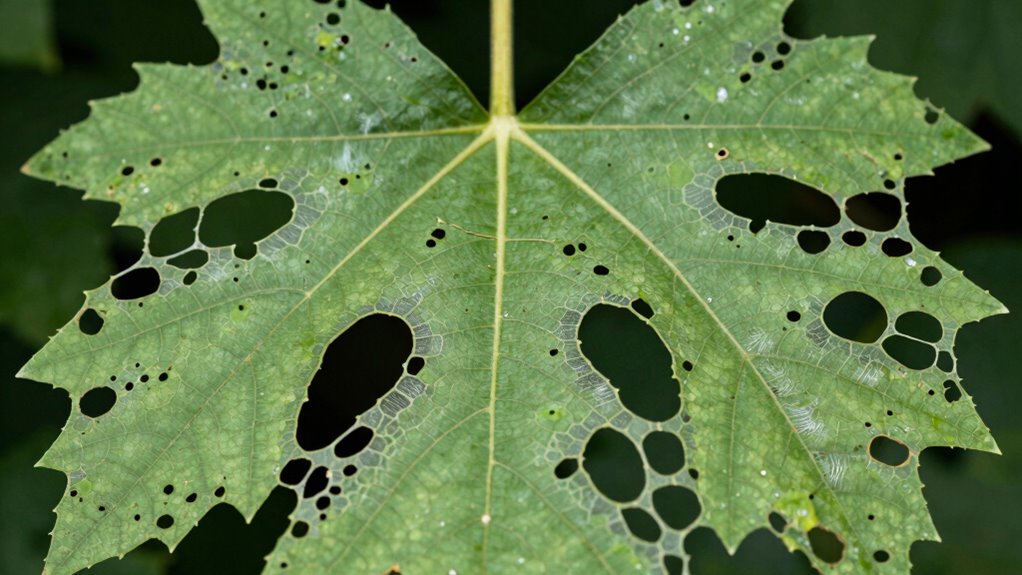

To understand chewed edges, holes, and skeletonized leaves, observe the damage patterns carefully. Jagged edges often mean strong mandibles from caterpillars or beetles, while smooth, clean cuts suggest other pests like leaf miners. Irregular, ragged holes indicate scraping from grasshoppers, and skeletonization reveals insects that eat soft tissue, leaving veins intact. Noticing where the damage occurs and how it looks can help you identify the pest. Keep exploring for more tips on controlling these pests effectively.
Key Takeaways
- Chewed edges with ragged or irregular holes indicate insects like grasshoppers or beetles nibbling from leaf margins.
- Clean, sharply cut holes suggest strong mandible feeders such as caterpillars or beetles.
- Skeletonized leaves, where tissue is eaten away leaving veins, point to soft-tissue eaters like sawfly larvae.
- The size and pattern of holes reveal whether pests feed individually or in groups.
- Damage location (edges vs. center) and pattern help identify pest feeding habits and activity stages.
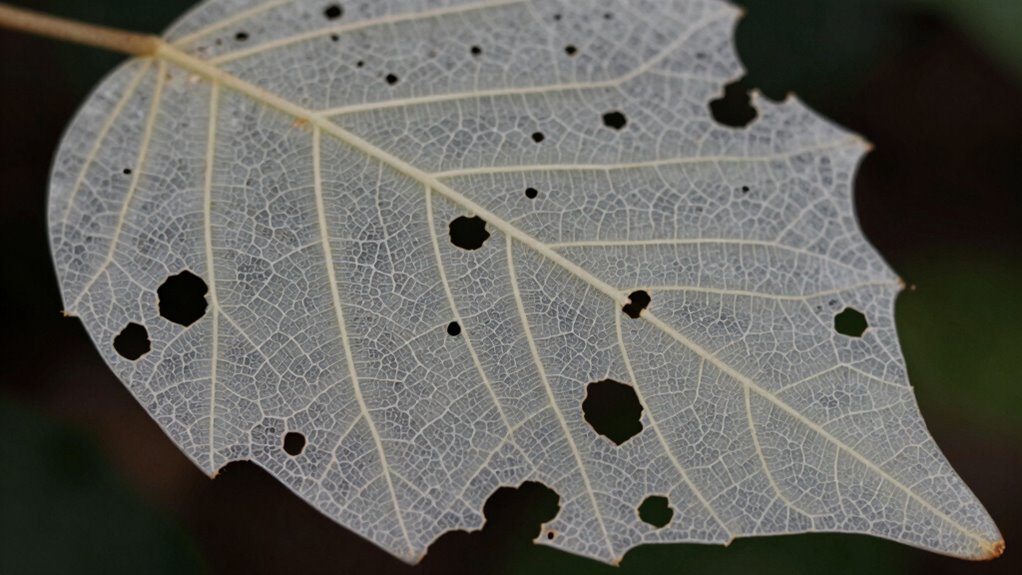
Ever wonder what clues chewed edges, holes, and skeletonized leaves can reveal about the insects and animals that have visited your garden? These subtle signs are like a secret language that, when interpreted correctly, can tell you a lot about pest identification and the insects responsible. To start, understanding leaf anatomy is essential. Leaves aren’t just flat surfaces; they have distinct structures—veins, margins, and surfaces—that influence how pests feed. For example, some insects prefer to chew along leaf edges, leaving jagged, irregular holes, while others burrow into the leaf tissue, skeletonizing it and leaving only the veins intact. Recognizing these patterns helps you identify the pest more precisely, enabling targeted control methods.
When you see sharply cut or clean-edged holes, it often indicates a pest with strong mandibles, such as caterpillars or beetles, that chew through the tissue. These insects tend to devour entire sections of leaf, creating holes that are roughly the same size and shape. In contrast, if the damage looks more irregular or ragged, it might be from insects that nibble randomly or scrape surfaces, like grasshoppers or certain beetles. Skeletonized leaves—those where only the veins remain—are typically the work of insects that selectively eat the softer tissue, such as sawfly larvae or some beetle larvae. Paying attention to these details helps you distinguish between pests, so you know whether to act or simply monitor.
The pattern of damage also offers clues about pest behavior. For example, if you notice small, evenly spaced holes, you might be dealing with a pest that feeds in groups or leaves frass (excrement) nearby, such as caterpillars. Larger, solitary holes could mean a different insect, like a beetle, is responsible. Additionally, the location of damage on the leaf—edges versus the center—can indicate the pest’s feeding habits. Edge-chewing pests tend to start at the margins, while those burrowing into the leaf often work from within. Recognizing feeding patterns can further refine your pest identification skills and help you choose the most effective response. Observing these signs closely can also help you understand the life cycle of the pests, which is crucial for effective management. Furthermore, understanding how insects prefer certain leaf areas can assist in predicting their impact and timing your intervention. Recognizing the specific damage types can also help differentiate between pest species and natural causes of leaf damage.
garden pest identification guide
As an affiliate, we earn on qualifying purchases.
As an affiliate, we earn on qualifying purchases.
Frequently Asked Questions
Can Animal Size Be Determined From Leaf Damage?
Animal size estimation from leaf damage analysis can be tricky but possible. Larger animals tend to create bigger holes and more extensive damage, while smaller ones leave finer, more intricate patterns. By examining the size and shape of the damage, you can roughly gauge the animal’s size. Keep in mind, factors like feeding behavior and plant type influence damage, so use this method as a general guide rather than an exact measurement.
What Tools Are Best for Examining Leaf Damage?
You should use a microscope for detailed examination of leaf damage, as it allows you to see fine details and subtle patterns. Microscope analysis helps in damage pattern recognition, revealing how pests or animals chewed or fed on the leaf. A hand lens can also be useful for quick inspections, but a good-quality microscope provides the clarity needed to identify specific damage types and determine the likely culprits behind the damage.
How Long Does Leaf Skeletonization Typically Take?
Think of leaf skeletonization as a slow dance of decay, taking anywhere from a few days to several weeks, depending on conditions. In humid weather, the damage timeline speeds up, sometimes revealing skeletonized leaves in just a week. In drier environments, it can stretch out over a month. Factors like leaf thickness and insect activity influence how quickly the leaf decays, creating a delicate, lace-like pattern.
Can Environmental Factors Cause Similar Leaf Damage?
Environmental factors like pollution effects and climate influence can indeed cause damage similar to chewing. Pollution, especially airborne pollutants, can weaken leaf tissues, making them more susceptible to holes or skeletonization. Extreme weather conditions, such as drought or heavy rain, also stress plants and can lead to irregular leaf damage. So, while pests are common culprits, environmental stressors play a significant role in leaf deterioration too.
How Can I Distinguish Between Insect and Fungal Damage?
Think of your plant leaves as crime scenes. To distinguish insect from fungal damage, start with insect identification—look for irregular holes and jagged edges caused by pests, often with visible bite marks. Fungal differentiation shows more uniform, powdery, or fuzzy spots, and sometimes lesions with a spread-out pattern. Noticing these clues helps you identify the culprit, so you can take targeted action to protect your plant effectively.
leaf damage pattern identification kit
As an affiliate, we earn on qualifying purchases.
As an affiliate, we earn on qualifying purchases.
Conclusion
By paying close attention to chewed edges, holes, and skeletonized leaves, you reveal nature’s secret stories etched in green. Imagine each bite as a tiny fingerprint, revealing which creatures roamed your garden overnight. As you decipher the delicate patterns and ragged edges, you become a detective in the woodland mystery. So, pick up your magnifying glass and embrace the thrill of uncovering nature’s hidden world, one leaf at a time.
As an affiliate, we earn on qualifying purchases.
As an affiliate, we earn on qualifying purchases.