
TL;DR
Two Cornell research papers examine how sheep grazing can fit into solar farm management. A three-year field study found that low-density grazing was associated with more beneficial insects than mowing, while a separate study introduced a planning tool for farmers managing solar-grazing flocks.
Two Cornell research teams have published studies on sheep grazing at solar farms: one found that low-density grazing was associated with more beneficial insects than mowing, and the other developed a planning tool to help farmers manage the costs and flock needs of solar-grazing contracts. The findings address both ecological trade-offs and the business decisions involved in using sheep to control vegetation beneath solar panels.

Get garden gear delivered free with Prime
- Fast, free delivery on millions of items
- Prime Video, Amazon Music and more included
- Member-only deals all year
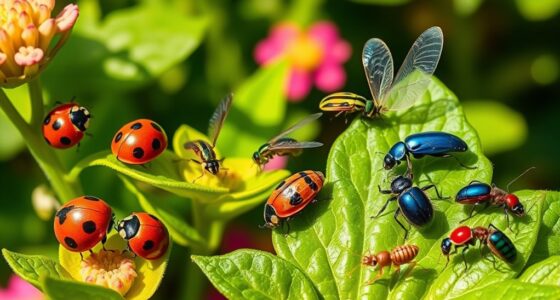
In a three-year study at the Cascadilla Community Solar Farm in Dryden, New York, researchers tested several sheep stocking rates, measured as animals per hectare. At two sheep per hectare, the combined abundance of wild bees, honey bees and lady beetles was 38% higher than in a mowed control plot. The research team said an 83% increase in honey bees was the main driver of that result. The paper, “Low solar-grazing densities support beneficial insects in agrivoltaic systems,” was published Oct. 7 in Environmental Research Letters.
Results varied at higher stocking rates. At four sheep per hectare, beneficial insect abundance was similar to the mowed control, while vegetation management was more effective than at the lower rate. At eight sheep per hectare, the team reported the greatest vegetation-management effectiveness and high flock health, but honey bee abundance was 45% lower. Those comparisons describe the study’s sites and conditions; they do not establish that the same rates will produce identical results at every solar farm.
The second paper, “Flock Management for Solar Grazing,” was published Sept. 28 in Manufacturing & Service Operations Management. Its authors developed a spreadsheet-based decision tool that helps farmers plan sheep purchases and sales using factors such as target flock size, costs, expected revenue and vegetation at a particular solar site. It also helps identify when a flock may be too small to manage the grass, requiring another method. The Ithaca-based organization United Agrivoltaics has incorporated the tool into its farmer onboarding process, according to the source material.
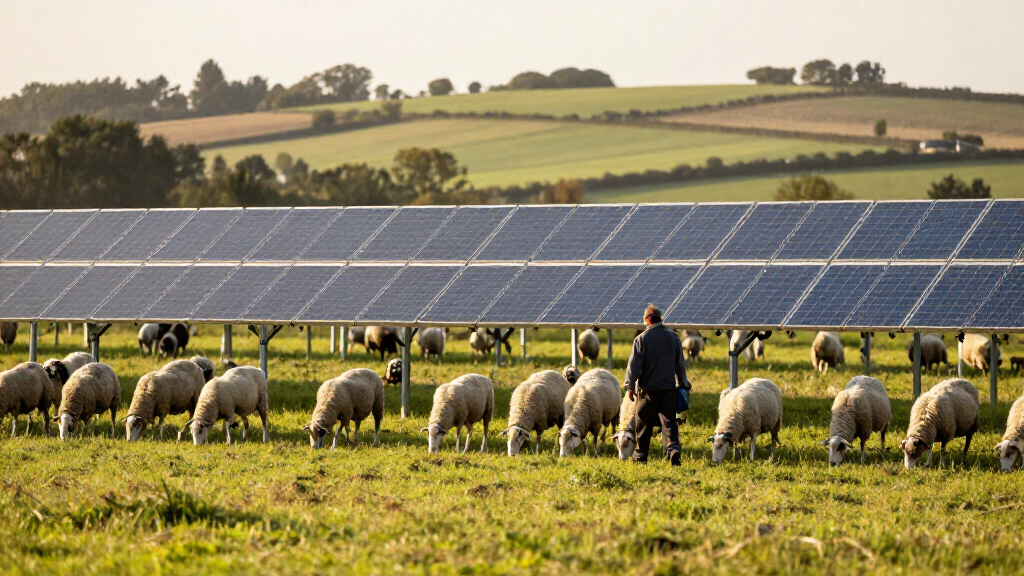
How Solar Arrays Share Fields With Grazing Sheep
Two Cornell studies examine how sheep grazing affects beneficial insects and how farmers can plan solar-grazing flocks and contracts.
Grazing density shapes trade-offs
In a three-year study at one solar farm, outcomes varied by stocking rate compared with mowing.
| Sheep per hectare | Insect findings | Vegetation control |
|---|---|---|
| Two | 38% more beneficial insects | Less effective than higher rates |
| Four | Similar to mowed control | More effective than at two |
| Eight | Honey bees 45% lower | Greatest effectiveness; high flock health |
A planning tool for farmers
A separate Cornell study developed a spreadsheet to help farmers plan flock decisions for solar-grazing contracts.
Plan sheep purchases and sales around the target flock size and site needs.
Estimate expenses and expected income before committing to a contract.
Identify when a flock may be too small to manage grass and another method is needed.
What the studies mean
The papers address connected but distinct decisions for solar developers and farmers.
- Stocking rate may affect insect outcomes.
- Vegetation control can improve at higher rates.
- Results come from one site and may vary elsewhere.
- Flock size and costs matter for contracts.
- The spreadsheet supports planning decisions.
- Industry-wide profitability gains have not been established.
Balancing Insect Habitat and Grass Control
The studies focus on decisions that solar developers and farmers must make when combining electricity production with agriculture. Grazing can manage vegetation while providing farmers access to solar-site contracts, but the insect findings suggest that stocking rate may affect ecological outcomes as well as the effectiveness of grass control. The results offer data for weighing those goals instead of treating grazing and insect habitat as separate issues.
The management tool addresses a different barrier: the costs and logistics of maintaining enough animals for a contract. Farmers need to estimate flock size, feed and other expenses, and revenue before committing to a site. A better planning process could help farmers and developers set workable terms, though the paper’s existence alone does not establish that the tool improves profitability across the industry.
The business implications may extend beyond individual farms. The source material says about half of the lamb and mutton consumed in the United States is imported, primarily from New Zealand and Australia. Cornell researcher Vincent Slaugh argued that solar-related income could support sheep-farm growth. That is a possible longer-term effect, not an outcome measured by the studies.
Products Worth Considering

Garvee 8 × 10 ft Walk-In Polycarbonate Greenhouse

Husqvarna 130 Gas Chainsaw, 16-Inch Bar

EGO Power+ 21 Cordless Electric Lawn Mower Kit, Self-Propelled (LM2135SP)
As an affiliate, we earn on qualifying purchases.
Two Studies, Different Questions
The insect study brought together researchers in agriculture, ecology, entomology and animal science, using sheep at a university-owned solar farm. Its central comparison was between different grazing densities and a mowed control. The researchers selected stocking rate as a practical measure because, as senior author Steve Grodsky said, it is a figure sheep farmers already use when planning their operations.
The management paper began after assistant professor Vincent Slaugh met Caleb Scott, an Ithaca sheep farmer and founder of United Agrivoltaics. Slaugh worked with operations-research colleagues to model flock decisions and the relationship between farm capacity and site vegetation needs. The two papers therefore address connected but distinct questions: what grazing density may mean for insects, and how farmers can plan the flock and finances needed to provide vegetation management.
““We’re trying to understand the connections between those pieces so that when solar developers, municipalities looking at solar development, or farmers are faced with a decision, they can have scientific information about potential trade-offs and synergies.””
— Steve Grodsky, senior author of the insect study and an assistant professor at Cornell
How Broadly the Findings Apply
The insect results come from one solar farm in Dryden and a three-year study. The supplied material does not provide the full study methods, sample sizes, seasonal breakdowns or statistical uncertainty, so readers cannot assess those details here. It is also unclear how soil, climate, plant mix, panel layout or local insect populations might affect outcomes at other sites. The reported differences should not be treated as universal stocking-rate recommendations.
The management paper’s model is described as a decision-support spreadsheet, but the source material does not report independent evaluations of its accuracy, the financial results of farms using it or how it performs across different regions and contract structures. United Agrivoltaics’ use of the tool in onboarding shows that it has been adopted by that organization, but does not establish broader industry uptake or proven gains in profitability.
Testing Results at More Sites
The research provides a basis for solar developers, farmers and local decision-makers to weigh stocking rates, vegetation goals and insect outcomes when planning projects. Further studies across more sites and conditions would help establish how consistently the observed patterns apply and whether other grazing strategies can meet vegetation needs while supporting beneficial insects.
For the decision tool, a key next step is evidence about how farmers and developers use it in practice, including whether it changes flock purchasing, contract terms or operating costs. The source material does not identify a scheduled follow-up study or a date for wider release. For now, both papers offer findings and planning methods, while the broader ecological and commercial effects of solar grazing remain under study.
Key Questions
What did the Cornell insect study find?
At the study site, grazing at two sheep per hectare was associated with 38% more wild bees, honey bees and lady beetles combined than a mowed control plot. The team said an 83% increase in honey bees drove most of the difference.
Did more sheep always mean better vegetation control?
In the study, vegetation management was more effective at four sheep per hectare than at two, and was greatest at eight. However, at eight sheep per hectare, the researchers also reported a 45% drop in honey bee abundance. The results show a trade-off at this site rather than a universal prescription.
What does the flock-management tool do?
The spreadsheet-based model helps farmers plan sheep purchases and sales using target flock size, costs, expected revenue and vegetation needs at a solar site. It can also help flag when the available flock may not be enough to manage the grass.
Are the study’s stocking rates recommendations for every solar farm?
No. The reported findings came from a three-year study at one solar farm in Dryden, New York. The supplied information does not establish that the same insect or vegetation outcomes will occur at sites with different conditions.
Source: Hacker News