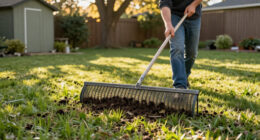
Your spreader can throw material farther than you might expect, making proper overlap essential for even coverage. If you don’t account for the wide dispersal, you risk gaps or over-application, which wastes materials and time. Environmental factors like wind, humidity, and temperature can also affect how far material travels. Understanding your spreader’s throw distance and adjusting accordingly helps you achieve uniform coverage. Keep exploring to uncover more ways to optimize your application.

Get garden gear delivered free with Prime
- Fast, free delivery on millions of items
- Prime Video, Amazon Music and more included
- Member-only deals all year
Key Takeaways
- Spreaders often project material farther than estimated, making proper overlap crucial for uniform coverage.
- Accurate knowledge of throw distance prevents gaps or over-application, saving time and resources.
- Environmental factors like wind and humidity can alter dispersal, requiring adjusted overlap strategies.
- Different spreader types have unique dispersal patterns, influencing how overlaps should be planned.
- Understanding equipment and material properties helps optimize overlap for consistent, waste-free results.

You might assume that spreaders—those tools used for dispersing seed, fertilizer, or other materials—have a limited reach, but in reality, they can throw much farther than you expect. This is especially true when you consider how different factors influence the spread pattern. One essential aspect often overlooked is the importance of overlap, which ensures even coverage and prevents gaps or over-application. When you’re using a spreader, understanding how far material travels helps you plan your passes more accurately, saving you time and material.
Spreaders can reach farther than expected; knowing their throw distance is key for even, efficient coverage.
A common mistake is assuming that all spreaders behave the same way. In reality, there are notable differences, especially when comparing types like broadcast versus drop spreaders. Broadcast spreaders tend to throw material wider, which might tempt you to set the settings higher. However, if you don’t account for the actual distance the material travels, you risk overlapping too much in some areas and missing spots in others. Precise adjustment and an understanding of how far the material will go are indispensable to efficient coverage. This is where knowing the spreader’s throw distance becomes essential, as it directly impacts your overlap strategy.
Weather plays a significant role in how far material is dispersed. Wind, humidity, and temperature can all impact the spread pattern. For example, a gust of wind can carry seed or fertilizer farther than usual, making it necessary to reduce the spreader’s settings or adjust your overlap to prevent overapplication. Conversely, damp or humid conditions might cause material to stick together or fall short, requiring you to increase your settings or overlap more to ensure even coverage. Temperature can also affect how materials disperse; in colder weather, certain fertilizers may not spread as far, prompting adjustments in your approach. Additionally, understanding spread distance variability helps you adapt more effectively to changing conditions. Recognizing the impact of environmental factors is crucial for optimizing your application and avoiding waste. Being aware of equipment specifications can help you better predict how your spreader will perform under different circumstances. Moreover, understanding the material properties of what you’re spreading can influence how far it travels and how it reacts to environmental influences.
Understanding the differences between golf club distances and spreader throw distances can be a helpful analogy. Just as different golf clubs are designed for specific ranges, spreaders have varying capacities and dispersal patterns. Recognizing these differences allows you to better gauge how far material will travel and adjust your overlap accordingly. When you consider the weather impact, you can make real-time modifications, ensuring your application remains even and efficient. Remember, the goal is to achieve uniform coverage without waste, and knowing how far your spreader throws material is fundamental for that. Overlap isn’t just a technical detail; it’s the key to a successful, precise application every time.
broadcast spreader for fertilizer
As an affiliate, we earn on qualifying purchases.
As an affiliate, we earn on qualifying purchases.
Frequently Asked Questions
How Does Weather Affect Spreader Throw Distance?
Weather impact can substantially affect your spreader’s throw distance, especially in windy conditions which push the material further than planned. Rain and humidity can also cause clumping, reducing effectiveness. That’s why equipment calibration is crucial; regularly checking and adjusting your spreader ensures consistent application despite weather changes. You should always account for weather impact when calibrating your equipment, so your spreading remains accurate and efficient regardless of outdoor conditions.
What Types of Spreaders Have the Widest Throw?
You’ll find that broadcast spreaders generally have the widest throw because their spread pattern covers a large area, thanks to their design. Their mechanics enable a more even and extensive distribution of seed or fertilizer. Some push or rotary spreaders also throw wider, but broadcast models are often the best choice if you want maximum coverage. Remember, understanding spread pattern and spreader mechanics helps you choose the right tool for efficient, wide-area coverage.
Can You Improve Spreader Accuracy With Adjustments?
Yes, you can improve spreader accuracy with adjustments. Use calibration techniques regularly to fine-tune your equipment, ensuring even distribution. Proper operator training also plays a vital role; learn to set and adjust the spreader correctly for different materials and conditions. When you combine calibration with skilled operation, you’ll achieve more precise coverage, reduce waste, and enhance overall efficiency in your spreading tasks.
How Does Seed or Fertilizer Type Influence Spreading Distance?
Seed or fertilizer type influences spreading distance like a gust of wind affects a kite’s flight. Heavier seeds or denser fertilizers tend to fall closer, reducing dispersal, while lighter materials travel farther. Choosing the right type enhances seed dispersal and fertilizer efficiency, ensuring even coverage. Adjust your spreader accordingly, considering material weight and flow properties, to optimize how far your materials spread and maximize field results.
Is There a Safety Risk With Wider Spreaders?
Wider spreaders can pose safety risks during operation if you’re not careful. Spreaders safety is vital because operational hazards increase with wider application areas, especially if you’re working near people, animals, or sensitive areas. Always check your spreader’s settings and guarantee proper training before use. Keep a safe distance, wear protective gear, and stay alert. Proper maintenance and adherence to safety guidelines help minimize operational hazards and guarantee a safe spreading process.
As an affiliate, we earn on qualifying purchases.
Conclusion
Next time you’re spreading, remember: your spreaders throw wider than you think, and overlap isn’t just about coverage—it’s about precision. Like a painter stepping back from their canvas, you might assume your work is tight, but gaps and overlaps tell a different story. Embrace the width, control the overlap, and turn a simple task into an art form. After all, in spreading as in life, a little extra reach can make all the difference.
As an affiliate, we earn on qualifying purchases.
As an affiliate, we earn on qualifying purchases.
Fall yard work Picks
leaf blowers
As an affiliate, we earn on qualifying purchases.