
TL;DR
A viable peach seed can be started by keeping a cleaned pit or kernel in a barely moist medium in the refrigerator for roughly three to four months. Iowa State University Extension recommends 98–105 days for peaches, while University of Georgia guidance gives 90–130 days for several peach rootstocks. University of Minnesota Extension notes that seedlings may differ from the parent peach in fruit and other traits, so growing from a pit is an experiment rather than a way to guarantee a particular variety.
A peach tree can be grown from a viable seed inside a pit, but the seed generally needs a period of cold, moist stratification before it will sprout. Iowa State University Extension recommends 98–105 days of chilling for peaches, while University of Georgia guidance gives 90–130 days for several peach rootstocks. Even if a seedling grows, University of Minnesota Extension explains that its fruit and other traits are not guaranteed to match the peach it came from.

Get garden gear delivered free with Prime
- Fast, free delivery on millions of items
- Prime Video, Amazon Music and more included
- Member-only deals all year
First wash the flesh from a pit taken from a fully ripe peach and let the hard stone dry briefly so it is easier to handle. The seed, or kernel, is inside the pit. Gardeners can chill the intact pit or carefully remove the kernel; cracking the stone is optional and can damage the seed. The seed should not be eaten.
Place the pit or kernel in a labeled bag with clean sand, vermiculite or another suitable medium that is damp but not dripping. Make small ventilation holes, then refrigerate the bag at about 35–40°F, keeping it away from the freezer compartment. Check it regularly for drying, mold or a root beginning to emerge. Plant promptly when a healthy root appears, taking care not to bend or break it.
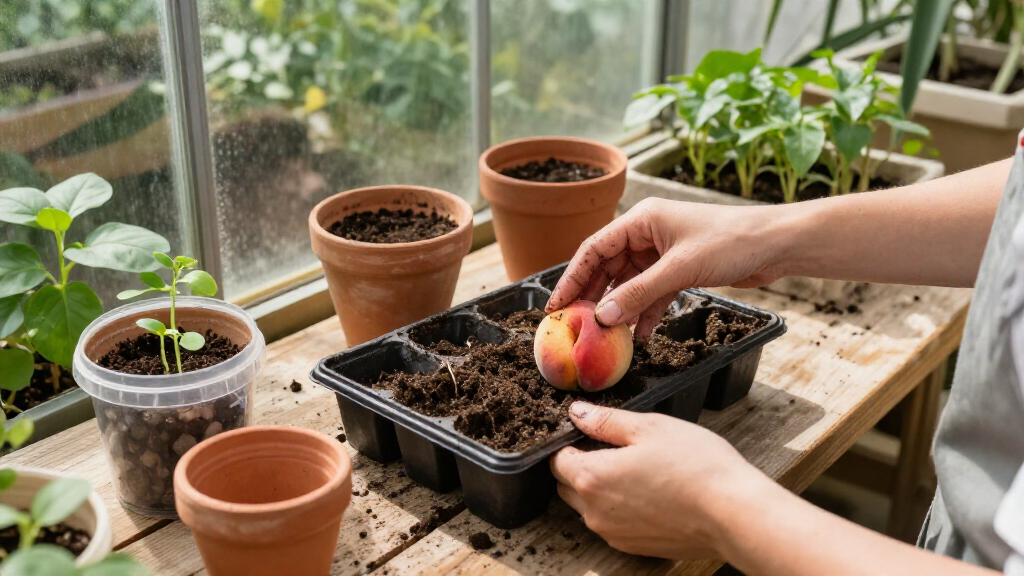
Use a deep container with drainage holes and fresh, freely draining potting mix. Plant a germinated seed with its root pointing down, at about 1½–2 inches below the surface, then water to settle the mix. Keep the soil moist but not waterlogged. Once shoots emerge, give the seedling strong light; indoor growers may need a suitable grow light.
Grow a Peach Tree from a Pit
Cold, moist stratification can help a viable peach seed sprout. Growing from a pit is an experiment: the resulting tree may not match its parent.
Prepare and chill the seed
Keep the medium damp, not dripping, and check the bag regularly.
Wash away the ripe peach flesh and let the hard stone dry briefly. Chill the intact pit or carefully remove the kernel.
Place it in a labeled, ventilated bag with damp clean sand, vermiculite or another suitable medium. Keep it away from the freezer.
Watch for drying, mold or a root beginning to emerge. Plant promptly when a healthy root appears.
Plant and raise the seedling
Give the root room
Use a deep pot with drainage and fresh, freely draining mix. Point the root down and cover the seed with about 1½–2 inches of mix.
Moist soil, strong light
Water to settle the mix and keep it moist, not waterlogged. Give emerging shoots strong light; indoors, a suitable grow light may help.
Acclimate gradually
After freezing weather passes, introduce the seedling gradually to outdoor sun and wind over about a week. Choose full sun and well-drained soil.
A seedling is not a named variety
Seed-grown trees may differ from the parent in fruit quality, ripening time, size or other traits.
- Low-cost growing experiment
- Fruit and tree traits are uncertain
- Harvest is not guaranteed
- Reproduces a named variety
- Offers a selected rootstock
- Fruit still depends on site and care
What to expect
| Question | What guidance says |
|---|---|
| Will every seed sprout? | No. Viability, moisture, oxygen and chilling all matter. |
| Will fruit match the parent? | No guarantee. Seedlings can inherit different traits. |
| When might it bear? | About three to five years under favorable conditions, or longer. |
What Seedlings Can—and Cannot—Promise
Starting a peach from a pit is a low-cost way to grow a tree and observe how a fruit seed develops. University of Minnesota Extension explains that fruit trees grown from seed may not come true to the parent because seedlings inherit a new combination of traits. The seedling may differ in fruit quality, ripening time, tree size or other characteristics, so a successful sprout is not a guarantee of a reliable harvest.
That distinction matters for gardeners choosing between experimentation and predictable variety selection. A seedling’s performance depends on its genetics and growing conditions, and its mature winter-chill needs may not suit every location. University extension guidance on fruit-tree propagation describes grafting as the method used to reproduce named varieties; a grafted nursery tree offers more known traits and a selected rootstock, though fruiting still depends on the site and care.
Outdoor planting requires more than waiting for a root to appear. Protect indoor seedlings from freezing weather, then acclimate them gradually to outdoor sun and wind over about a week. Choose a full-sun site with well-drained soil and allow room for a potentially large tree; seed-grown trees do not inherit the size control of a nursery rootstock.
Products Worth Considering

Solo Stove Pi Prime Portable Propane Pizza Oven

Husqvarna Automower 410iQ Wire-Free Robotic Lawn Mower

Husqvarna Automower 550 Commercial Robotic Lawn Mower
As an affiliate, we earn on qualifying purchases.
Why Peach Seeds Need Winter-Like Chilling
Many peach seeds are dormant and need exposure to cold and moisture before germination. Cold stratification imitates winter conditions. Iowa State University Extension recommends 98–105 days for peaches, while University of Georgia guidance gives 90–130 days for several peach rootstocks. These are source-specific planning ranges, not fixed deadlines for every seed.
After outdoor planting, handle the young tree gently and keep its soil moisture under observation. As it develops, branches may need training and leaves and stems should be checked for symptoms. University of Minnesota Extension notes that seed-grown fruit trees can take several years to bear; a peach seedling may begin bearing in roughly three to five years under favorable conditions, but it can take longer. Climate, genetics, care, winter survival and damage to blossoms all affect the outcome.
What a Peach Pit Cannot Tell You
Germination is not assured: the seed must be viable, receive suitable moisture and oxygen, and get an adequate cold period. Iowa State University Extension recommends 98–105 days for peaches, while University of Georgia guidance gives 90–130 days for several peach rootstocks. Neither source establishes a deadline for an individual seed, and the exact time to sprout varies.
The seedling’s eventual fruit, size, climate suitability and time to bearing also remain uncertain. University of Minnesota Extension explains that seed-grown fruit trees may not reproduce the parent’s traits. A tree may not fruit at all if growing conditions are unsuitable or winter and bloom conditions damage it. The cited university extension guidance describes general growing and propagation practices, not a guarantee that any particular pit will produce a healthy tree or edible fruit.
From Chilled Seed to Outdoor Tree
Check the refrigerated bag regularly through the chilling period. When a healthy root emerges, plant the seed promptly in a draining container and provide strong light after the shoot appears. Once freezing weather has passed, gradually expose an indoor-grown seedling to outdoor conditions before moving it to its permanent site.
Over the following seasons, monitor growth and water needs, train branches as the tree develops, and watch for signs of problems before deciding on treatment. University extension guidance describes grafting as the way to reproduce named fruit varieties; gardeners who want known variety traits can compare grafted nursery trees. Those continuing with a seedling should treat its eventual harvest as uncertain.
Key Questions
Can you grow a peach tree from a peach pit?
Yes. A pit contains a seed that can grow into a tree if it is viable and receives suitable conditions, including cold, moist stratification for many peach seeds. University extension guidance describes this as a general method, not a guarantee for an individual seed.
How long should a peach seed be cold-stratified?
Iowa State University Extension recommends 98–105 days for peaches; University of Georgia guidance gives 90–130 days for several peach rootstocks. These ranges support planning for about three to four months, but individual seeds may vary.
Does the seed need to be removed from the hard pit?
No. You can chill the intact pit or remove the kernel carefully. Cracking the pit is optional and risks damaging the seed; do not eat the seed.
Will a tree grown from a pit produce the same peaches?
That is not guaranteed. University of Minnesota Extension explains that seedlings may not reproduce the parent fruit’s traits, so they can differ in fruit and other characteristics. A grafted nursery tree is a better choice when a named variety and selected rootstock matter.
How long until a seed-grown peach tree bears fruit?
A seed-grown peach may begin bearing in about three to five years under favorable conditions, but it can take longer and fruiting is not guaranteed. University of Minnesota Extension notes that seed-grown fruit trees can take several years to bear; genetics, climate and care affect the timing.
Source: groworganic.com