The best traditional greenhouse overall in this roundup is the Jocisland 6 × 12 ft Walk-In Polycarbonate Greenhouse, a practical middle ground between growing space and a manageable footprint. For a larger garden, the Coumy 8 × 14 ft offers more room, while the Backyard Discovery Bellerose XL stands out for its cedar construction and pergola design. The main tradeoffs are usable growing area, frame material, glazing, ventilation, and assembly demands. Wooden models bring a classic garden look, while metal-frame options emphasize function and often ask less visual commitment. Read on for the full comparison and guidance on choosing a greenhouse that suits your site and growing plans.

Get garden gear delivered free with Prime
- Fast, free delivery on millions of items
- Prime Video, Amazon Music and more included
- Member-only deals all year
Complete the kit


Key Takeaways
The Jocisland 6 × 12 ft polycarbonate model earns the overall nod because it balances walk-in room with a footprint that is less demanding than the 8 × 14 ft Coumy or 10 × 13.2 ft Jocisland.
The cedar models—especially the Bellerose XL and Poppy—make the strongest case for buyers who want a greenhouse to look like a lasting garden structure, not just growing equipment.
Ventilation is a meaningful point of separation: the Jocisland 6 × 12 ft specifies two roof vents, while larger dimensions alone do not tell you how well heat can escape.
Built-in extras serve different needs rather than adding universal value: the PHONDIKO pairs its walk-in layout with irrigation, while the 6 × 4 ft option includes a hygrometer for monitoring conditions.
Frame and panel choices shape upkeep as much as appearance: wood brings a traditional presence but calls for care, while aluminum and galvanized steel alternatives prioritize a more utilitarian structure.
| Coumy 8 × 14 ft Walk-In Greenhouse with Polycarbonate Panels |  | Best for Flexible, Spacious Growing | Brand: Coumy | Model: DJ1286 | Dimensions: 160.98 × 87.8 × 85 in | VIEW LATEST PRICE | See Our Full Breakdown |
| 6 × 4 ft Greenhouse with Hygrometer | 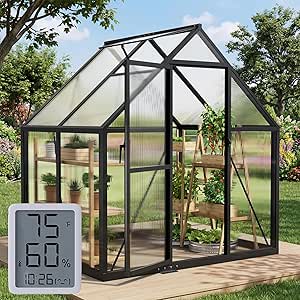 | Best Compact Pick for Beginners | Dimensions: 6 × 4 ft | Frame material: Aluminum alloy | Panel material: Double-wall polycarbonate | VIEW LATEST PRICE | See Our Full Breakdown |
| Backyard Discovery Bellerose XL Cedar Wood Greenhouse with Pergola |  | Best Premium Traditional Greenhouse | Brand: Backyard Discovery | Model: 2404113 | Dimensions: 13 ft × 11 ft | VIEW LATEST PRICE | See Our Full Breakdown |
| Jocisland 6 × 12 ft Walk-In Polycarbonate Greenhouse with Two Roof Vents |  | Best Value for a Long Walk-In Layout | Brand: Jocisland | Model: YPG207 | Dimensions: 6 × 12 × 6.4 ft | VIEW LATEST PRICE | See Our Full Breakdown |
| Rotihom 7 x 8 ft Wooden Greenhouse with 9 mm Polycarbonate Panels |  | Best Wooden Greenhouse for Organized Growing | Brand: Rotihom | Size: 7 × 8 ft | Dimensions: 93.3 × 84.6 × 80.3 in | VIEW LATEST PRICE | See Our Full Breakdown |
| PHONDIKO 15 × 7 × 7 ft Walk-In Greenhouse with Irrigation System | 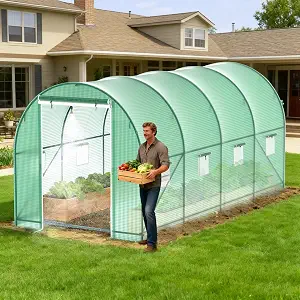 | Best for Built-In Watering | Dimensions: 178 × 78 × 78 in | Footprint: 15 × 7 ft | Frame: Galvanized steel with horizontal crossbars and four diagonal bars | VIEW LATEST PRICE | See Our Full Breakdown |
| Modern Shade 6.5’x8′ Wooden Greenhouse with USB Charging Power Strip |  | Best for Integrated Garden Utilities | Dimensions: 6.5 × 8 ft | Peak height: 8 ft | Wood: FSC Certified cedar | VIEW LATEST PRICE | See Our Full Breakdown |
| Backyard Discovery Poppy 11 x 7 ft Cedar and Polycarbonate Walk-In Greenhouse Kit |  | Best for Year-Round Growing Capacity | Dimensions: 11 × 7 ft | Interior space: 78 sq ft | Materials: Cedar wood and four-wall polycarbonate panels | VIEW LATEST PRICE | See Our Full Breakdown |
| Jocoevol 6 x 8 ft Galvanized Steel Walk-In Greenhouse |  | Best Compact Rigid-Panel Pick | Dimensions: 95.59 × 70.86 × 77.16 in | Footprint: 6 × 8 ft | Frame: Galvanized steel with support rods | VIEW LATEST PRICE | See Our Full Breakdown |
| Jocisland 10 x 13.2 ft Wooden Greenhouse |  | Best for a Large Cedar Footprint | Dimensions: 13.2 × 10 × 8 ft | Weight: 314 lb | Frame: Cedar with metal hardware | VIEW LATEST PRICE | See Our Full Breakdown |
| Garvee 6 x 10 ft Aluminum Greenhouse with Polycarbonate Panels |  | Best for Stability in a Mid-Size Aluminum Greenhouse | Dimensions: 6 x 10 ft | Frame material: Reinforced aluminum | Panel material: Polycarbonate | VIEW LATEST PRICE | See Our Full Breakdown |
| traditional greenhouse | Dimensions | Ventilation |
|---|---|---|
| Coumy 8 × 14 ft Walk-In Greenh | 160.98 × 87.8 × 85 in | 4 adjustable windows |
| 6 × 4 ft Greenhouse with Hygro | 6 × 4 ft | Adjustable roof vents |
| Backyard Discovery Bellerose X | 13 ft × 11 ft | Temperature-activated exhaust fan and 2 windows |
| Jocisland 6 × 12 ft Walk-In Po | 6 × 12 × 6.4 ft | — |
| Rotihom 7 x 8 ft Wooden Greenh | 93.3 × 84.6 × 80.3 in | 1 adjustable roof vent, 19 × 18 in |
| PHONDIKO 15 × 7 × 7 ft Walk-In | 178 × 78 × 78 in | — |
| Modern Shade 6.5’x8′ Wooden Gr | 6.5 × 8 ft | Four fans in a symmetrical configuration |
| Backyard Discovery Poppy 11 x | 11 × 7 ft | Temperature-activated exhaust fan and two windows |
| Jocoevol 6 x 8 ft Galvanized S | 95.59 × 70.86 × 77.16 in | — |
| Jocisland 10 x 13.2 ft Wooden | 13.2 × 10 × 8 ft | Two adjustable roof vents |
| Garvee 6 x 10 ft Aluminum Gree | 6 x 10 ft | Adjustable vents |
More Details on Our Top Picks
Coumy 8 × 14 ft Walk-In Greenhouse with Polycarbonate Panels
The Coumy suits gardeners who want a roomy traditional greenhouse without moving up to the much more elaborate Backyard Discovery Bellerose XL. Its 8 × 14 ft footprint leaves space for plants and supplies, while four adjustable windows let you tune airflow as conditions change. UV-blocking polycarbonate panels, two lockable doors, and rain gutters make it a practical enclosed growing space with useful access and water-management features. The reinforced aluminum frame and six ground anchors add support, but the panel gaps may need glass glue for a tighter seal and added stability. Assembly is eased by slide-in panels and labeled parts; still, the two-package shipment can arrive separately. Choose it over the 6 × 4 ft Greenhouse with Hygrometer when interior room matters more than a compact footprint.
Pros:- Spacious 8 × 14 ft layout accommodates plants and gardening supplies.
- Four adjustable windows provide several ways to manage airflow.
- Reinforced aluminum frame, six ground anchors, and two lockable doors support outdoor use and access.
- Rain gutters and slide-in, labeled panels add practical water-management and assembly features.
Cons:- Glass glue may be needed to seal panel gaps and improve stability.
- Ships in two separate packages, which may arrive at different times.
Best for: Gardeners who want a sizable walk-in growing space with multiple ventilation points, two entrances, and room for gardening supplies.
Not ideal for: Buyers seeking a small, quick-to-assemble greenhouse or a kit that needs no extra panel sealing; this one has a large footprint and may require glass glue.
- Brand:Coumy
- Model:DJ1286
- Dimensions:160.98 × 87.8 × 85 in
- Frame:Reinforced aluminum
- Panels:UV-blocking polycarbonate
- Ventilation:4 adjustable windows
- Doors:2 lockable doors
- Ground anchors:6
Our verdict“Choose the Coumy if you want a roomy aluminum-and-polycarbonate greenhouse with flexible ventilation and can handle panel sealing during setup.”
6 × 4 ft Greenhouse with Hygrometer
This compact greenhouse is the most approachable choice here for growers who need a protected place for a modest plant collection rather than a full backyard growing room. Its 6 × 4 ft footprint takes up less space than the Jocisland 6 × 12 ft Walk-In Greenhouse, while 4 mm double-wall polycarbonate is designed to guard plants against weather and harmful UV rays. Adjustable roof vents offer a simple way to release warm air, and the lockable door keeps the enclosure closed when not in use. The kit includes instructions and tools, though assembly may be easier with another person. Its compact scale is also its main limit: it offers less room to move around, add benches, or expand a larger collection. Panel gaps may need glass glue for reinforcement.
Pros:- Compact 6 × 4 ft footprint fits smaller growing areas.
- 4 mm double-wall polycarbonate panels are designed for weather and UV protection.
- Adjustable roof vents and a lockable door add useful basic controls.
- Assembly instructions and tools are included.
Cons:- Limited interior space leaves little room for larger collections or working comfortably inside.
- Assembly may be easier with help.
- Glass glue may be needed to reinforce panel gaps.
Best for: New gardeners or homeowners with limited yard space who want a small, enclosed greenhouse for a focused collection of plants.
Not ideal for: Gardeners who need a walk-in work area, space for multiple benches, or a greenhouse they can assemble entirely alone.
- Dimensions:6 × 4 ft
- Frame material:Aluminum alloy
- Panel material:Double-wall polycarbonate
- Panel thickness:4 mm
- Panel weight:580 g
- Ventilation:Adjustable roof vents
- Door:Lockable
Our verdict“Pick this greenhouse for a compact, straightforward start to protected growing, but choose the Jocisland 6 × 12 ft model if you need more walk-in room.”
Backyard Discovery Bellerose XL Cedar Wood Greenhouse with Pergola
The Bellerose XL is the most feature-rich traditional greenhouse in this group, combining a 143 sq ft interior with cedar construction and four-wall polycarbonate panels. Unlike the more straightforward aluminum-framed Coumy 8 × 14 ft, it arrives with a workstation, extensive staging shelves, plant hooks, hose hookups, and a temperature-activated exhaust fan. That built-in infrastructure makes it better suited to gardeners who want a dedicated growing and potting space, not just a protected shell. Its stated snow and wind resistance depends on anchoring the structure as specified, and the PowerPort needs an external power source. Assembly is also a larger undertaking than the compact 6 × 4 ft Greenhouse with Hygrometer. The cedar-and-polycarbonate design and five-year warranty support a more substantial setup, but buyers should plan for installation and anchoring.
Pros:- 143 sq ft interior includes a workstation, extensive shelving, and plant hooks.
- Cedar construction and four-wall polycarbonate panels support a durable, insulated growing enclosure.
- Temperature-activated exhaust fan and two windows provide built-in ventilation.
- Includes interior and exterior hose hookups plus a PowerPort with outlets and USB ports.
Cons:- Assembly and the substantial footprint require significant space and setup effort.
- Power source for the PowerPort is not included.
- Stated weather-resistance ratings depend on anchoring as specified.
Best for: Dedicated gardeners who want a large, furnished greenhouse with integrated ventilation, shelving, hose hookups, and electrical access.
Not ideal for: Buyers with limited space, a preference for a simple greenhouse kit, or no suitable power source and anchoring plan.
- Brand:Backyard Discovery
- Model:2404113
- Dimensions:13 ft × 11 ft
- Interior area:143 sq ft
- Materials:Cedar wood and four-wall polycarbonate
- Roof snow load:Up to 9,200 lb or 30 in of snow
- Wind resistance:Up to 100 mph when anchored as specified
- Ventilation:Temperature-activated exhaust fan and 2 windows
- Warranty:5 years
Our verdict“Choose the Bellerose XL if you want a furnished, large-scale growing space and are prepared to assemble, anchor, and power it.”
Jocisland 6 × 12 ft Walk-In Polycarbonate Greenhouse with Two Roof Vents
The Jocisland offers a useful middle ground for gardeners who want a walk-in greenhouse but do not need the Coumy’s 8 × 14 ft footprint or its four adjustable windows. At 6 × 12 ft, it provides a long growing area for rows of plants while keeping the overall width narrower. Its 4 mm polycarbonate panels are listed as blocking 99.99% of UV rays, and two adjustable roof vents help warm air escape. Reinforced supports, ground stakes, and bolts add structural support, while quick-connect joints are intended to simplify assembly. The product details list both aluminum and steel for the frame, so the exact material composition is unclear. Assembly is described as a two-person, 2–3-hour job; that is quicker on paper than setting up the much larger Bellerose XL, but it is not a solo build.
Pros:- 6 × 12 ft walk-in layout offers useful growing length in a relatively narrow footprint.
- Two adjustable roof vents support airflow.
- 4 mm polycarbonate panels are specified to block 99.99% of UV rays.
- Reinforced supports, stakes, bolts, and quick-connect joints are included.
Cons:- Assembly requires two people.
- Product details give mixed descriptions of the frame material, listing aluminum and steel.
Best for: Gardeners who want a long, narrow walk-in greenhouse with roof ventilation and room for plant rows without a very wide footprint.
Not ideal for: Solo assemblers or buyers who want fully clear frame-material details before choosing a greenhouse.
- Brand:Jocisland
- Model:YPG207
- Dimensions:6 × 12 × 6.4 ft
- Frame material:Listed as aluminum; product details also mention steel
- Cover material:4 mm polycarbonate
- UV protection:Blocks 99.99% of UV rays
- Door:1 swing door
- Roof vents:2 adjustable vents
- Assembly:About 2–3 hours for two people
Our verdict“Choose the Jocisland for a narrow, walk-in growing layout with two roof vents, provided you have a helper for assembly.”
Rotihom 7 x 8 ft Wooden Greenhouse with 9 mm Polycarbonate Panels
The Rotihom stands apart from the aluminum-frame options with a spruce wood frame and thicker, 9 mm polycarbonate panels. That combination gives it a more substantial wooden character than the 6 × 4 ft Greenhouse with Hygrometer, while its 7 × 8 ft footprint is far smaller than the cedar Bellerose XL. Inside, a folding two-sided shelf and tool-hook panel help keep supplies organized; folding the shelf away makes room for taller plants. One adjustable roof vent provides basic airflow, but the kit has no exhaust fan, and the listed fan installation area is not a supplied fan. At 226 lb, it is a heavy structure to position, and the single vent offers less ventilation flexibility than the Coumy’s four windows. This suits buyers who value wood construction and built-in organization over powered climate control.
Pros:- Spruce wood frame and 9 mm polycarbonate panels create a substantial greenhouse structure.
- Folding shelf can be stowed to free space for taller plants.
- Tool-hook panel provides a dedicated place to organize gardening tools.
- Metal reinforcements are included for outdoor use.
Cons:- Exhaust fan is not included, despite the listed fan installation area.
- At 226 lb, the greenhouse is heavy to position.
- One adjustable roof vent offers less airflow flexibility than the Coumy’s four windows.
Best for: Gardeners who prefer a wood-framed greenhouse with thicker polycarbonate panels, a stowable shelf, and dedicated tool storage.
Not ideal for: Buyers who need powered ventilation, several adjustable vents, or a lighter greenhouse that is easy to reposition.
- Brand:Rotihom
- Size:7 × 8 ft
- Dimensions:93.3 × 84.6 × 80.3 in
- Weight:226 lb
- Frame material:Spruce wood
- Panel material:Polycarbonate, 9 mm thick
- Door:1
- Ventilation:1 adjustable roof vent, 19 × 18 in
- Exhaust fan:Not included
Our verdict“Choose the Rotihom if wood construction and flexible built-in storage matter more to you than powered ventilation or easy repositioning.”
PHONDIKO 15 × 7 × 7 ft Walk-In Greenhouse with Irrigation System
The PHONDIKO pairs a large walk-in footprint with an included watering line, making it a practical pick for growers who want room for multiple plant rows without setting up a separate irrigation kit. Its 32-foot hose has three adjustable nozzles, while eight screen windows give air more routes through the PE-covered structure. Compared with the more permanent cedar-and-polycarbonate Backyard Discovery Poppy, this greenhouse is lighter in construction and comes with a flexible cover rather than rigid panels; that makes it a different fit for gardeners prioritizing a roomy growing space and included watering features. The tradeoffs are meaningful: the extended base needs to be secured with stones or sandbags, and the product information does not spell out assembly demands. I would choose it for capacity and convenience, not for a set-and-forget structure.
Pros:- 15 × 7 ft footprint provides room for multiple planting areas.
- Eight screen windows support cross-ventilation.
- Included 32-foot hose has three adjustable, removable nozzles.
- Galvanized steel frame and reinforced PE cover add structural support and weather resistance.
Cons:- The extended base needs stones or sandbags for added stability.
- Assembly steps and setup requirements are not detailed in the supplied product information.
Best for: Gardeners who want a spacious walk-in growing area and an included adjustable watering line.
Not ideal for: Buyers seeking a rigid-panel greenhouse for a more permanent setup, or anyone unable to secure the extended base against movement.
- Dimensions:178 × 78 × 78 in
- Footprint:15 × 7 ft
- Frame:Galvanized steel with horizontal crossbars and four diagonal bars
- Cover:140 g/m² polyethylene; described as 99% waterproof, UV-resistant, and tear-resistant
- Doors and windows:Two roll-up doors and eight screen windows
- Irrigation:32 ft trimmable hose with three removable adjustable nozzles
- Intended use:Outdoor
Our verdict“Choose the PHONDIKO if you want a roomy soft-cover greenhouse with watering hardware included and can anchor its base securely.”
Modern Shade 6.5’x8′ Wooden Greenhouse with USB Charging Power Strip
This cedar greenhouse stands apart from simpler structures by bringing irrigation, powered outlets, and four ventilation fans into one compact footprint. The 8-foot peak gives tall plants and standing gardeners more headroom than a low-profile shelter, while the 6mm polycarbonate roof panels add an insulated roof surface. Compared with the Backyard Discovery Poppy, which offers substantially more floor area and extensive staging, the Modern Shade is better suited to a smaller garden where built-in utilities matter more than capacity. Its integrated systems also create the main drawback: plumbing and electrical components can make assembly more involved than a basic greenhouse kit. Cedar needs regular care outdoors, too. I would favor it for an organized, utility-rich growing space, but not for buyers who want minimal upkeep or a straightforward build.
Pros:- Eight-foot peak offers generous vertical growing and standing room.
- Integrated brass-faucet irrigation reduces the need for a separate watering setup.
- Four symmetrically arranged fans support air circulation.
- USB, USB-C, and standard outlets add convenient access to power.
Cons:- Integrated plumbing and electrical features may complicate assembly.
- Cedar requires regular maintenance to limit weathering.
- The 6.5 × 8 ft footprint provides less growing area than larger options such as the Backyard Discovery Poppy.
Best for: Gardeners with a compact outdoor space who want integrated watering, ventilation, and convenient power access.
Not ideal for: Buyers who want a simple assembly, a low-maintenance frame, or extensive floor space for large plant collections.
- Dimensions:6.5 × 8 ft
- Peak height:8 ft
- Wood:FSC Certified cedar
- Roof panels:6mm polycarbonate
- Ventilation:Four fans in a symmetrical configuration
- Power:USB, USB-C, and two standard outlets
- Irrigation:Integrated faucet kit with 1/2-inch brass faucet
Our verdict“Pick the Modern Shade if integrated utilities and headroom matter more to you than the larger growing area offered by the Poppy.”
Backyard Discovery Poppy 11 x 7 ft Cedar and Polycarbonate Walk-In Greenhouse Kit
The Poppy earns its place through a balanced combination of 78 square feet of growing space, cedar framing, and four-wall polycarbonate panels. Its shelving and four-tier staging rack make it easier to keep propagation supplies and established plants organized than in the more open PHONDIKO, while a temperature-activated exhaust fan works alongside two windows for ventilation. The included hose hookups and PowerPort also support everyday garden tasks, though the PowerPort needs an external power source. Listed wind and snow capacities apply when the greenhouse is anchored as specified, so site preparation is part of the deal. Compared with the compact Modern Shade, the Poppy gives gardeners more room for benches and plant collections, but it occupies more yard space and requires proper assembly and anchoring. This is the strongest fit here for a structured, feature-rich growing room.
Pros:- 78 sq ft interior pairs with 45 linear feet of fixed shelving and a four-tier staging rack.
- Temperature-activated exhaust fan and two windows provide active and natural ventilation.
- Cedar construction and four-wall polycarbonate panels are designed for year-round gardening.
- Interior and exterior hose hookups plus outlets and USB ports support routine garden work.
Cons:- The PowerPort requires a power source that is not included.
- Assembly and anchoring are required.
- Its footprint takes more yard space than compact choices such as the Modern Shade.
Best for: Gardeners planning a substantial year-round growing space who want built-in shelving, ventilation, hose hookups, and electrical access.
Not ideal for: Small-yard growers or buyers who cannot anchor the structure as specified or provide a power source for the PowerPort.
- Dimensions:11 × 7 ft
- Interior space:78 sq ft
- Materials:Cedar wood and four-wall polycarbonate panels
- Ventilation:Temperature-activated exhaust fan and two windows
- Storage:45 linear feet of fixed shelves and a four-tier staging rack
- PowerPort:Three electrical outlets and three USB ports; external power source not included
- Hose hookups:Interior and exterior
Our verdict“Choose the Poppy for a roomy, organized greenhouse with useful built-ins, provided you can anchor it properly and supply power.”
Jocoevol 6 x 8 ft Galvanized Steel Walk-In Greenhouse
The Jocoevol is a compact rigid-panel greenhouse for gardeners who prefer polycarbonate over the flexible PE cover on the PHONDIKO. Its double-layer panels are described as blocking 99% of harmful UV rays, and the galvanized steel frame has support rods; together, those features suit buyers looking for a more structured enclosure in a 6 × 8 ft footprint. The adjustable roof vent helps release warm air, while the sloped roof supports drainage. A lockable door handle adds a practical security feature that is absent from the PHONDIKO’s listed details. The tradeoff is setup: the bottom frame must sit in a pre-dug trench, making site preparation less straightforward than the supplied instructions and tools might suggest. Compared with the much larger Backyard Discovery Poppy, this option sacrifices room and built-in amenities for a smaller footprint and simpler feature set.
Pros:- Double-layer polycarbonate panels are described as blocking 99% of harmful UV rays.
- Galvanized steel frame includes support rods.
- Adjustable roof vent and sloped roof support airflow and drainage.
- Installation instructions and tools are included.
Cons:- The bottom frame must be installed in a pre-dug trench.
- Its 6 × 8 ft footprint offers less capacity than the Backyard Discovery Poppy.
- The supplied product details do not specify a panel thickness or a snow or wind rating.
Best for: Gardeners with limited yard space who want a rigid-panel greenhouse with a roof vent and lockable door.
Not ideal for: Buyers who cannot prepare a trench for the bottom frame or need a large interior for shelving and multiple plant zones.
- Dimensions:95.59 × 70.86 × 77.16 in
- Footprint:6 × 8 ft
- Frame:Galvanized steel with support rods
- Panels:Double-layer polycarbonate; described as blocking 99% of harmful UV rays
- Door:One door with lockable handle
- Ventilation and drainage:Adjustable roof vent and sloped roof
- Installation:Instructions and tools included; bottom frame requires a pre-dug trench
Our verdict“Choose the Jocoevol if you want a compact rigid-panel greenhouse and can handle the required trench preparation.”
Jocisland 10 x 13.2 ft Wooden Greenhouse
With a listed footprint of 13.2 × 10 ft, this Jocisland offers more space than the 11 × 7 ft Backyard Discovery Poppy, making it a compelling choice for gardeners who want a broad cedar-and-polycarbonate enclosure without relying on a flexible cover. Its two doors can make access more convenient across a larger layout, and the adjustable roof vents let growers respond to changing heat and humidity. Pre-assembled walls, doors, and windows are intended to simplify assembly, but they do not remove the work of putting a large structure together. At 314 lb, moving components into position may also take extra help and planning. The listed wall height is 5.45 ft, with a 7.68 ft peak, so headroom is not uniform across the interior. Compared with the Poppy, it gives up the listed shelves, rack, fan, and power features for more floor area and a simpler set of built-ins.
Pros:- Large 13.2 × 10 ft footprint offers more floor area than the Backyard Discovery Poppy.
- Cedar frame pairs with polycarbonate panels for an insulated, UV-protective enclosure.
- Two doors and two adjustable roof vents support access and airflow.
- Pre-assembled walls, doors, and windows are designed to simplify assembly.
Cons:- At 314 lb, the components can be difficult to move and position.
- Assembly is still required despite the pre-assembled sections.
- The listed 5.45 ft wall height provides less headroom near the sides than at the peak.
Best for: Gardeners with room for a large cedar greenhouse who prioritize floor area and two-door access over integrated shelving or powered ventilation.
Not ideal for: Buyers with narrow access routes, limited help for moving heavy parts, or a preference for a greenhouse with built-in staging and an exhaust fan.
- Dimensions:13.2 × 10 × 8 ft
- Weight:314 lb
- Frame:Cedar with metal hardware
- Panels:Polycarbonate
- Doors:Two
- Ventilation:Two adjustable roof vents
- Wall and peak height:5.45 ft wall height; 7.68 ft peak height
- Assembly:Pre-assembled walls, doors, and windows; assembly required
Our verdict“Pick the Jocisland for a spacious cedar greenhouse if you have the room and help to manage its heavy components.”
Garvee 6 x 10 ft Aluminum Greenhouse with Polycarbonate Panels
The Garvee 6 x 10 ft pairs a reinforced aluminum frame with polycarbonate panels, making it a practical choice for gardeners who want a walk-in setup without moving to one of the lineup’s larger footprints. Its four reinforced ground nails and two mid-post supports add anchoring and frame support, while adjustable vents give you a way to manage airflow. UV-coated panels and roof drainage round out the weather-minded details. Compared with the Coumy 8 × 14 ft, the Garvee takes up less space and has more clearly specified ground supports, but offers a smaller growing area. Assembly is required, though tools, instructions, and videos are included. This pick suits buyers who value a supported aluminum structure; gardeners seeking a wood-frame look or a substantially larger workspace should compare other options.
Pros:- Reinforced aluminum frame with four ground nails and two mid-post supports
- Adjustable vents allow airflow to be managed
- UV-coated polycarbonate panels and roof drainage system
- Assembly tools, instructions, and videos are included
Cons:- Requires assembly, which can take time and coordination
- Its 6 x 10 ft footprint provides less growing space than larger options such as the Coumy 8 × 14 ft
- Aluminum construction may not suit buyers who prefer the appearance of the wooden greenhouse models in this lineup
Best for: Gardeners with room for a 6 x 10 ft walk-in greenhouse who want an aluminum frame, adjustable ventilation, and included anchoring supports.
Not ideal for: Gardeners who want a low-assembly setup, a wooden greenhouse appearance, or the larger growing footprint of the Coumy 8 × 14 ft.
- Dimensions:6 x 10 ft
- Frame material:Reinforced aluminum
- Panel material:Polycarbonate
- Panel weight:720 g/m²
- Weight capacity:Up to 110 lbs/sq ft
- Ventilation:Adjustable vents
- Door:Lockable
- UV protection and drainage:UV-coated panels; roof drainage system
- Included supports:4 reinforced ground nails and 2 mid-post supports
Our verdict“Choose the Garvee if you want a mid-size aluminum walk-in greenhouse with specified anchoring supports and can handle assembly.”
How We Picked
I ranked these greenhouses by how well they serve the central promise of a traditional backyard growing space: a usable enclosed structure for plants, with practical access, glazing, and ventilation. I compared stated dimensions, frame and panel materials, roof vent details, walk-in access, and included features such as irrigation or humidity monitoring. I also weighed how each design fits a different garden: compact starter spaces, larger growing plans, and buyers who want the greenhouse to complement the landscape.
The order reflects the balance of those factors, not size alone. The Jocisland 6 × 12 ft rises to the top for its middle-ground footprint and two roof vents; the larger Coumy offers more room but demands more site space. Cedar models earn distinction for their traditional appearance, while specialized or compact options rank for narrower needs. I treated features as useful only when they address a clear buyer concern, and considered tradeoffs such as upkeep, capacity, and the limits of judging a structure from listed specifications alone.
Factors to Consider When Choosing Best Traditional Greenhouses
Before choosing among traditional greenhouses, I would start with the garden you have and the routines you can sustain. A bigger enclosure can support more crops, but only if the site, access, ventilation, and maintenance plan fit it. These broader checks help distinguish a greenhouse that looks right on paper from one that works for your growing habits.
Match the footprint to the site, not just the crop list
Measure the full area the greenhouse will occupy, then leave room to open doors, move panels, and work around the exterior. A listed footprint does not include a comfortable approach path or clearance near fences and walls. Check the ground for levelness and think about where rainwater will drain before settling on a location. Also map the route from the greenhouse to a water source and, if relevant, a power outlet. Commonly, buyers focus on interior capacity and overlook the space needed to assemble and service the structure. If your site is tight, a modest greenhouse that remains accessible may be more useful than a larger one crowded into a corner.
Plan the interior around daily movement
Walk-in access matters most when you need to carry trays, reach plants at the back, or tend crops during bad weather. Work out how much of the interior will be taken by benches, shelves, containers, and a central path; the nominal floor area can overstate usable growing space. Tall plants need headroom, while seedlings and propagation trays benefit more from shelf area than open floor. Decide whether you want a permanent bench layout or room to rearrange pots seasonally. A narrow aisle can turn a roomy greenhouse into an awkward workspace, especially when plants fill out. Choosing around your actual routine helps avoid paying for empty volume you cannot use comfortably.
Treat ventilation as part of temperature control
Glazing helps retain warmth, but trapped heat can stress plants even in mild weather. Look for a ventilation plan that matches the enclosure’s size and your ability to open vents or doors during the day. Roof vents can release rising hot air, while lower openings can help fresh air move through; one opening may not create much circulation on its own. Consider whether you will be present to adjust the greenhouse as conditions change or need a setup that is easier to manage remotely. Buyers often compare panel thickness and forget that airflow is also central to plant health. If you plan warm-season crops, prioritize practical vent access over decorative details.
Choose frame and glazing for the care you will provide
Wood can blend naturally into a garden, but it brings maintenance needs that vary with exposure and finish. Metal frames may reduce some routine care, though connection points and panel fittings still deserve attention over time. Polycarbonate is a common alternative to glass because it is lighter and less prone to shattering, but panel construction and fastening details affect how the enclosure performs. Check what the product includes and what tools or extra materials may be needed; do not assume every greenhouse arrives ready for a finished installation. Consider local wind, snow, and sun exposure, and check the manufacturer’s guidance for those conditions before buying. The right material is the one whose upkeep and site demands fit your habits, not simply the one that looks most durable in a listing.
Budget for the full setup and ongoing care
A greenhouse is only one part of a growing space: benches, pots, shade, water delivery, and a prepared base can add time and expense. Included extras such as an irrigation system or hygrometer may simplify a specific task, but they do not replace a stable foundation or a workable watering routine. Compare what is supplied with what you already own, then list any missing components before choosing. Assembly time also matters; a large or complex structure may require help and a clear work area. Buyers sometimes stretch for a bigger model without planning for its setup and upkeep. Paying more makes sense when a feature solves a real recurring problem or a better fit reduces compromises every day.
Set expectations for seasonal use and expansion
Think about whether the greenhouse will serve seedlings in spring, extend harvests into colder months, or support year-round growing. Those goals call for different attention to ventilation, insulation, heating, and access to utilities. A greenhouse alone does not guarantee frost protection, and a listed panel material is not a promise of a particular indoor temperature. Check whether you can add shelving, shade, or automated vent controls later without obstructing movement. If you expect your growing plans to expand, allow room for future equipment instead of filling every corner from day one. A smaller structure can be a sensible starting point when its layout supports the crops you grow now and the additions you may make later.
Frequently Asked Questions
Which greenhouse is the best choice if I want a traditional look?
I would start with the cedar models: the Backyard Discovery Bellerose XL, Backyard Discovery Poppy, Rotihom, Modern Shade, and Jocisland 10 × 13.2 ft. They bring a warmer garden-structure appearance than the aluminum or galvanized steel choices. The Bellerose XL adds a pergola element, while the Poppy combines cedar with polycarbonate panels. Compare the footprint and care requirements as closely as the look, since a traditional finish still needs a suitable site and ongoing attention. If low maintenance matters more than a wood appearance, a metal-frame option may be the better fit.
Is a larger greenhouse always a better buy?
No: extra area helps only when you can use it and have room to install the structure. Larger choices in this group include the Coumy 8 × 14 ft, the Jocisland 10 × 13.2 ft wooden greenhouse, and the PHONDIKO 15 × 7 × 7 ft walk-in. Before choosing one, account for access around the greenhouse, assembly space, ventilation, and the time needed to tend a larger number of plants. A compact model can be easier to manage and may suit a focused seed-starting or container-growing routine. Pick capacity based on your planned layout, not just the biggest dimensions available.
Should I choose wood, aluminum, or galvanized steel?
Choose based on the balance of appearance and upkeep you want. Wood is the strongest fit if you want the greenhouse to sit naturally within a garden, but it calls for more attention to its condition and finish. Aluminum and galvanized steel options offer a more functional look and may suit buyers who prefer to avoid routine wood care. Frame material alone does not tell the whole story: panel attachment, base preparation, local weather, and manufacturer guidance all affect long-term suitability. Compare those details before deciding that one material is automatically stronger or easier.
Do I need a greenhouse with built-in irrigation or a hygrometer?
These additions help when they address a task you already expect to manage regularly. The PHONDIKO includes an irrigation system, which may appeal if watering many plants is a routine burden. The 6 × 4 ft greenhouse with a hygrometer offers a way to monitor humidity, useful for growers who want another indicator of the indoor environment. Neither feature removes the need to check plants, manage airflow, or adjust watering to weather and crop needs. If you already have tools for those jobs, a simpler greenhouse may offer a better match.
What should I check before ordering a walk-in greenhouse?
Confirm the assembled dimensions, door access, and the clearance needed around the structure before you place an order. Check how the product is intended to attach to a base and whether that base is included, then review the assembly requirements and any need for a second person. Look at roof and side ventilation rather than assuming a walk-in design will stay comfortable in warm weather. Verify the manufacturer’s guidance for wind, snow, and other local conditions that could affect placement. Finally, plan where water, tools, and plants will go so the interior path remains usable once the greenhouse is set up.
Conclusion
For most buyers, I recommend the Jocisland 6 × 12 ft Walk-In Polycarbonate Greenhouse as the best overall balance of room and stated roof ventilation. The best value by practical fit is the 6 × 4 ft Greenhouse with Hygrometer for buyers who need a compact setup and humidity monitoring rather than a large walk-in workspace. For a premium garden presence, the Backyard Discovery Bellerose XL pairs cedar construction with a pergola design; for beginners, I would favor the same compact 6 × 4 ft option if its capacity suits their plans. Choose the PHONDIKO when built-in irrigation is a priority, the Coumy for a larger walk-in footprint, or the Jocoevol galvanized steel model if a straightforward metal-frame structure better fits your preferences. Match the choice to your space, care routine, and growing goals before settling on a style.
Evergreen bestsellers Picks
bestsellers
As an affiliate, we earn on qualifying purchases.