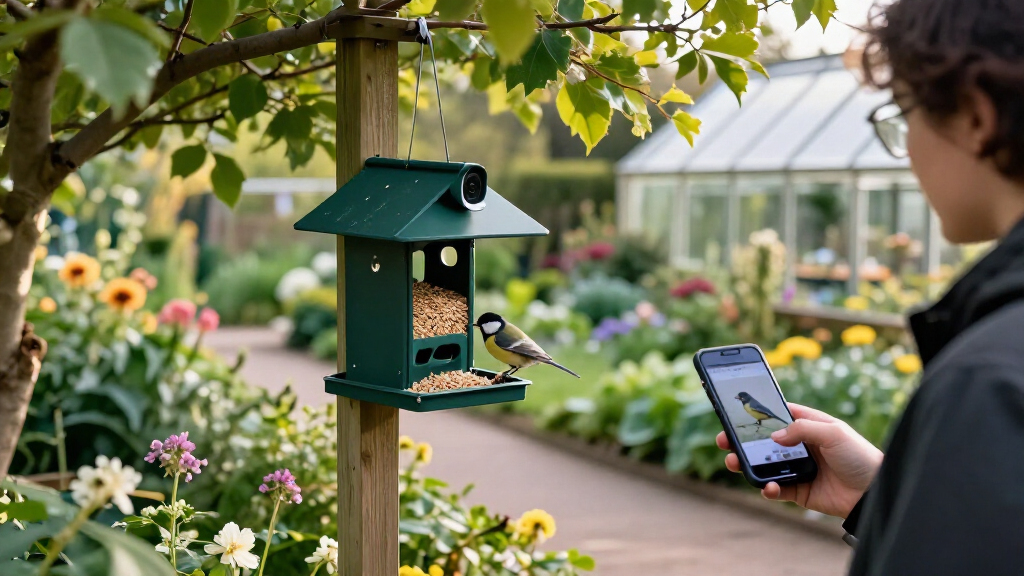

The best AI bird feeders combine dependable bird identification, useful camera footage, and practical power options. My best overall pick is the Kiwibit Solar Smart Bird Feeder with 4K Camera and AI Bird Identification, which brings high-resolution video and identification together. The Bird Buddy Pro Solar Smart Bird Feeder is a standout for buyers drawn to a camera-centered birdwatching experience, while the HARYMOR model with dual solar panels suits shoppers focused on solar coverage. The main tradeoffs are camera detail versus power demands, identification features versus app dependence, and a convenient setup versus ongoing feeder maintenance. Read on for the full comparison and guidance on choosing a model for your yard.

Get garden gear delivered free with Prime
- Fast, free delivery on millions of items
- Prime Video, Amazon Music and more included
- Member-only deals all year
Complete the kit


Key Takeaways
4K resolution and AI identification are separate strengths. Several Kiwibit models pair 4K cameras with AI, but a camera listed as 4K does not by itself promise bird recognition.
Solar charging varies by design. The lineup includes solar-powered cameras, solar feeder setups, and a HARYMOR model with dual panels, so panel placement and exposure matter as much as the label.
Bird Buddy Pro stands apart as a camera-led option. It gives buyers an alternative to the Kiwibit combination of high resolution and identification features.
There are multiple ways to choose a Birdfy. The range includes hanging and solar-powered models, making mounting style and setup a meaningful distinction within the same brand family.
2K can be a sensible fit for routine viewing. Models from BirdSnap, HARYMOR, and the solar-powered AI feeder show that buyers need not make 4K the deciding factor if broader setup needs matter more.
| Kiwibit Solar Smart Bird Feeder with 4K Camera and AI Bird Identification |  | Best Overall for Detailed Bird Footage | Model: BW512 | Camera: 8MP photos; 4K Ultra HD video with HDR | Field of view: 132° | VIEW LATEST PRICE | See Our Full Breakdown |
| Kiwibit Solar-Powered Smart Bird Feeder with 4K Camera |  | Best for Flexible Placement | Model: BW514 | Video: 4K UHD; 1080p at 60 FPS playback | Photo resolution: 8MP | VIEW LATEST PRICE | See Our Full Breakdown |
| Bird Buddy Pro Solar Smart Bird Feeder with Camera |  | Best for Low-Light Viewing | Model: BBG1003BAD | Camera: 2K video; 5MP photos; HDR | Sensor: 1/2.7-inch | VIEW LATEST PRICE | See Our Full Breakdown |
| Birdfy Smart Solar-Powered Hanging Bird Feeder with Camera |  | Best for Seed-and-Suet Feeding | Construction: All-metal body | Seed capacity: 1.7L | Camera resolution: 1080p | VIEW LATEST PRICE | See Our Full Breakdown |
| Birdfy Smart Bird Feeder with Solar-Powered Camera |  | Best for Subscription-Free AI | Material: Natural fir wood | Video: 1080p; 60 fps capture | Night vision: Full-color | VIEW LATEST PRICE | See Our Full Breakdown |
| NETVUE by Birdfy Smart Bird Feeder with Camera |  | Best for Straightforward Alerts | Brand: NETVUE | Model: N12 | Camera resolution: 1080p | VIEW LATEST PRICE | See Our Full Breakdown |
| NETVUE Birdfy Smart Bird Feeder with Camera and Solar Panel |  | Best Solar Starter Kit | Brand: NETVUE | Model: Birdfy AI N12 | Camera resolution: 1080p | VIEW LATEST PRICE | See Our Full Breakdown |
| Solar-Powered Smart Bird Feeder with 2K Camera and AI Bird Identification |  | Best for Broad Species Identification | Camera resolution: 2K HD | Power source: Built-in solar panel; wired power also supported | AI identification: Over 10,000 species | VIEW LATEST PRICE | See Our Full Breakdown |
| Kiwibit 4K Bird Feeder with Camera, Solar Powered |  | Best for High-Detail Footage | Camera: 4K livestream; 8MP photos | Field of view: 132° | Bird identification: Over 10,000 species | VIEW LATEST PRICE | See Our Full Breakdown |
| BirdSnap Smart Bird Feeder with Camera, Solar Powered, 2K Video |  | Best for Flexible Feeding Accessories | Brand: BirdSnap | Capacity: 1.8 L | Camera: 2K video; 155° wide-angle view; night vision | VIEW LATEST PRICE | See Our Full Breakdown |
| HARYMOR Solar-Powered Smart Bird Feeder with 2K Camera |  | Best for Shared Viewing | Camera: 2K HD | Viewing angle: 120° | Seed capacity: 1.5 L | VIEW LATEST PRICE | See Our Full Breakdown |
| Birdfy Solar-Powered Smart Bird Feeder with Camera |  | Best for Beginners | Camera resolution: 1080p HD | Night vision: Full-color | Battery: 9,000 mAh rechargeable | VIEW LATEST PRICE | See Our Full Breakdown |
| Kiwibit Bird Feeder 2 Pro with 4K Camera and Solar Power |  | Best for Video Detail | Camera: 4K HDR with autofocus | Slow-motion recording: 1080p at 60 fps up to 4× or 120 fps up to 8× | Solar panel: Built-in 5W | VIEW LATEST PRICE | See Our Full Breakdown |
| 4K Smart Bird Feeder with Camera, Solar Power, and AI Bird Identification |  | Best Subscription-Free AI | Video: 4K at 30 fps; 1080p at 120 fps | Photos: 8 MP HDR | Bird identification: AI identifies more than 10,000 species | VIEW LATEST PRICE | See Our Full Breakdown |
| HARYMOR Smart Bird Feeder with 2K Camera and Dual Solar Panels |  | Best for Larger Seed Capacity | Video resolution: 2K | Lens: 120° angle with 3× magnification | Seed capacity: 2 L | VIEW LATEST PRICE | See Our Full Breakdown |
| AI bird feeder | Weather resistance |
|---|---|
| Kiwibit Solar Smart Bird Feede | IP65 |
| Kiwibit Solar-Powered Smart Bi | IP65 |
| Bird Buddy Pro Solar Smart Bir | — |
| Birdfy Smart Solar-Powered Han | — |
| Birdfy Smart Bird Feeder with | — |
| NETVUE by Birdfy Smart Bird Fe | IP65 |
| NETVUE Birdfy Smart Bird Feede | IP65 |
| Solar-Powered Smart Bird Feede | Rainproof, snow-resistant, and heat-tolerant |
| Kiwibit 4K Bird Feeder with Ca | IP65 |
| BirdSnap Smart Bird Feeder wit | IP65 |
| HARYMOR Solar-Powered Smart Bi | IP65 |
| Birdfy Solar-Powered Smart Bir | — |
| Kiwibit Bird Feeder 2 Pro with | IP65 |
| 4K Smart Bird Feeder with Came | — |
| HARYMOR Smart Bird Feeder with | — |
More Details on Our Top Picks
Kiwibit Solar Smart Bird Feeder with 4K Camera and AI Bird Identification
I’d choose the Kiwibit BW512 when image detail and broad species recognition matter more than avoiding ongoing app costs. Its 4K HDR video and 8MP photos give close visits more visual detail than the Bird Buddy Pro’s 2K video and 5MP photos, while the 132° view helps capture birds approaching from the sides. AI identification covers more than 10,000 species, and visit alerts, night vision, and two-way audio add useful ways to follow activity.
The dual solar panels support the rechargeable battery, and the detachable 1.5L dual-seed hopper offers more capacity than the 1L container on the Kiwibit BW514. The tradeoff is a paid AI subscription after 30 days; streaming and alerts also depend on 2.4GHz Wi-Fi. I’d pick it over the smaller BW514 for capacity, but skip it if subscription-free identification is a priority.
Pros:- 4K HDR video and 8MP photos capture more detail than the Bird Buddy Pro’s 2K and 5MP camera.
- AI identification covers more than 10,000 bird species.
- Dual solar panels supplement a 5200mAh rechargeable battery.
- Detachable 1.5L dual-seed hopper is easier to refill and clean.
Cons:- AI features require a paid subscription after the 30-day trial.
- App streaming and alerts require 2.4GHz Wi-Fi.
Best for: Bird watchers who want high-resolution footage, broad species identification, and a larger hopper with solar-assisted power.
Not ideal for: Buyers who want ongoing AI identification without a subscription or whose outdoor Wi-Fi network does not support 2.4GHz.
- Model:BW512
- Camera:8MP photos; 4K Ultra HD video with HDR
- Field of view:132°
- AI identification:More than 10,000 bird species
- Power:5200mAh rechargeable battery; dual solar panels
- Hopper capacity:1.5L dual-seed hopper
- Connectivity:2.4GHz Wi-Fi
- Weather resistance:IP65
- Storage:Micro SD card or cloud
Our verdict“Choose the BW512 for detailed footage, extensive species identification, and more seed capacity, provided you accept a paid AI subscription.”
Kiwibit Solar-Powered Smart Bird Feeder with 4K Camera
The Kiwibit BW514 suits buyers who want a 4K camera but need several ways to position the feeder. It can mount to a pole, wall, fence, or compatible surface, and its removable camera module makes servicing less tied to the whole feeder. Like the higher-capacity Kiwibit BW512, it records 4K video and 8MP photos with a 132° view and infrared night vision; its smaller 1L seed container makes it a better fit where space matters more than fewer refills.
The solar roof supplements power, while local storage supports Micro SD cards up to 512GB, which gives owners an alternative to relying only on cloud storage. The card is not included, though, and AI identification requires a paid Premium subscription after the 30-day trial. I’d choose this over the BW512 for mounting flexibility and a more compact feeder, but not for larger seed capacity or subscription-free AI.
Pros:- 4K UHD video and 8MP photos with a 132° field of view.
- Multiple mounting options suit varied outdoor spaces.
- Removable camera module can make camera servicing easier.
- Local storage supports Micro SD cards up to 512GB.
Cons:- The 1L seed container holds less than the Kiwibit BW512’s 1.5L hopper.
- Micro SD card is not included.
- AI identification requires a paid Premium subscription after the trial.
Best for: Bird watchers who need wall, fence, or pole mounting and want 4K footage in a smaller feeder.
Not ideal for: Households seeking a large hopper, an included Micro SD card, or AI identification without a continuing subscription.
- Model:BW514
- Video:4K UHD; 1080p at 60 FPS playback
- Photo resolution:8MP
- Field of view:132°
- Seed container:1L
- Storage:Micro SD card up to 512GB; card not included
- Connectivity:2.4GHz Wi-Fi
- Weather resistance:IP65
- Mounting:Pole, wall, fence, or compatible surface
Our verdict“Pick the BW514 if flexible mounting and 4K capture matter more than hopper size and included storage.”
Bird Buddy Pro Solar Smart Bird Feeder with Camera
The Bird Buddy Pro Solar makes more sense for bird watchers who value a sensor designed for low-light scenes over maximum resolution. Its 1/2.7-inch sensor, HDR, and stated low-light focus pair with 2K video and 5MP photos, giving it a different strength from the 4K Kiwibit BW512: the Kiwibit offers more pixels, while the Bird Buddy Pro emphasizes the sensor and HDR. The app adds bird identification and visit alerts, though advanced features require a paid subscription.
Power options include USB-C or solar, and the box includes both a hanger and universal pole mount, so it can suit more than one setup without requiring a separate mount purchase. Its 0.9L capacity is smaller than the BW512’s 1.5L hopper, and a wall mount is not included. I’d shortlist it for adaptable mounting and low-light capture, but choose another option if resolution or long stretches between refills lead your priorities.
Pros:- HDR and a 1/2.7-inch sensor are designed to improve low-light viewing.
- Offers 2K video and 5MP photos.
- Can charge by USB-C or solar.
- Includes a metal hanger and universal pole mount.
Cons:- Camera resolution is lower than the Kiwibit BW512’s 4K video and 8MP photos.
- The 0.9L capacity is smaller than the BW512’s 1.5L hopper.
- Advanced app features require a paid subscription; wall mount is not included.
Best for: Bird watchers who want a camera geared toward low-light visits and need both hanger and pole-mount options.
Not ideal for: Buyers who prioritize 4K footage, a large seed capacity, or advanced app features without a subscription.
- Model:BBG1003BAD
- Camera:2K video; 5MP photos; HDR
- Sensor:1/2.7-inch
- Capacity:0.9L
- Power:Rechargeable battery; USB-C or solar
- Connectivity:2.4GHz Wi-Fi and Bluetooth
- Dimensions:6.89 x 6.3 x 9 inches
- Weight:1.63kg
- Mounting:Included hanger and universal pole mount; wall mount not included
Our verdict“Choose the Bird Buddy Pro Solar for low-light-focused capture and included mounting flexibility, not for maximum resolution or hopper capacity.”
Birdfy Smart Solar-Powered Hanging Bird Feeder with Camera
The Birdfy hanging feeder stands apart from the Kiwibit BW514 and Bird Buddy Pro by pairing its camera with seed and side suet cages. That gives buyers a way to offer different foods from one feeder, and its 1.7L capacity is larger than either model’s listed container. An all-metal body also sets it apart from the Bird Buddy Pro’s ABS plastic construction, a useful distinction for shoppers looking for a sturdier-feeling outdoor feeder.
Its camera records 1080p video with 60 FPS slow-motion playback, rather than the higher-resolution 2K or 4K footage offered by those alternatives. AI recognition and phone alerts cover the smart-feeder basics, while a 3W solar panel works with a 5200mAh battery. The supplied information does not state storage options or weather-resistance rating, so I wouldn’t choose it for buyers who need those details spelled out. It also requires 2.4GHz Wi-Fi.
Pros:- All-metal construction differs from the Bird Buddy Pro’s ABS plastic body.
- 1.7L capacity and side suet cages support multiple feeding options.
- 60 FPS playback allows slow-motion viewing of visits.
- Solar panel and 5200mAh rechargeable battery support outdoor power.
Cons:- 1080p resolution is lower than the 2K Bird Buddy Pro and 4K Kiwibit models.
- Only supports 2.4GHz Wi-Fi.
- The supplied product details do not specify storage options or a weather-resistance rating.
Best for: Bird watchers who want a durable hanging feeder with room for seed and suet in one setup.
Not ideal for: Buyers who need 2K or 4K footage, a stated weather-resistance rating, or Wi-Fi beyond 2.4GHz.
- Construction:All-metal body
- Seed capacity:1.7L
- Camera resolution:1080p
- Slow-motion playback:60 FPS
- Feeding options:Seed and side suet cages
- Solar panel:3W
- Battery:5200mAh rechargeable
- Connectivity:2.4GHz Wi-Fi
- Model:AMZ-Q10-ASG
Our verdict“Choose this Birdfy if seed-and-suet feeding and metal construction matter more than higher-resolution video.”
Birdfy Smart Bird Feeder with Solar-Powered Camera
If ongoing AI access without a paid plan is your priority, I’d put this Birdfy solar feeder ahead of the Kiwibit BW512 and BW514. Its lifetime-free identification for more than 6,000 species and free cloud storage with 30-day video retention make the recurring app cost clearer from the outset. The tradeoff is resolution: its 1080p camera is less detailed than the Kiwibit models’ 4K footage, though 60 fps capture supports slow-motion viewing and full-color night vision adds another useful view of activity.
A built-in solar panel supplements the 5200mAh battery, and the feeder’s tool-free cleaning and wall, pole, or tree mounting help keep setup and upkeep straightforward. Its natural fir wood construction gives it a different look from Birdfy’s all-metal hanging model, but the supplied details specify an IP66 rating for the camera, not the whole feeder. Cloud videos are retained for only 30 days, and app features require 2.4GHz Wi-Fi.
Pros:- Lifetime-free AI identification covers more than 6,000 species.
- Free cloud storage includes 30-day video retention.
- 1080p video supports 60 fps capture and full-color night vision.
- Tool-free cleaning and wall, pole, or tree mounting simplify upkeep and placement.
Cons:- 1080p footage offers less detail than the Kiwibit BW512 and BW514’s 4K video.
- Cloud videos are retained for 30 days.
- The stated IP66 rating applies to the camera, and app features require 2.4GHz Wi-Fi.
Best for: Bird watchers who want AI identification without a recurring subscription and prefer simple cleaning and flexible mounting.
Not ideal for: Buyers who want 4K footage, longer stated cloud-video retention, or a specified whole-feeder weather rating.
- Material:Natural fir wood
- Video:1080p; 60 fps capture
- Night vision:Full-color
- Battery:5200mAh rechargeable
- Connectivity:2.4GHz Wi-Fi
- Camera weather protection:IP66-rated camera
- AI identification:Lifetime free; more than 6,000 species
- Cloud storage:Free; 30-day video retention
- Mounting:Wall, pole, or tree
Our verdict“Pick this Birdfy for subscription-free AI and easy maintenance if 1080p footage and 30-day cloud retention fit your needs.”
NETVUE by Birdfy Smart Bird Feeder with Camera
I’d choose this Birdfy when the main goal is to get a notice when birds arrive and review close-up footage, rather than maximize resolution. Its 1080p camera, color night vision, and real-time app alerts cover the core smart-feeder experience, while the 50 oz capacity means fewer refills than many compact feeders. Compared with the solar-equipped NETVUE Birdfy N12, this model’s listing doesn’t include a solar panel, so expect to manage its power separately. AI identification spans more than 6,000 species, but it is optional and paid after a seven-day trial; that ongoing cost matters if automatic ID is the reason you’re buying. I’d also check your network first: it only supports 2.4 GHz Wi-Fi.
Pros:- Real-time app alerts make it easier to catch visits as they happen.
- Color night vision supports viewing in low light.
- The 50 oz (1.5 L) container reduces how often it needs refilling.
- IP65 weather resistance suits outdoor placement.
Cons:- AI identification requires a subscription or one-time purchase after the seven-day trial.
- Does not support 5 GHz Wi-Fi.
- No solar panel is listed, so power management is less hands-off than on the solar-equipped NETVUE Birdfy N12.
Best for: Birdwatchers who want real-time arrival alerts, color night footage, and a larger seed supply, and are comfortable with 2.4 GHz Wi-Fi.
Not ideal for: Buyers who want included solar charging, 5 GHz Wi-Fi, or AI identification without a paid plan.
- Brand:NETVUE
- Model:N12
- Camera resolution:1080p
- Wi-Fi:2.4 GHz; 5 GHz not supported
- Weather resistance:IP65
- Capacity:50 oz (1.5 L)
- AI identification:Over 6,000 bird species; paid option after a seven-day trial
- Warranty:1 year
Our verdict“Pick this NETVUE if alerts and capacity matter more than included solar power or subscription-free AI.”
NETVUE Birdfy Smart Bird Feeder with Camera and Solar Panel
The included 3W solar panel makes this Birdfy a practical entry point for people who want app-based bird viewing without building a separate power setup. Its 1080p camera and 155° view cover a broad area around the feeder, and live viewing lets you check activity on demand. Compared with the other NETVUE N12 in this lineup, the key advantage here is that solar panel included in the box; the other model specifies color night vision, while this one lists infrared night vision. It also comes with three months of cloud storage, but that window is limited, so anyone hoping to keep a long video archive should check the available storage options. AI identification and connected features depend on outdoor Wi-Fi, which may constrain placement.
Pros:- Included 3W solar panel can reduce manual charging.
- The 155° view captures a wide area around the feeder.
- Live app viewing and AI identification add interactive birdwatching features.
- Includes three months of cloud storage.
Cons:- Cloud video storage is limited to three months.
- Connected features require outdoor Wi-Fi at the mounting location.
- Infrared night vision does not provide the color night footage specified for the other NETVUE N12.
Best for: First-time smart-feeder buyers with a sunny outdoor spot, nearby Wi-Fi, and a preference for an included solar panel.
Not ideal for: Birders who need color night footage, a long-term cloud archive, or a feeder location beyond reliable Wi-Fi range.
- Brand:NETVUE
- Model:Birdfy AI N12
- Camera resolution:1080p
- Field of view:155°
- Capacity:1.5 liters
- Power:Battery and solar powered; includes 3W Type-C solar panel
- Weather resistance:IP65
- Cloud storage:Three months
- Mounting options:Pole, tree, or wall mount
Our verdict“Choose this Birdfy for a ready-to-mount solar setup, provided your outdoor Wi-Fi reaches the feeder.”
Solar-Powered Smart Bird Feeder with 2K Camera and AI Bird Identification
This feeder is the better fit for birders who value species coverage over an established brand name: its AI claims identification of more than 10,000 species, compared with over 6,000 on the NETVUE N12. The 2K video also offers more detail than that model’s 1080p camera, while solar power and wired-power support give owners two ways to keep it running. It supports tree, pole, or wall mounting, making placement more flexible than a feeder limited to one mounting style. The tradeoff is that AI is only free for a one-month trial, after which a subscription is available. Live viewing is also capped at two simultaneous viewers, so a household that wants several people watching together may prefer the Kiwibit 4K’s stated sharing options.
Pros:- 2K video provides more stated resolution than the 1080p NETVUE models.
- AI identification covers over 10,000 species.
- Solar power and wired power offer two power approaches.
- Tree, pole, and wall mounting allow flexible placement.
Cons:- AI requires a subscription after the one-month free trial.
- Only two viewers can watch live footage simultaneously.
- The product data does not specify a feeder capacity or warranty.
Best for: Birdwatchers who want 2K footage, broad AI species coverage, and flexibility to mount the feeder in a sunny or wired location.
Not ideal for: Households that want subscription-free species recognition or more than two people watching the live feed at once.
- Camera resolution:2K HD
- Power source:Built-in solar panel; wired power also supported
- AI identification:Over 10,000 species
- AI service:One-month free trial; monthly or yearly subscription available afterward
- Mounting options:Tree, pole, or wall
- Weather resistance:Rainproof, snow-resistant, and heat-tolerant
- Simultaneous live viewers:2
- Color:Red
Our verdict“Pick this model if detailed 2K footage and broad species recognition matter more than subscription-free AI or larger group viewing.”
Kiwibit 4K Bird Feeder with Camera, Solar Powered
Among these five, the Kiwibit makes the strongest case for image detail: its 4K livestream and 8MP photos exceed the 2K BirdSnap and 1080p NETVUE options on stated resolution. HDR, night vision, and a 132° view add useful context, while the 1.5L dual-compartment hopper gives room for two seed types rather than one. Solar charging supports the rechargeable battery, and owners can save footage locally to a microSD card or use cloud storage. That local option is a meaningful distinction from relying solely on cloud clips, though the card is not included. AI identification covers over 10,000 species, but premium service is required after a 30-day trial, and the camera only connects to 2.4 GHz Wi-Fi.
Pros:- 4K livestream and 8MP photos offer the highest stated resolution in this group.
- HDR and night vision support viewing across varied lighting.
- Dual compartments let owners offer two kinds of seed.
- Supports local microSD storage as well as cloud storage.
Cons:- AI premium subscription is required after the 30-day trial.
- Does not support 5 GHz Wi-Fi.
- MicroSD card is not included, and free cloud history is limited to one rolling day.
Best for: Detail-focused birders who want 4K footage, two seed compartments, and the choice of local or cloud video storage.
Not ideal for: Buyers using only 5 GHz Wi-Fi, those unwilling to buy a microSD card separately, or anyone avoiding paid AI service.
- Camera:4K livestream; 8MP photos
- Field of view:132°
- Bird identification:Over 10,000 species
- Solar panel and battery:Adjustable 3W solar panel; 5200mAh rechargeable battery
- Seed hopper:1.5L, dual-compartment
- Weather resistance:IP65
- Wi-Fi:2.4 GHz; 5 GHz not supported
- Local storage:MicroSD card up to 512GB; card not included
- Cloud storage:Free 1-day rolling video history
Our verdict“Choose the Kiwibit if 4K detail and flexible recording matter enough to accept a paid AI plan and separate storage purchase.”
BirdSnap Smart Bird Feeder with Camera, Solar Powered, 2K Video
BirdSnap stands apart from the Kiwibit 4K by putting more emphasis on adaptable feeding than maximum video resolution. Its 2K camera with a 155° view, night vision, and arrival alerts cover the core smart-feeder functions, while the 1.8L capacity is larger than the 1.5L hoppers listed for both NETVUE models. A solar panel helps reduce charging, and the included fruit fork, hummingbird feeder, and jelly box give owners several ways to attract different visitors. The product data also says AI recognition has no required subscription, a welcome contrast with the paid-after-trial plans on the Kiwibit and the 2K solar model. One storage detail is unclear: a 32GB card is listed as included, yet the description also says microSD storage is sold separately.
Pros:- 2K video, night vision, and a wide 155° view support close observation.
- The 1.8L capacity exceeds the 1.5L capacity listed for the NETVUE models.
- Fruit fork, hummingbird feeder, and jelly box offer varied feeding setups.
- AI recognition is described as available without a required subscription.
Cons:- Requires 2.4 GHz Wi-Fi and does not list 5 GHz support.
- Storage details conflict: a 32GB card is listed as included, while microSD storage is also described as sold separately.
- Cloud storage is optional rather than included as a defined ongoing service.
Best for: Birdwatchers who want to experiment with fruit, jelly, and hummingbird feeding alongside app alerts and 2K video.
Not ideal for: Buyers who need 5 GHz Wi-Fi, want 4K video, or require clear, consistent details about included storage and cloud plans.
- Brand:BirdSnap
- Capacity:1.8 L
- Camera:2K video; 155° wide-angle view; night vision
- Power:Rechargeable battery with 3W solar panel
- Connectivity:2.4 GHz Wi-Fi
- Weather resistance:IP65
- Included accessories:Fruit fork, hummingbird feeder, jelly box, 32GB storage card, mounting kit
- Color:Blue
- Target species:Cardinal
Our verdict“Choose BirdSnap for varied feeding accessories and subscription-free AI, but verify the storage package before buying.”
HARYMOR Solar-Powered Smart Bird Feeder with 2K Camera
The HARYMOR Q8 suits households that want a wide view of the feeder and an easy way to share visits: its 120° lens and access for up to four people make it more group-friendly than the single-viewer experience some buyers expect from a camera feeder. The 1.5 L hopper is smaller than the 2 L capacity of the other HARYMOR in this lineup, so it calls for more frequent refills, but its solar power and included mounting kit simplify setup. The 2K footage gives a sharper view than Birdfy’s 1080p model, while the AI identification feature comes with a catch: ongoing use requires a subscription. Buyers also need to supply a memory card for local recording or rely on the cloud trial’s short loop.
Pros:- 2K camera with a 120° viewing angle covers a broad area around the feeder.
- Solar power reduces the need for routine battery charging.
- Live viewing can be shared with up to four people.
- Includes mounting accessories and squirrel deterrents.
Cons:- AI bird identification requires a subscription.
- Memory card and mounting pole are sold separately.
- The 1.5 L seed container is smaller than the 2 L hopper on the other HARYMOR model.
Best for: Households who want several people to view bird alerts and live footage from a solar-powered feeder.
Not ideal for: Birders who want AI identification without a subscription or who need a larger seed hopper and included local storage.
- Camera:2K HD
- Viewing angle:120°
- Seed capacity:1.5 L
- Power:Solar-powered
- Weather resistance:IP65
- AI identification:More than 10,000 species; subscription required
- Local storage:Memory card up to 128 GB; card sold separately
- Cloud storage:Two-year trial with 3-day loop recording
- Device sharing:Up to 4 people
Our verdict“Choose this HARYMOR if shared viewing and a wide camera angle matter more than a larger hopper or subscription-free AI.”
Birdfy Solar-Powered Smart Bird Feeder with Camera
For a first smart feeder, Birdfy keeps the core routine straightforward: AI identification and phone alerts put visiting birds on a phone, while the included solar panel helps recharge its 9,000 mAh battery. Its weather-resistant metal body gives it a different feel from the more specification-heavy Kiwibit Bird Feeder 2 Pro, which adds 4K video, slow motion, and dual-band Wi-Fi. Birdfy instead records at 1080p, a practical step down for anyone who wants close detail, but it offers full-color night vision for viewing visits in low light. The tradeoff is connectivity: it requires 2.4 GHz Wi-Fi, so a network using only 5 GHz won’t work. The supplied mounting kit, retractable perch, and seed guard make it a simpler starting package.
Pros:- AI species identification and phone alerts are built into the Birdfy app.
- Full-color night vision helps show activity in low light.
- Solar panel recharges the built-in 9,000 mAh battery.
- Metal construction is described as weather-resistant and includes a mounting kit, perch, and seed guard.
Cons:- 1080p video offers less detail than the 4K Kiwibit Bird Feeder 2 Pro.
- Requires 2.4 GHz Wi-Fi.
- No seed capacity or local-storage details are provided in the product data.
Best for: First-time smart-feeder buyers who want solar-assisted power, automatic species identification, and a ready-to-mount kit.
Not ideal for: Birders seeking 4K detail, dual-band Wi-Fi, or a feeder that can connect to a 5 GHz-only network.
- Camera resolution:1080p HD
- Night vision:Full-color
- Battery:9,000 mAh rechargeable
- Power:Solar panel and rechargeable battery
- Connectivity:2.4 GHz Wi-Fi
- Material:Metal
- AI feature:AI species identification and phone alerts through the Birdfy app
- Included components:Mounting kit, retractable perch, seed guard, and solar panel
Our verdict“Pick Birdfy as an approachable first camera feeder if 1080p is enough and your home Wi-Fi supports 2.4 GHz.”
Kiwibit Bird Feeder 2 Pro with 4K Camera and Solar Power
The Kiwibit Bird Feeder 2 Pro is the detail-first choice here: 4K HDR autofocus and high-frame-rate slow motion are built for close inspection of plumage and quick movements, going beyond the 2K video on both HARYMOR models. It also has a 1.7 L seed bin, a detachable battery, and a 5W solar panel, giving it a more capable power and refill setup than the smaller HARYMOR Q8. Dual-band Wi-Fi may help it fit more home networks than Birdfy’s 2.4 GHz-only model. The tradeoff is that FeatherPal AI is only included for a 30-day trial; a subscription is needed afterward. Solar charging also depends on available sun, so buyers in shaded spots may still need to manage the battery.
Pros:- 4K HDR autofocus captures more detail than the 2K HARYMOR models.
- Records 1080p slow motion at 60 or 120 fps.
- 5W solar panel works alongside a detachable 5200 mAh battery.
- Dual-band Wi-Fi and detachable hopper and tray support flexible setup and cleaning.
Cons:- FeatherPal AI requires a subscription after the 30-day trial.
- Solar charging depends on sunny conditions.
- The 1.7 L hopper is smaller than the 2 L HARYMOR feeder.
Best for: Birdwatchers who prioritize sharp 4K footage, slow-motion clips, and flexible Wi-Fi over subscription-free AI.
Not ideal for: Buyers who want ongoing AI identification without recurring fees or who plan to place the feeder in a persistently shaded location.
- Camera:4K HDR with autofocus
- Slow-motion recording:1080p at 60 fps up to 4× or 120 fps up to 8×
- Solar panel:Built-in 5W
- Battery:Detachable 5200 mAh
- Seed capacity:1.7 L
- Wi-Fi:2.4 GHz and 5 GHz
- Weather resistance:IP65
- AI trial:30 days; subscription required afterward
- Warranty:12 months
Our verdict“Choose the Kiwibit Pro for high-detail video and slow motion, provided you accept a paid AI plan after its trial.”
4K Smart Bird Feeder with Camera, Solar Power, and AI Bird Identification
This 4K feeder stands out for buyers who want AI identification without an ongoing plan: 10,000+ species recognition and 32 GB of local storage are included without a subscription. That makes it a more predictable alternative to the Kiwibit Bird Feeder 2 Pro, whose FeatherPal AI requires a subscription after its trial. Video reaches 4K at 30 fps, with 1080p slow motion at 120 fps and 8 MP HDR photos, so it also gives more capture options than the 2K HARYMOR Q8. Its removable camera should make charging and cleaning less awkward, and the bird-safe ports help keep birds out of the seed container. The main compromise is finite local capacity: 32 GB can fill if footage is kept for long periods, and connected features still need Wi-Fi.
Pros:- AI identifies more than 10,000 species without a subscription.
- Includes 32 GB of local storage.
- Captures 4K video, 8 MP HDR photos, and 1080p slow motion at 120 fps.
- Removable camera and bird-safe feeding ports support easier upkeep and safer feeding.
Cons:- The 32 GB local storage capacity may limit how long footage can be retained.
- Wi-Fi is required for connected features.
- The 3 W solar panel may offer less charging capacity than the Kiwibit Pro’s 5W panel.
Best for: Birders who want 4K video and AI species identification without recurring subscription fees.
Not ideal for: Buyers who need long-term footage storage without managing space or who want connected features in a Wi-Fi-free location.
- Video:4K at 30 fps; 1080p at 120 fps
- Photos:8 MP HDR
- Bird identification:AI identifies more than 10,000 species
- Storage:32 GB local storage
- Wi-Fi:2.4 GHz and 5 GHz
- Solar panel:3 W
- Seed capacity:1.8 L
- Material and water resistance:Metal; waterproof
- Dimensions and weight:6.3 × 6.5 × 9.8 in; 3.5 lb
Our verdict“Choose this model if subscription-free AI and local recording matter more than expandable or cloud-based storage.”
HARYMOR Smart Bird Feeder with 2K Camera and Dual Solar Panels
With a 2 L seed capacity and two 3W solar panels, this HARYMOR is the practical pick for buyers who want fewer refills and solar support. It holds more seed than the other HARYMOR Q8 in this lineup, whose hopper is 1.5 L, and adds 3× magnification to its 2K, 120° camera for a closer view of birds at the perch. It supports alerts, multiple app users, and cloud or optional memory-card recording. Unlike the subscription-free 4K smart feeder in this group, however, detailed AI information requires an app subscription; the camera also records at 2K rather than 4K. Its Wi-Fi is limited to 2.4 GHz, and local memory storage requires a card that is not included.
Pros:- 2 L seed capacity means fewer refills than the other HARYMOR Q8’s 1.5 L hopper.
- Two 3W solar panels help reduce charging frequency.
- 2K video combines a 120° lens with 3× magnification.
- Supports motion-triggered alerts, multiple app users, cloud recording, and memory cards up to 128 GB.
Cons:- Detailed AI bird information requires an app subscription.
- Supports 2.4 GHz Wi-Fi only, not 5 GHz.
- Memory card is not included, and the camera records at lower resolution than the 4K models in this lineup.
Best for: Birders who want a larger seed hopper, solar-assisted power, and shared alerts without stepping up to a 4K camera.
Not ideal for: Buyers who want subscription-free detailed AI, 5 GHz Wi-Fi, or included memory-card storage.
- Video resolution:2K
- Lens:120° angle with 3× magnification
- Seed capacity:2 L
- Solar panels:Two 3W panels, one built-in and one external
- Wi-Fi:2.4 GHz; 5 GHz not supported
- Water resistance:IP65
- Storage:3-day cloud loop recording; supports memory cards up to 128 GB, sold separately
- AI identification:More than 10,000 species; detailed information requires an app subscription
- Included components:Bird feeder camera, manual, mounting kit, and solar panel
Our verdict“Pick this HARYMOR for its larger hopper and dual-panel solar setup if 2K video and subscription-based AI fit your needs.”

How We Picked
I compared these 15 feeders on the features that shape day-to-day use: camera resolution, bird identification, solar setup, feeder format, and practical upkeep. I treated stated specs as evidence of a product’s intended strengths, not proof of how well it performs in every yard. A 4K camera can offer more image detail, while AI identification can add species information; neither substitutes for reliable placement, lighting, and a clear view of visiting birds.
The ranking favors models that bring together useful birdwatching features without making one headline spec do all the work. That puts the Kiwibit 4K-and-AI combination first, while other products earn their place through distinct priorities such as camera-centered use, hanging installation, dual solar panels, or a 2K setup. Models with overlapping feature sets are differentiated by their stated configuration and likely buyer fit; readers should check current app, connectivity, storage, and compatibility details before choosing.
| AI bird feeder | Weather resistance |
|---|---|
| Kiwibit Solar Smart Bird Feede | IP65 |
| Kiwibit Solar-Powered Smart Bi | IP65 |
| Bird Buddy Pro Solar Smart Bir | — |
| Birdfy Smart Solar-Powered Han | — |
| Birdfy Smart Bird Feeder with | — |
| NETVUE by Birdfy Smart Bird Fe | IP65 |
| NETVUE Birdfy Smart Bird Feede | IP65 |
| Solar-Powered Smart Bird Feede | Rainproof, snow-resistant, and heat-tolerant |
| Kiwibit 4K Bird Feeder with Ca | IP65 |
| BirdSnap Smart Bird Feeder wit | IP65 |
| HARYMOR Solar-Powered Smart Bi | IP65 |
| Birdfy Solar-Powered Smart Bir | — |
| Kiwibit Bird Feeder 2 Pro with | IP65 |
| 4K Smart Bird Feeder with Came | — |
| HARYMOR Smart Bird Feeder with | — |
Factors to Consider When Choosing Best AI Bird Feeders
Choosing an AI feeder is less about chasing the longest feature list and more about matching the camera and power setup to your yard. These factors help separate genuine everyday benefits from specs that may matter less for your situation.
Decide How Much Camera Detail You Need
4K offers more image detail than 2K, which can help when you want to inspect markings or crop footage. That advantage depends on a stable view, adequate light, and a camera aimed at the feeding perch. Higher resolution may also mean larger video files or more demands on network and storage, depending on the product. A common mistake is choosing resolution alone while overlooking whether the camera’s angle captures birds clearly. If you mainly want to see visits and share clips, a 2K camera may suit you. Choose 4K when fine visual detail is a priority and the rest of your setup can support it.
Treat AI Identification as a Helpful Aid
AI identification adds context by attempting to name visiting birds, but it should be treated as a guide rather than a guaranteed field identification. Image quality, bird position, lighting, and the species available to the software can all affect the result. Check how the identification feature is accessed and whether ongoing use depends on an app plan or other service. Buyers sometimes focus on the word “AI” without checking what the app actually provides. If learning species is your main goal, prioritize a clear identification workflow and useful records over camera resolution alone. If you primarily want footage, identification may be a secondary feature.
Match Solar Charging to Your Yard
Solar power reduces charging chores, but it cannot compensate for a panel that sits in shade for most of the day. Before buying, map the feeder’s likely location and note seasonal changes in sun, nearby branches, and roof shadows. Separate panels can offer more placement freedom than a panel fixed to the feeder, while a dual-panel design may appeal where available exposure is limited but not absent. Do not assume “solar-powered” means maintenance-free or that every configuration charges at the same rate. If the best bird location is shaded, plan for occasional manual charging or compare models with flexible panel placement. The feeder should serve the birds first; the panel can sometimes be positioned separately.
Choose a Feeder Style Birds Can Reach
Mounting affects both access and footage. Hanging feeders can fit yards with limited ground space, while other shapes may be easier to mount on a post or place near a window. Consider the birds you hope to attract, the available mounting surface, and whether the camera has a clear view of the feeding area. A feeder that is awkward to reach can make refilling and cleaning a regular frustration. Think through how you will open it, remove seed, and wipe the camera before settling on a location. Avoid mounting directly against a busy route or exposed area where the feeder may be disturbed. A workable placement is more valuable than a feature you cannot use well.
Check App, Network, and Recording Details
The camera is only part of the system. Before buying, verify the app’s phone compatibility, the network requirements, how clips are stored, and whether alerts or identification rely on a subscription. These details shape whether you can review visits conveniently and keep recordings for later. Do not assume that every camera feature is included with the feeder or available without an ongoing service. If your outdoor network signal is weak, check coverage at the intended mounting spot rather than relying on indoor Wi-Fi strength. Buyers who want simple live viewing should prioritize straightforward access, while birding hobbyists may care more about clip history and species records.
Plan for Cleaning and Weather Exposure
Regular upkeep protects both birds and equipment. Seed can get damp or stale, and feeder surfaces need cleaning; a camera adds another component that may collect dust, water spots, or residue. Check how easily the seed container opens and whether the camera area can be cleaned without disturbing the whole mount. A product’s outdoor-ready description does not remove the need to follow its care instructions or protect connections. Choose a location that is easy to reach safely, especially if you will refill it often. A convenient cleaning routine can matter more over time than a small difference in listed resolution. If your yard gets heavy rain, wind, or direct sun, review the maker’s care and placement guidance before installation.
Frequently Asked Questions
Is a 4K AI bird feeder worth choosing over a 2K model?
Choose 4K for image detail when identifying visual markings or saving sharper footage matters to you. A 2K model may be a better fit if you mainly want to check visits, share clips, or prioritize another feature such as solar configuration. Resolution alone does not make bird identification more accurate; camera angle, light, and the AI service also matter. Check the app and storage requirements, since higher-detail recordings may place different demands on your setup. If you are unsure, decide first whether you will regularly use close-up footage.
Will a solar-powered bird feeder work in a shaded yard?
Solar charging depends on available sunlight, so a feeder placed under dense shade may still need manual charging. Look for a setup that lets you position the panel where it gets better exposure, if the product supports that arrangement. Consider how sunlight changes across seasons rather than judging only by the conditions on installation day. A nearby sunny spot may support charging even when the best feeder location is shaded, but cable reach and mounting options vary. Confirm the maker’s power guidance before relying on solar as the only source.
Do AI bird feeders require a subscription to identify birds?
Subscription terms vary by model and service. Before purchasing, check whether species identification, cloud storage, alerts, or saved clips require an ongoing plan. A feeder may include a camera and app while reserving some software features for paid access. Read the current product and app details rather than assuming “AI identification” describes what is included indefinitely. If you want to avoid recurring service costs, ask which features remain available without a plan. Also check whether local recording or basic viewing is supported.
Should I choose a hanging feeder or a post-mounted design?
Choose based on your yard and maintenance routine. Hanging models can work well where ground space is limited, but the mount must stay steady enough for useful footage. A post-mounted feeder may be easier to reach for cleaning or refilling, depending on its height and placement. Think about which birds you want to attract, nearby surfaces, and whether you can keep the camera’s view unobstructed. Before installation, check that the feeder can be reached safely without taking down a difficult mount. The best format is the one you can maintain while giving birds a clear, calm feeding spot.
What should I check if the camera will not connect reliably?
Check signal strength at the feeder location, not just near your router or inside the house. Outdoor walls, distance, and garden structures can weaken a connection, while the product may also have specific network requirements. Confirm the feeder’s setup instructions, app permissions, and software status before changing its mounting position. If the signal is weak, moving the feeder or improving outdoor coverage may help, but keep bird access and safe mounting in mind. Verify whether recording or alerts depend on an active connection so you know which features may pause during an outage.
Conclusion
For most buyers, I recommend the Kiwibit Solar Smart Bird Feeder with 4K Camera and AI Bird Identification as the best overall choice in this lineup because it combines the two headline features many shoppers seek. The best value depends on which capability matters most: a 2K model can be a sensible pick if everyday viewing matters more than maximum resolution. For a best premium direction, start with a 4K Kiwibit configuration and verify its app, recording, and power details before committing. Beginners may prefer a model whose mounting, refilling, and app setup match their comfort level; the Bird Buddy Pro is a camera-centered alternative to compare. For specific needs, consider Birdfy’s hanging options for limited-space setups, HARYMOR’s dual-panel model if solar placement is a priority, and BirdSnap or other 2K choices if routine footage is enough. My final recommendation is to choose your installation spot and must-have app features first, then select the resolution and identification tools that fit them.