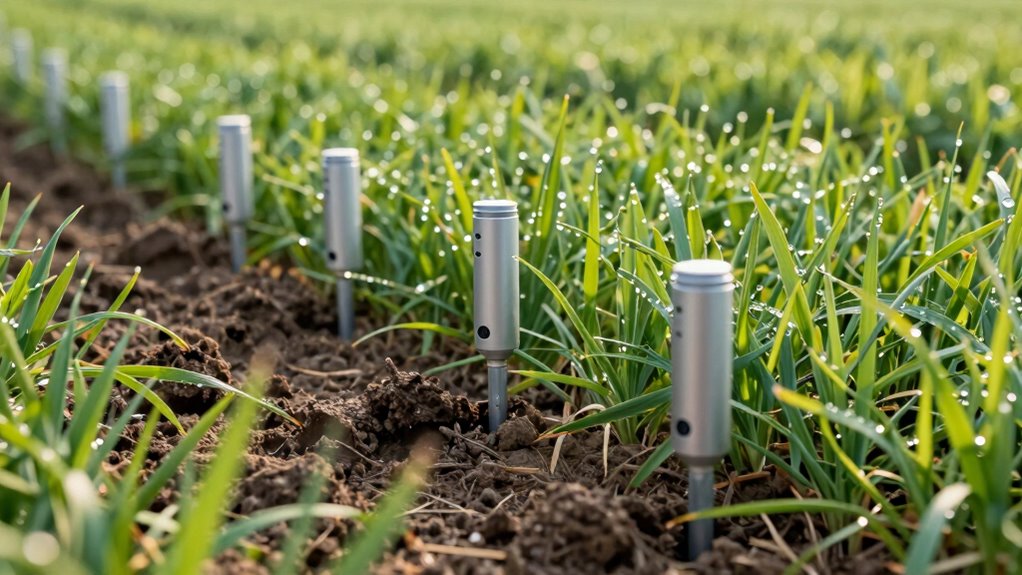

You need more than one spot for moisture sensors because soil varies even within small areas. Relying on just one sensor can give you an inaccurate picture, causing overwatering or underwatering. Different spots in your garden may hold moisture differently, especially with soil types like clay or sand. By taking multiple measurements, you get a clearer understanding of your soil’s true condition, helping you make better watering decisions. Keep reading to learn how to optimize your moisture monitoring.

Get garden gear delivered free with Prime
- Fast, free delivery on millions of items
- Prime Video, Amazon Music and more included
- Member-only deals all year
Key Takeaways
- Soil variability within small areas affects moisture levels, requiring multiple readings for accurate assessment.
- Single sensor spots may not detect dry patches or overly wet areas, leading to improper watering.
- Different soil types and properties influence moisture retention, necessitating diverse sampling locations.
- Environmental factors cause moisture fluctuations; multiple readings at different times capture true conditions.
- Monitoring multiple spots helps optimize watering, preventing overwatering or underwatering based on comprehensive data.
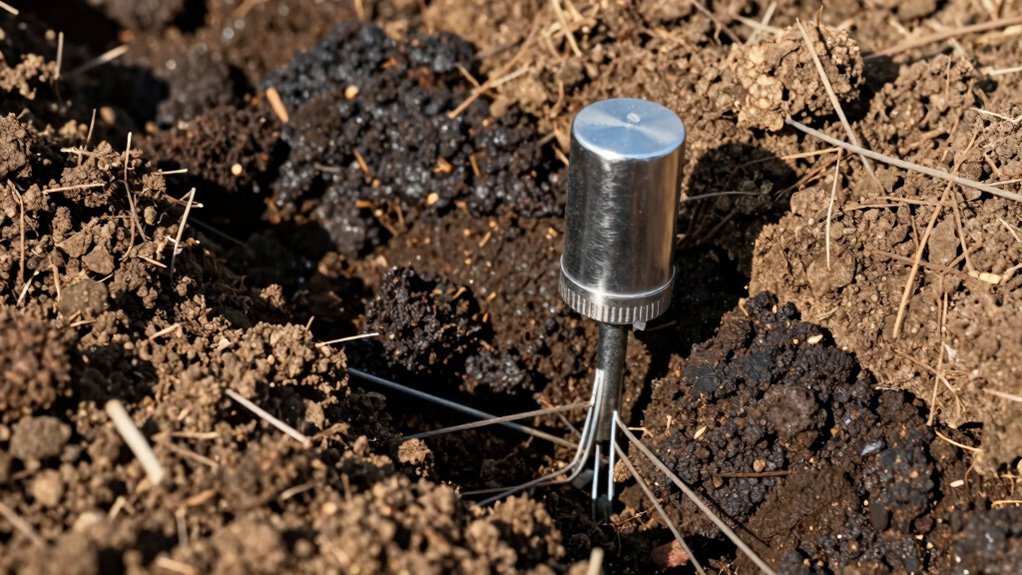
Moisture sensors are vital tools for accurately monitoring soil conditions, but relying on a single reading can lead to misleading results. Soil composition varies markedly even within a small area, affecting how moisture is retained and transmitted. Different soil types—clay, sand, silt—each have unique properties that influence moisture levels. For example, clay holds water tightly, while sandy soil drains quickly. If you only take one measurement in a spot that doesn’t represent the entire area, you might misjudge the moisture content and either overwater or underwater your plants. To get a true picture, you need multiple readings across different spots, considering the soil’s heterogeneity. Proper calibration plays an essential role in ensuring sensor accuracy, as uncalibrated sensors can give skewed data that misguides your watering decisions. Calibration involves tuning the sensor to match the soil’s properties, which can vary based on texture, organic matter, and compaction. Without calibration, even multiple readings might be skewed, leading you to incorrect conclusions. Regularly calibrating your sensors for different soil conditions helps improve the accuracy of each measurement, giving you confidence that your irrigation decisions are based on reliable data. Taking readings from multiple spots helps you understand the broader moisture profile of your soil. Moisture levels can fluctuate due to sunlight exposure, shade, slope, or recent rain, meaning a single reading might not reflect the overall condition. By sampling various locations, you can identify dry patches or overly wet spots, allowing for targeted watering. This approach prevents overwatering in some areas and underwatering in others, promoting healthier plants and conserving water. It also helps you detect inconsistencies caused by soil compaction or poor drainage, which might not be visible at first glance. In addition to collecting multiple readings, consider the timing of measurements. Moisture levels change throughout the day, especially after watering or rainfall. Taking readings at different times provides a more extensive view of soil moisture dynamics. This data helps you develop a watering schedule that maintains ideal soil conditions, tailored to your specific garden or field. Understanding the soil’s heterogeneity and variations over time is crucial for effective irrigation management, especially when factoring in the soil’s properties, which can influence moisture retention and transmission. Recognizing how Soil composition impacts moisture behavior enables more precise irrigation strategies. Additionally, understanding soil moisture dynamics can help you adapt your watering practices to seasonal changes and weather patterns.
soil moisture sensor with multiple spots
As an affiliate, we earn on qualifying purchases.
As an affiliate, we earn on qualifying purchases.
Frequently Asked Questions
How Do Different Soil Types Affect Moisture Sensor Readings?
Different soil types affect moisture sensor readings because soil composition varies, impacting how water is retained and conducts electricity. Sandy soils drain quickly, giving lower readings, while clay soils hold more water, causing higher readings. To verify accuracy, you need to calibrate sensors for each soil type. This calibration helps you interpret readings correctly, making sure you water plants appropriately without over- or under-watering based on soil-specific moisture levels.
Can Moisture Sensors Detect Underground Water Movement Accurately?
Moisture sensors can detect underground water movement, but their accuracy depends on proper sensor calibration and careful data interpretation. You might sense water flowing beneath the surface, yet the readings can be misleading without understanding soil variability and sensor placement. Suspense builds as you realize that relying on a single spot isn’t enough—multiple readings are essential to truly track underground water movement and make informed decisions.
What Is the Optimal Number of Readings for Reliable Data?
You should take at least three to five readings for reliable data. This allows you to perform sensor calibration accurately and use data averaging to minimize errors caused by soil variability. Multiple readings ensure you capture a thorough moisture profile, making your measurements more precise. Relying on just one reading risks inaccuracies, while multiple spots give you a solid foundation for informed irrigation or soil management decisions.
How Do Environmental Factors Influence Sensor Accuracy Over Time?
Environmental factors like temperature fluctuations, humidity, and soil composition can impact sensor accuracy over time. You should regularly perform sensor calibration to guarantee precise readings. Additionally, data averaging from multiple readings helps compensate for environmental variability, giving you a more reliable picture of moisture levels. By combining calibration with data averaging, you reduce errors caused by changing conditions, maintaining the sensor’s accuracy and longevity.
Are There Specific Sensor Placements Best for Certain Crops?
You should prioritize crop-specific placement to get accurate moisture readings. While some sensors may seem versatile, calibrating them for particular crops guarantees precision. For example, root depth and water needs differ among vegetables, grains, and fruits, so placing sensors at appropriate depths and locations is essential. Proper sensor calibration combined with strategic placement helps you make better irrigation decisions, ultimately boosting crop health and yield.
As an affiliate, we earn on qualifying purchases.
Conclusion
Just as a single drop of water can’t reveal the full story of a river, one moisture reading can’t tell you everything about your soil. Multiple spots act as the eyes and ears of your garden, revealing hidden truths beneath the surface. By gathering diverse readings, you guarantee your plants get the nourishment they need to thrive. Think of each spot as a chapter—together, they tell the complete story of healthy, balanced soil.
garden moisture sensors calibration kit
As an affiliate, we earn on qualifying purchases.
As an affiliate, we earn on qualifying purchases.
multi-location soil moisture probe
As an affiliate, we earn on qualifying purchases.
As an affiliate, we earn on qualifying purchases.
Columbus Day / Indigenous Peoples' Day Picks
long weekend sales
As an affiliate, we earn on qualifying purchases.