
TL;DR
A recent Greenhouse Grower article outlines five considerations for measuring supplemental light: intensity, uniformity, spectrum, changes over time and consistent measurement methods. It recommends calibrated professional instruments, while noting that results depend on where and how readings are taken.
A Greenhouse Grower article has outlined five considerations for measuring supplemental lighting, urging growers to check not just how much light reaches plants but also how evenly it is distributed and what spectrum fixtures provide. The guidance matters because real-world output can differ from a lighting plan as fixtures age or installation conditions vary.

Get garden gear delivered free with Prime
- Fast, free delivery on millions of items
- Prime Video, Amazon Music and more included
- Member-only deals all year
The first consideration is measuring photosynthetically active radiation (PAR) rather than relying on lux or lumens, which describe light in relation to human vision. The article says PAR intensity is measured in micromoles per square meter per second. A fixture’s specified output does not by itself establish the intensity reaching a crop in operation; age, environmental conditions and installation differences can affect actual readings.
Second, growers should map light uniformity across the growing area. Adequate average intensity can coexist with darker patches or shadows, potentially contributing to uneven plant growth. Fixture arrangement and mounting height, as well as structural obstructions, can affect distribution. Third, spectral measurements can help growers understand light quality as well as quantity. The article says this information may inform cultivar-specific lighting approaches intended to influence traits such as color, flavor and flowering response.
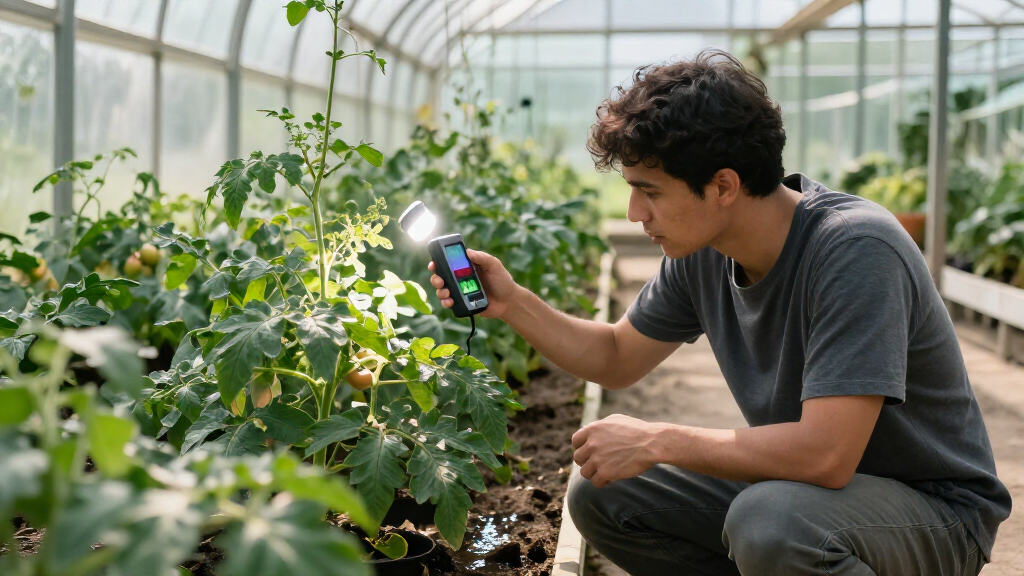
The remaining considerations are tracking performance over time and using a repeatable measurement method. The article says light sources can lose intensity and change in spectral quality as they age, making baseline readings useful for spotting depreciation and checking whether service or replacement may be needed. It recommends a professional-grade, calibrated meter or spectrometer. It names the LI-COR LI-180 Spectrometer as an example of an instrument designed for horticultural use that measures intensity and spectrum.
Measure garden light where crops grow
Five checks help growers compare planned lighting with real conditions at plant level and spot changes that may affect crops.
Five checks for growers
Measure both the amount and quality of light, and make readings comparable over time.
Use plant-relevant PAR readings in micromoles per square meter per second, rather than lux or lumens.
Check multiple spots for darker patches, shadows, and uneven coverage.
Spectral information can help assess lighting choices against crop goals.
Compare readings over time to spot possible intensity loss or spectral shifts as fixtures age.
Use a calibrated professional meter or spectrometer, with consistent locations and conditions.
Why readings vary
A lighting plan does not guarantee the same conditions during production.
- Fixture age and environmental conditions
- Installation differences
- Fixture arrangement and mounting height
- Structural obstructions and shadows
Build a useful baseline
Consistent records make later comparisons more meaningful.
Choose for the readings
A calibrated professional meter or spectrometer can measure intensity and spectrum. LI-COR LI-180 is one example.
Keep locations consistent
Document repeatable measurement points and conditions to compare results over time.
Map multiple points
A single reading can miss distribution differences across the growing area.
Why Measurement Can Change Crop Decisions
For growers using supplemental lighting, measurements provide a way to compare a system’s planned performance with conditions at plant level. Without readings, a facility could miss uneven coverage or gradual changes in fixture output. Those differences may affect how consistently plants receive light and make it harder to distinguish lighting issues from other causes of crop variation.
The article also links intensity to crop outcomes, stating that a 1% loss in light equals roughly a 1% loss in yield. That is a general claim presented in the article, not a quantified result tied there to a particular crop, facility, measurement period or study. Growers should not treat it as a guaranteed one-to-one forecast for every operation. The practical point is that small output changes may matter, and measurements can help identify them before decisions about service, replacement or lighting adjustments are made.
Spectral information may also help growers evaluate lighting choices against crop goals, but the article does not establish that taking a spectrum reading alone will produce a particular change in quality. Results depend on crop, growing conditions and how the measurements are used.
Products Worth Considering

Weber Original Kettle Charcoal Grill, 22-Inch, Black

Solo Stove Basecamp 24-Inch Smokeless Wood-Burning Fire Pit with Stand

Greenworks 48V Cordless Push Lawn Mower, 17-Inch, with Two 4.0Ah Batteries and Charger
As an affiliate, we earn on qualifying purchases.
From Fixture Plans to Crop-Level Readings
Lighting plans specify expected fixture performance, but a design value and a reading taken during production are not the same thing. The article identifies fixture aging, environmental conditions and installation inconsistencies as possible reasons real-world intensity may differ from the plan. It also points to layout, mounting height and obstructions as factors that can affect uniformity.
Its advice is aimed at facilities using supplemental horticultural lighting and centers on checking performance periodically rather than assuming a system continues to deliver its original output. The article recommends keeping measurements that can be compared over time. It does not provide a specific testing schedule or a universal sampling grid, and it directs readers to P.L. Light Systems for further guidance on protocols and common measurement challenges.
Limits of the Lighting Guidance
The article does not specify how often growers should measure, how many points to sample in a facility, or what uniformity thresholds to use. It also gives no crop-specific target values for intensity or spectrum. Those decisions may depend on the crop, facility design and lighting goals, so the guidance does not replace an operation-specific measurement plan.
The yield relationship is not accompanied by a cited study, time period or explanation of how it applies across different crops and conditions. The article also does not report measured results from particular facilities or establish that the named instrument is the only suitable option. Its claims about fixture degradation and the value of spectral measurements are guidance, not evidence that a particular grower’s system is underperforming.
Build a Repeatable Measurement Routine
Growers applying the guidance can begin by selecting a calibrated instrument suited to the measurements they need, then documenting consistent locations and conditions for readings. Recording both intensity and spectrum creates a baseline for later comparisons; mapping multiple points can also reveal distribution differences that a single reading would miss.
The article points readers to P.L. Light Systems for further information on measurement protocols and common challenges. It does not announce a new product, rule or research finding, and no follow-up date is given. Decisions about fixture service, replacement or changes to a lighting plan remain dependent on readings and the needs of each facility.
Source: rss
Key Questions
What should growers measure?
Measure PAR intensity and spectral distribution. The article also recommends checking how evenly light is distributed across the growing area.
Why not use lux or lumens?
The article says lux and lumens describe light in relation to human vision. For plant-usable PAR intensity, it gives micromoles per square meter per second as the relevant unit.
What equipment does the article recommend?
It recommends a professional-grade, calibrated light meter or spectrometer and gives the LI-COR LI-180 Spectrometer as one example. It does not say that this is the only appropriate instrument.
How often should a greenhouse measure its lights?
The article does not give a specific schedule. It recommends regular measurements and consistent records so growers can compare performance over time.
Does a 1% light loss always mean a 1% yield loss?
The article presents that relationship as a general rule of thumb, but supplies no crop-specific evidence or conditions. It should not be read as a guaranteed result for every facility.
Source: greenhousegrower.com