TL;DR
Drilling holes in a cut Christmas tree trunk does not improve how much water it takes up, according to the supplied cut-tree care guidance. The recommended approach is a fresh, flat cut at the base and keeping the cut end submerged in plain water; letting it dry out can reseal the trunk and stop water uptake.
Drilling holes in a Christmas tree trunk does not help a cut tree take up more water, according to the care guidance in the supplied report, which recommends a clean cut across the base and keeping that cut continuously submerged instead. The advice matters because a tree that dries out can shed needles and become a greater fire risk, while a trunk that seals over may stop absorbing water.

Get garden gear delivered free with Prime
- Fast, free delivery on millions of items
- Prime Video, Amazon Music and more included
- Member-only deals all year
Water moves upward through wood just beneath the bark, with the outer layers carrying most of the water, the report says. After a tree is cut, sap can ooze from the base and dry into a seal. Holes in the bottom or sides of the trunk do not remove that seal, so they do not provide the same access to fresh wood as a new cut across the base.
If a tree was cut more than about 12 hours earlier, the guidance recommends sawing a flat disk roughly ¼ to 1 inch (6 mm to 2.5 cm) thick from the bottom before placing it in water. A tree cut at the farm that morning can go straight into a stand. The cut should be horizontal: angled or V-shaped cuts do not improve water uptake and can make the tree harder to secure upright.
Keep the trunk’s outer wood intact. The report advises against shaving bark or carving the trunk to fit a small stand; if the trunk is too wide, use a larger stand. Most important, do not let the water level drop below the trunk’s cut end. The guidance says a tree can take up more than 1 gallon (3.8 liters) in a day early on, so check the stand at least daily during the first week.
Do trunk holes help?Fresh cuts do
Drilling holes does not increase water uptake, according to the supplied care guidance. A fresh, flat cut and steady access to plain water are the recommended approach.
Why holes fall short
Water moves through wood just beneath the bark; dried sap can seal the cut base.
- Do not remove the seal on the cut end.
- Do not offer the same access as fresh wood.
- Removes dried sap from the base.
- Exposes clean wood to water.
Set up the tree
Keep the outer trunk wood intact and the cut end under water.
If the tree was cut more than about 12 hours ago, saw a flat disk from the base.
Choose a stand that fits without shaving bark or carving the trunk.
Check the stand daily during the first week and refill as needed.
If uptake seems to stop
A tree brought home very dry or cold may take a day or two to begin drinking.
- Check that water reaches the trunk’s cut end.
- Look for a dried sap seal at the base.
- If undecorated and sealed, make another fresh cut.
- If needles are brittle or come off easily, take the tree down.
Fresh Cuts Matter More Than Holes
The practical consequence is that a popular fix may not address the reason a tree stops drinking. If the cut end has dried and sap has sealed it, side holes leave that blockage in place, while a fresh cut exposes new wood. A tree that continues taking up water is less likely to dry rapidly and shed needles, although watering alone cannot guarantee a tree will stay fresh indefinitely.
The distinction also affects what owners should do when the water level stops falling. Check whether water is actually touching the trunk, rather than relying on water still visible elsewhere in the stand. For an undecorated tree whose base has sealed, the report favors removing it from the stand and making another fresh cut. Drilling is described only as a sometimes-suggested fallback when a tree is already decorated, not as an equally supported alternative.
Dryness has a household safety dimension. The source says a tree that loses moisture becomes a greater fire risk, but it gives no quantitative estimate of that risk or a threshold for when a tree becomes unsafe. Owners should treat brittle needles and needles that come off easily as signs that the tree is too dry to save and should be taken down, according to the guidance.
Products Worth Considering

EGO POWER+ 56V Cordless Leaf Blower Kit with 2.5Ah Battery and Charger, 615 CFM (LB6151)

EGO Power+ 880 CFM Cordless Leaf Blower with Two 4.0Ah Batteries

Blackstone 2363 20 x 14-Inch Camping Griddle
As an affiliate, we earn on qualifying purchases.
How a Cut Tree Takes Up Water
The report frames trunk drilling as a recurring holiday tip: the idea is that extra openings might let more water enter the wood. Its explanation focuses instead on the tree’s natural water pathway beneath the bark and on sap that dries over the cut base. That is why the recommended preparation preserves the trunk’s outer layers and creates a clean, flat surface at the bottom.
Care starts before a tree enters the home. The supplied guidance suggests checking that few needles fall when a hand runs along a branch, that the stump feels sticky with sap, and that the tree retains its green color and feels heavy for its size. If the tree must wait before being brought indoors, it recommends standing the trunk in water in a cool, shaded place.
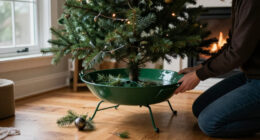
Once inside, use a stand with enough capacity: the report suggests about 1 quart (0.95 liters) per inch (2.5 cm) of trunk width, and at least a gallon for most trees. Keep the tree away from fireplaces, heaters, heat vents and sunny windows; the source also recommends LED lights, which produce less heat than older incandescent strings, and switching lights off at bedtime. It advises against homemade additives such as sugar, aspirin, bleach or soda. It says independent evidence that commercial additives outperform plain water is limited.
“Holes drilled into the trunk’s base don’t increase how much water a cut tree takes up.”
— The supplied Christmas tree care report
When a Tree Stops Drinking
The supplied material does not identify the researchers, studies or institutions behind its assessment of drilling, and it provides no publication date or links to the underlying evidence. The article therefore presents the conclusion as care guidance rather than a newly announced scientific finding. It also does not quantify how much a fresh cut changes water uptake or how long a properly watered tree will remain fresh.
A tree that has not taken up water for a day or two may not have a sealed base. The report says trees brought home very dry or very cold can take a day or two to begin drinking. Owners should first check whether the water reaches the trunk and look for dried sap at the base. If the tree is decorated, recutting may be difficult; the source says drilling is sometimes suggested in that situation but that a fresh cut has stronger support. It does not provide evidence that drilling reliably revives a sealed tree.
The report also gives no precise fire-risk measure or date-based rule for disposal. Its practical warning is condition-based: when needles feel brittle, break easily or come off in the hand, it says the tree is too dry to save and should be taken down.
Check the Stand and Tree
For households with a real tree, the immediate steps are to check that the trunk’s cut surface is below the waterline, refill the stand as needed and inspect the tree for drying. Check water daily during the first week, when the report says uptake can be especially high. If the tree has stopped drinking, first check the stand and the cut end; if the base has sealed and the tree is not decorated, the guidance recommends making a fresh cut before returning it to water.
The supplied material does not announce a formal follow-up study or a new product release. Its guidance points readers toward routine monitoring and established care steps rather than relying on drilled holes or additives. If needles become brittle or come off easily, the report says to take the tree down.
Key Questions
Do holes drilled in a Christmas tree trunk help it take up water?
No, according to the supplied care report. It says drilling the base or sides does not increase water uptake because the openings do not remove the dried sap that can seal the cut end.
What should I do if my tree stopped drinking?
First check that the water actually reaches the trunk and look for a dry sap crust on the cut surface. If the base has sealed and the tree is not decorated, the report recommends removing it from the stand and sawing off a fresh, flat slice.
How often should I water a real Christmas tree?
Check the stand at least once a day during the first week, the report advises. It says a tree can use more than 1 gallon (3.8 liters) in a day early on, though uptake varies.
Do additives keep a Christmas tree fresh longer?
The report advises against homemade mixtures such as sugar, aspirin, bleach and soda. It says independent evidence that commercial tree additives work better than plain water is limited, so it recommends keeping the cut end submerged in plain water.
When is a Christmas tree too dry to keep?
The report says a tree is too dry to save when its needles feel brittle, break easily or come off in your hand. It recommends taking the tree down at that point.
Source: gardeningknowhow.com