
TL;DR
The supplied guidance outlines ways to reduce winter stress on trees, including watering before the ground freezes, adding mulch without piling it against trunks, and protecting vulnerable bark and evergreens. It is a seasonal care guide, not a report of a new policy or event; timing and methods should be adjusted for tree species and local conditions.
The supplied tree-care guidance recommends fall watering, careful mulching and targeted protection to help trees face winter conditions, while cautioning against premature heavy pruning. The advice is relevant to homeowners and gardeners as temperatures drop, but it is general guidance rather than a report of a new official rule or research finding; appropriate steps depend on species, site and local weather.

Get garden gear delivered free with Prime
- Fast, free delivery on millions of items
- Prime Video, Amazon Music and more included
- Member-only deals all year
For trees in the ground, the guidance advises watering well through autumn, particularly for recently planted trees, and doing so before the soil freezes. It offers about 10 gallons per inch of trunk diameter as a rule of thumb, applied slowly. That figure is a general recommendation, not a universally suitable amount for every soil, tree or climate. Evergreens may need additional attention because they retain foliage and continue to lose moisture during winter. The source suggests checking them after two or three weeks without rain or snow cover and watering when the ground is not frozen.
Mulch can help moderate soil temperature and reduce moisture loss, according to the guidance. It recommends a layer of two to three inches placed around the root zone, but not against the trunk. The intended shape is a broad ring rather than a mound piled around the tree’s base. In places where the ground freezes and remains frozen, it advises waiting until after the freeze to mulch, to reduce the chance that rodents will shelter in the material.
Pruning advice distinguishes between immediate hazards and larger structural work. Dead or dangerous branches may need attention, but the source cautions that pruning too early in fall can prompt tender growth before cold weather. It says late winter is often preferred for structural pruning, while the right timing varies by species. It also recommends checking branches for risks to homes and walkways, and seeking qualified help where work is hazardous or requires significant cutting.
Prepare trees for winter stress
Fall watering, careful mulching and targeted protection can help trees face cold weather. Adjust each step for the tree and local conditions.
Water before the ground freezes
Recently planted trees and evergreens may need extra attention through autumn.
Water trees well before soil freezes; actual needs vary with species, soil and weather.
During extended dry spells, check soil moisture and water when the ground is not frozen.
Mulch in a broad ring
Mulch moderates soil temperature and helps reduce moisture loss.
- Spread two to three inches around the root zone.
- Leave a gap between mulch and trunk.
- Piling mulch against the bark.
- In areas with lasting ground freeze, mulch after the freeze.
Protect vulnerable trees
Young trees, thin-barked species, exposed evergreens and potted trees face particular winter risks.
Reduce bark injury
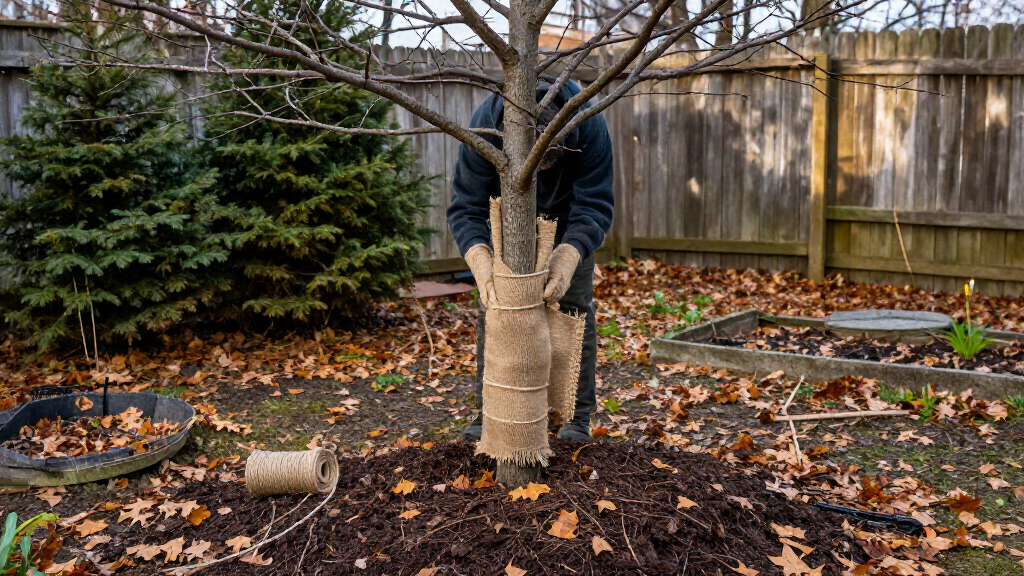
Light-colored trunk wrap may help protect susceptible trees from sunscald and frost cracks.
Buffer wind exposure
A burlap windbreak can shield exposed foliage without touching it.
Tie upright forms loosely
Loose ties can help reduce splitting under snow; remove seasonal ties in spring.
Time pruning and seasonal checks
Early fall pruning can prompt tender growth before cold weather; timing depends on species and local conditions.
Reducing Winter Stress on Trees
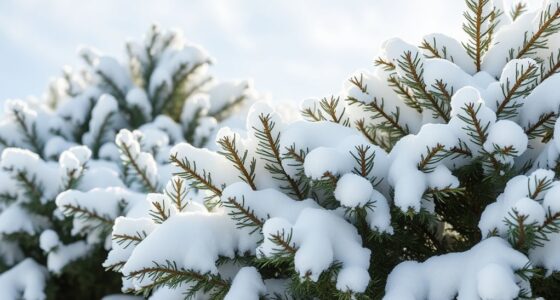
Winter damage can affect tree health and create hazards around homes and paths. Frozen ground can limit a tree’s access to water even when leaves or needles continue to lose moisture; abrupt temperature changes can also injure vulnerable trunks. The source identifies young trees and thin-barked species as particular candidates for trunk protection, and evergreens as susceptible to winter drying.
Preparation is not a guarantee against injury. It is a set of preventive measures aimed at moderating conditions around roots and branches. Careful timing matters: excess or poorly placed mulch can cause problems, while wrapping or tying that is left in place too long can rub or constrain a tree. Readers should treat the steps as site-specific maintenance, not a substitute for an arborist’s assessment of damaged or unstable trees.
Products Worth Considering

Husqvarna 130 Gas Chainsaw, 16-Inch Bar

EGO POWER+ 21-Inch Single-Stage Snow Blower with Two 4.0Ah Batteries and 320W Charger

Traeger Woodridge Wood Pellet Grill and Smoker, 860 sq. in., WiFi
As an affiliate, we earn on qualifying purchases.
Common Sources of Winter Damage
The guidance describes several distinct risks. Repeated freezing and thawing can move soil and disturb roots, particularly around young trees. Sunscald can occur when winter sunlight warms trunk tissue and a later temperature drop injures it; the source says thin-barked trees, including some maples, lindens, honey locusts, ornamental cherries and fruit trees, may be vulnerable. It also describes frost cracks as vertical splits associated with uneven cooling and contraction.
Evergreens face a separate moisture challenge: foliage can continue to lose water while frozen soil restricts uptake. The resulting winter burn may appear as brown or bronzed foliage, often on the side exposed to sun or prevailing winds. Potted trees are also more exposed to cold at the roots than trees planted in the ground. These explanations frame the recommendations; the source does not provide research citations or data comparing how well each intervention works.
How Local Conditions Change Care
The source does not identify a region, publication date, named expert or research study, so the recommendations cannot be treated as a locally tailored prescription. It does not specify watering needs by species, soil type, rainfall, container size or climate, and the suggested 10 gallons per inch of trunk diameter should not be read as a requirement in every setting. The best time to prune also differs among trees and local conditions.
It is also unclear how much protection a particular wrap, windbreak or mulch layer offers in a given yard. The source recommends light-colored trunk wrap for susceptible trees, a burlap windbreak for exposed evergreens and loose ties for upright forms that may split under snow. It does not give product testing or quantified outcomes. For large limbs, visible trunk damage or uncertain tree health, a qualified local arborist can assess the situation.
Checks to Make Before Spring
As winter approaches, homeowners can first identify dead or hazardous branches, check which trees are newly planted or thin-barked, and note whether evergreens and containers are exposed to wind or cold. They can water before the ground freezes, then apply mulch with space around each trunk. Any pruning beyond minor work should be timed for the species and local conditions, with hazardous jobs left to trained professionals.
During winter, the source advises avoiding ice melts containing sodium chloride near trees, because it can interfere with root uptake of water, oxygen and nutrients. It suggests products containing potassium, magnesium chloride or calcium instead. After heavy snow, branches may need gentle clearing; avoid forceful knocking that could break frozen limbs. In spring, remove seasonal trunk wraps and branch ties, and check for signs of injury. The guidance does not set a specific inspection date, so follow-up should reflect local weather and the tree’s condition.
Key Questions
When should I water trees before winter?
Water through autumn, especially for recently planted trees, and finish before the ground freezes. The source offers about 10 gallons per inch of trunk diameter as a general rule of thumb, but actual needs vary with soil, weather and species.
How should mulch be placed around a tree?
The guidance recommends two to three inches of mulch spread around the base in a ring, with a gap around the trunk. Do not pile it against the bark. In places where the ground freezes and stays frozen, wait until it has frozen before mulching.
Should I prune trees in fall?
The source cautions that pruning too early in fall can prompt new growth that may not harden before cold weather. Address immediate hazards as needed, but it says late winter is often a better time for structural pruning. Timing depends on the tree species and local conditions.
How can I protect evergreens from winter damage?
Water them before the ground freezes and check soil moisture during extended periods without rain or snow cover. For exposed trees, the guidance suggests a burlap windbreak that does not touch the foliage. It also advises against tightly wrapping branches in burlap or using plastic.
Do trees in pots need different winter care?
Yes. Container-grown roots are more exposed to cold than roots in the ground. After dormancy, move pots to a sheltered location when possible, or group and insulate them outdoors. Water when the potting mix is dry and not frozen.
Source: gardenerspath.com