
TL;DR

Get garden gear delivered free — and shop member deals
- Fast, free delivery on millions of items
- Access to Prime Big Deal Days deals on October 6–7
- Prime Video, Amazon Music and more included
A Gardening Know How report says turning off a sprinkler system may not remove water trapped in pipes, valves and heads, leaving components vulnerable to freeze damage. It recommends winterizing before the first hard freeze and warns that compressed-air blowouts require eye protection, careful pressure control and zone-by-zone operation.
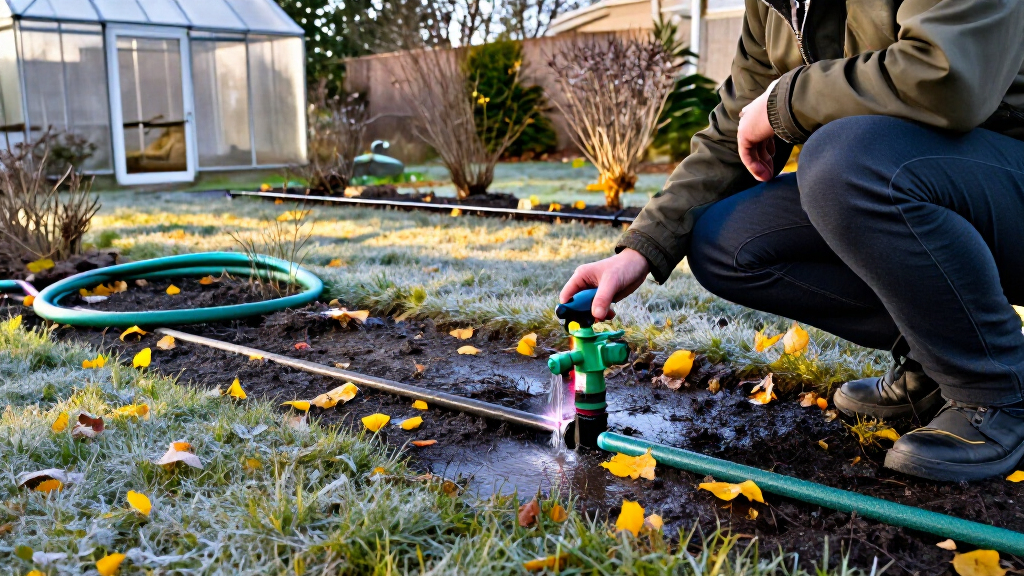
Turning off a sprinkler system does not necessarily remove water from its pipes, valves and heads, leaving components at risk of cracking when temperatures fall below freezing, according to a Gardening Know How report. The report advises homeowners to winterize before their area’s first hard freeze, using a system’s drain valves or a controlled compressed-air blowout where appropriate.
Water can remain in buried pipe low points, valves and sprinkler heads after the supply is shut off. The report says water expands by about one-eleventh as it freezes at 32°F (0°C), which can put enough pressure on plastic pipes, fittings, valves and sprinkler casings to cause damage. Electric valves can also retain water above an internal diaphragm, which the report says may require compressed air to clear.
Drain valves can remove some water, but they may not empty every section if pipes are not evenly sloped or have shifted and developed low spots. A blowout uses an air compressor connected to a system’s blowout port, with one irrigation zone opened at a time. The report says to stop when the heads produce only a fine mist and air, and to give each zone two passes rather than continuing to blow through already-cleared lines.
The report stresses that airflow matters alongside pressure: it cites around 5 cubic feet per minute as sufficient for many residential systems when clearing one zone at a time. It does not prescribe one pressure setting for every system. Homeowners should wear safety glasses, keep clear of heads and fittings, and avoid forcing air against a closed valve. The report says some systems are better handled by a professional.
Freeze Damage Can Start Inside Lines
Winterizing can prevent a fall shutoff from creating a false sense that an irrigation system is protected. Water left in a vulnerable section may freeze and crack components, with damage potentially becoming apparent only when the system is restarted in spring. Repairs may involve split fittings, broken valves or damaged sprinkler casings, rather than a single easy-to-spot problem.
Compressed-air clearing brings its own hazards. A forceful blast can send water, grit and debris flying, and excessive or prolonged air pressure can damage nozzles, pipes, seals and heads. The report’s safety guidance means the task is not simply a matter of attaching a compressor: homeowners need to know the system layout, use suitable equipment and stop when a zone is clear.
As an affiliate, we earn on qualifying purchases.
Timing Depends on Local Freeze Risk
The report recommends completing winterization before the first hard freeze. In colder areas, that may mean early to mid-fall. It says an established lawn can be taken off irrigation a little early and should green up again when watering resumes in spring.
Exposure differs across a system. Backflow preventers and above-ground pipework face freezing air directly, while buried lines are more vulnerable after prolonged cold drives frost deeper into the ground. In some mild-winter regions, systems may not have a blowout port because draining exposed components is generally considered enough. The report says those homeowners may need to shut off the supply, turn off the controller and drain exposed parts, rather than use a blowout.
““A sprinkler blowout isn’t hard, but you shouldn’t rush it.””
— Gardening Know How report
irrigation system winterization tools
As an affiliate, we earn on qualifying purchases.
As an affiliate, we earn on qualifying purchases.
System Design Changes the Right Method
The report does not specify a single pressure limit that applies to every sprinkler system, nor does it establish that every residential system can safely be cleared with the same compressor. System design, pipe condition and local climate vary, and the report says some systems are better left to a professional. Whether a simple drain is adequate in a mild-winter area also depends on the system’s layout and exposure.
Homeowners who cannot identify the blowout port, shutoff, backflow preventer or zone controls should not assume that shutting off the supply has emptied the lines. The report does not offer a system-by-system assessment; the appropriate procedure for a particular installation remains dependent on its components and manufacturer guidance.
As an affiliate, we earn on qualifying purchases.
Complete Draining Before Cold Arrives
Homeowners should check their local freeze outlook and identify how their system is designed to drain before temperatures approach a hard freeze. Where the system calls for a blowout, the report advises closing the water supply, connecting the compressor at the blowout fitting downstream of the backflow preventer, and keeping air from passing back through that device. Open one zone before applying air, proceed gradually, and stop once only a fine mist and air emerge.
After clearing the zones, the report says to leave the backflow preventer’s ball valves and test cocks half-open so water is less likely to remain trapped. It also advises draining pumps and storing them indoors. Anyone unsure about the equipment or safe operating procedure can consult an irrigation professional before the first hard freeze.
As an affiliate, we earn on qualifying purchases.
Key Questions
Is turning off the sprinkler water enough for winter?
Not necessarily. Gardening Know How says water can remain in pipes, valves and sprinkler heads after the supply is shut off, where it may freeze and cause damage.
When should I winterize my sprinkler system?
The report recommends doing it before the first hard freeze. In colder regions, that often means early to mid-fall, though local conditions vary.
Does every sprinkler system need a compressed-air blowout?
No. Some systems, especially in mild-winter regions, may be designed for draining exposed components without a blowout. The right method depends on system design and local freeze exposure.
What safety steps matter during a sprinkler blowout?
Wear safety glasses, keep people and pets clear of sprinkler heads and fittings, open one zone before starting the compressor, and do not force air against a closed valve. Stop once the zone is clear; prolonged air through dry pipes can cause damage.
Source: rss
Halloween Picks
halloween
As an affiliate, we earn on qualifying purchases.