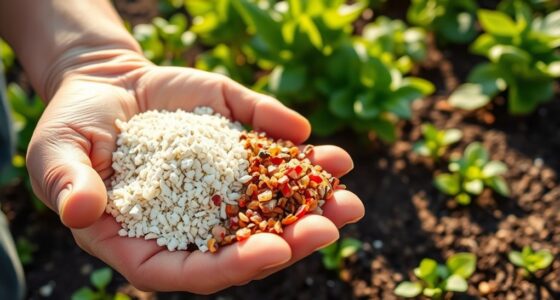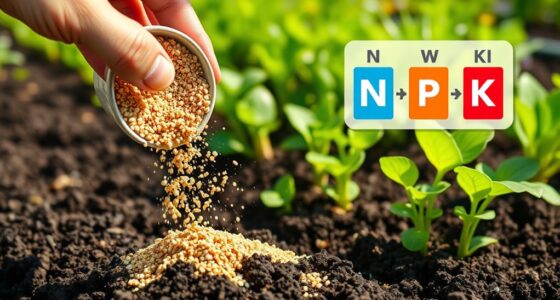
Understanding N-P-K ratios helps you choose fertilizers that match your plants’ needs. Nitrogen (N) promotes lush foliage, phosphorus (P) supports root growth and flowers, and potassium (K) boosts overall health and disease resistance. By selecting the right balance, you give your plants essential nutrients for healthy development. Organic options like compost foster beneficial microbes, supporting long-term soil health. Stay tuned to learn how adjusting these ratios can optimize your garden’s success.
Key Takeaways
- N-P-K ratios indicate the levels of nitrogen, phosphorus, and potassium in fertilizers, essential for different plant growth stages.
- Nitrogen (N) promotes lush, green foliage; phosphorus (P) supports root and flower development; potassium (K) enhances overall plant health.
- Understanding your plants’ specific needs helps choose the right fertilizer ratio for optimal growth.
- Organic fertilizers supply nutrients naturally and foster beneficial microbes that improve nutrient availability.
- Proper N-P-K management prevents nutrient deficiencies or excesses, ensuring healthy, resilient plants.
Have you ever wondered how plants grow so lush and healthy? The secret lies in understanding what they need to thrive, especially the role of soil conditions and nutrients. One essential factor is soil pH, which affects how plants absorb nutrients. If your soil is too acidic or too alkaline, your plants might struggle to get what they need, even if you’re applying the right fertilizer. Testing your soil pH is a simple step that can make a big difference. Most plants prefer a slightly acidic to neutral pH, around 6.0 to 7.0. If your soil’s pH isn’t in this range, you can adjust it using organic amendments. For example, adding compost or peat moss can help lower the pH if it’s too alkaline, while sulfur or pine needles can help increase acidity if it’s too acidic. These organic amendments not only balance soil pH but also improve soil structure, moisture retention, and microbial activity, creating a healthier environment for your plants. Additionally, understanding the vibrational energy of your soil and plants can help optimize growth conditions by aligning your gardening practices with natural rhythms.
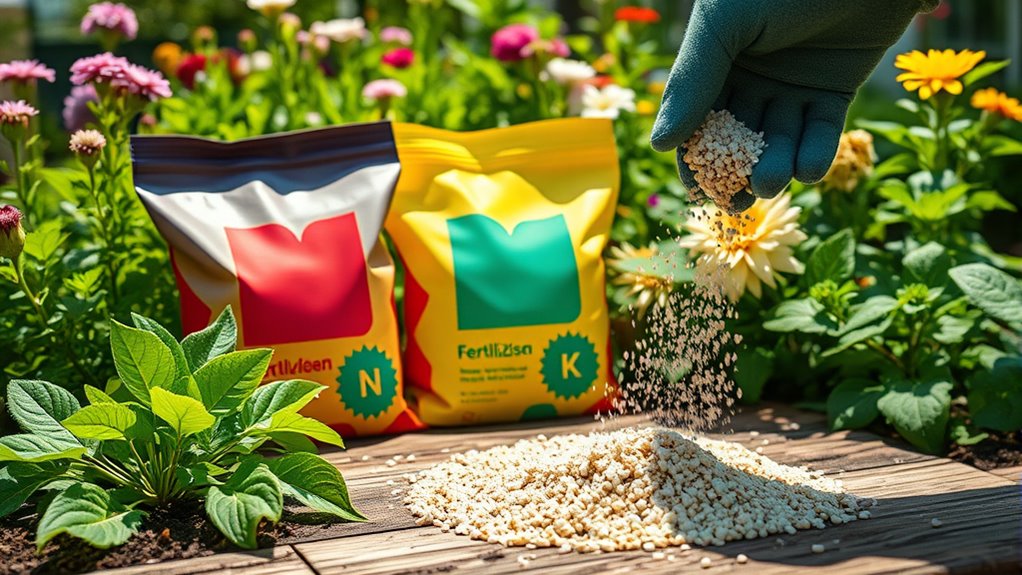
Once your soil pH is in the right range, you need to think about the nutrients your plants require. Understanding N-P-K, or the ratio of nitrogen, phosphorus, and potassium in fertilizers, is essential. Nitrogen promotes lush, green foliage; phosphorus supports root development and flowering; potassium helps with overall plant health and disease resistance. The right balance depends on what you’re growing. For leafy vegetables, a fertilizer high in nitrogen works well, while flowering plants benefit from more phosphorus. When choosing fertilizers, always read the label to see the N-P-K ratio and match it to your plant’s needs. Applying fertilizer too much or too little can hinder growth or cause damage. Using organic amendments such as compost and manure can also enhance nutrient availability by fostering beneficial soil microbes, leading to healthier plant growth over time.
As an affiliate, we earn on qualifying purchases.
Frequently Asked Questions
How Do I Choose the Right Fertilizer for My Specific Plants?
To select the right fertilizer for your plants, start by considering their specific needs. Soil testing helps you identify nutrient deficiencies and imbalances. Then, look at your plant species, as some require more nitrogen, phosphorus, or potassium. Choose a fertilizer with the appropriate N-P-K ratio matching these needs. Applying the right product guarantees healthy growth, vibrant blooms, and strong roots tailored to each plant’s unique requirements.
Can Over-Fertilizing Harm My Plants or the Environment?
Over-fertilizing your plants is like pouring too much seasoning into a dish—what’s meant to enhance can become harmful. It can lead to soil contamination and nutrient runoff, polluting nearby water sources. Excess fertilizer doesn’t stay put; it leaks into the environment, harming ecosystems. So, always follow recommended amounts, and remember, more isn’t better—balance keeps your plants healthy and the environment safe.
Are Organic Fertilizers as Effective as Synthetic Ones?
You might wonder if organic fertilizers are as effective as synthetic ones. Organic benefits include improved soil health and fewer chemical drawbacks, making them a great choice for sustainable gardening. While synthetic fertilizers can provide quick nutrients, they may lead to runoff and soil degradation over time. Your plants can thrive with either option, but choosing organic helps protect the environment and promotes long-term fertility.
How Often Should I Fertilize Different Types of Plants?
Your garden’s growth depends on your nurturing, like a symphony conductor guiding each instrument. You should fertilize most plants every 4-6 weeks, but always consider their specific needs. Adjust your watering schedule to prevent over- or under-fertilizing, and monitor soil pH to keep nutrients available. For potted plants, fertilize more frequently, while outdoor plants may need less. Regularly observing your plants helps you fine-tune this essential routine.
What Are Signs That My Plants Need More or Less Fertilizer?
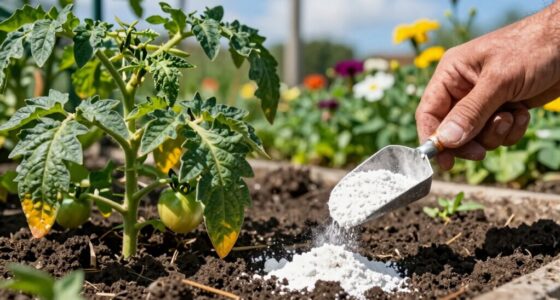
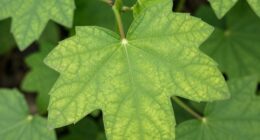
You’ll notice signs that your plants need more or less fertilizer by observing their plant health. If your plants have yellowing leaves, stunted growth, or weak stems, they might suffer from nutrient deficiency and need extra nutrients. Conversely, if you see leaf burn, dark spots, or wilting, you could be over-fertilizing. Adjust your fertilization schedule accordingly to promote healthy growth and avoid stressing your plants.

Rapitest Soil Test Kit for Gardens, Vegetables, Flowers and Lawns. USA designed and assembled soil tester completely, quickly and accurately measures/analyzes soil pH acidity and garden nutrients.
- Quick at-home soil pH testing: Measures soil pH, Nitrogen, Phosphorous, Potash
- Easy-to-use capsule system: Innovative and inexpensive testing method
- Includes 20 tests: 5 tests each for pH, N, P, K
As an affiliate, we earn on qualifying purchases.
As an affiliate, we earn on qualifying purchases.
Conclusion
Now that you understand the basics of N-P-K and what your plants crave, you’re ready to give them the right boost. Remember, just like a trusty steed needs the right care, your plants thrive with proper nutrients. Don’t forget to read labels and adjust your fertilizing game accordingly. With a little know-how, you’ll be a gardening legend in no time—no need to channel your inner Renaissance gardener, but a little old-fashioned wisdom never hurts!
As an affiliate, we earn on qualifying purchases.
plant fertilizer for flowering plants
As an affiliate, we earn on qualifying purchases.
As an affiliate, we earn on qualifying purchases.