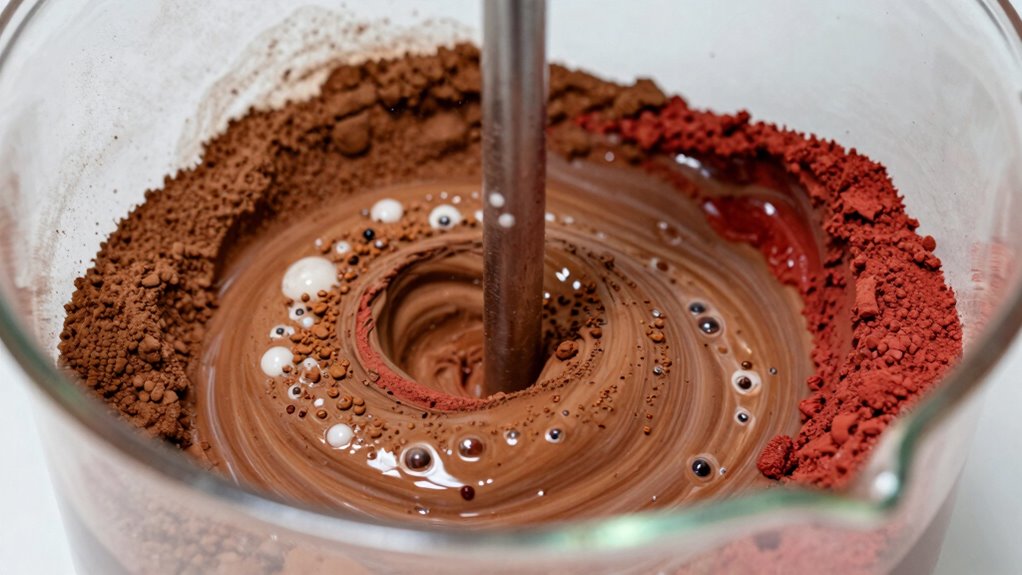

Agitation is essential because it keeps powders, clays, and suspensions uniformly mixed and stable. It breaks up clumps, prevents settling, and guarantees particles stay evenly distributed. This process also controls viscosity, maintaining the right flow for application, and reduces air bubbles or separation. By actively managing these factors, you improve product consistency and quality. Keep exploring to discover how proper agitation techniques can boost your material performance even further.
Key Takeaways
- Ensures uniform distribution and prevents settling or separation of powders, clays, and suspensions.
- Breaks down agglomerates, promoting consistent particle dispersion throughout the medium.
- Regulates viscosity to maintain optimal flow and application properties.
- Reduces risks of clumping, air bubbles, and component separation, preserving product integrity.
- Enhances process efficiency and final product quality by maintaining stability and performance.

Agitation plays an essential role in guaranteeing the uniformity and stability of powders, clays, and suspensions. When you’re working with these materials, proper agitation helps break down clumps, evenly distribute particles, and prevent settling or separation over time. This process isn’t just about mixing; it’s about maximizing the physical properties of your material to achieve the desired consistency and performance. Particle dispersion is a core aspect of effective agitation. By continuously moving the mixture, you break apart agglomerates, ensuring that each particle is evenly suspended throughout the liquid or medium. This uniform distribution is fundamental because it directly influences the quality and consistency of your final product. Without proper particle dispersion, you risk uneven textures, inconsistent color, or compromised structural integrity in your powders, clays, or suspensions.
Vibration or stirring techniques are your tools for controlling the viscosity of your mixture. When you agitate effectively, you can prevent the mixture from becoming too thick or too thin, maintaining a viscosity that’s ideal for your process. For instance, if the suspension becomes too viscous, it can hinder flow and application, leading to poor coating, uneven spreading, or difficulty in handling. Conversely, if it’s too thin, it may not hold particles in suspension long enough, causing settling and uneven composition. Through controlled agitation, you can adjust the viscosity dynamically, guaranteeing the mixture remains workable and stable for the duration of your process. Proper agitation methods are essential for achieving these viscosity controls effectively. Additionally, selecting the right agitation equipment can enhance efficiency and ensure consistent results.
The significance of agitation extends beyond just mixing—it’s about maintaining the right physical conditions. By continuously moving the particles and controlling viscosity, you reduce the risk of sedimentation and clumping. This is especially critical in industries like ceramics, pharmaceuticals, and cosmetics, where material stability directly impacts quality. Proper agitation also minimizes the formation of air bubbles and prevents the separation of components, which could compromise the integrity of your product. Additionally, understanding the physical properties of powders, clays, and suspensions helps optimize agitation techniques for specific applications. Incorporating proper agitation techniques can also improve process efficiency by reducing the need for rework or adjustments later in production.
In essence, your ability to manage particle dispersion and viscosity control through agitation determines the success of your material processing. It guarantees that powders, clays, and suspensions perform predictably and reliably. Whether you’re manufacturing a fine cosmetic cream, a ceramic glaze, or a pharmaceutical suspension, understanding and applying the right agitation techniques keeps your mixture uniform, stable, and of high quality. It’s a simple yet powerful step that can make all the difference in achieving maximum results.
As an affiliate, we earn on qualifying purchases.
Frequently Asked Questions
How Does Agitation Affect Powder Particle Size Distribution?
Agitation improves particle size distribution by promoting better particle breakage and uniform dispersion. You’ll notice enhanced particle uniformity because consistent agitation prevents clumping and ensures even mixing. This directly boosts mixing efficiency, making sure all particles are evenly distributed throughout the suspension. When you maintain proper agitation, it minimizes larger particles, creates a more consistent powder, and optimizes the overall quality of your mixture.
Can Improper Agitation Cause Chemical Degradation?
Improper agitation can lead to chemical degradation by causing uneven mixing, which exposes some components to unfavorable conditions or catalysts. This disrupts chemical stability and increases the risk of degradation. To prevent this, you should guarantee proper agitation techniques, maintaining consistent mixing to promote degradation prevention. By doing so, you help preserve the product’s integrity, ensuring it remains effective and safe throughout its shelf life.
What Equipment Is Best for Large-Scale Powder Agitation?
For large-scale powder agitation, you should opt for industrial mixers like ribbon blenders or paddle mixers, which maximize mixer efficiency. These devices guarantee thorough blending and consistent results. Regular equipment maintenance is essential to keep the mixers running smoothly and prevent contamination or breakdowns. Choosing the right equipment and maintaining it properly guarantees effective agitation, reduces downtime, and maintains powder quality across your production process.
How Does Temperature Influence Agitation Effectiveness?
A stitch in time saves nine, and with temperature’s role in agitation, it’s vital to keep it steady. You’ll find that proper temperature control guarantees ideal agitation speed, preventing clumping or settling. When temperatures fluctuate, powders may become harder to suspend, reducing mixing efficiency. By maintaining consistent temperature, you enhance agitation effectiveness, making sure powders, clays, and suspensions stay uniformly mixed and prevent issues that could compromise your process.
Are There Environmental Concerns With Agitation Methods?
Yes, there are environmental concerns with agitation methods. You should consider the environmental impact of energy consumption from equipment like mixers and paddles, which can contribute to carbon emissions. To promote sustainable practices, opt for energy-efficient machinery and methods that reduce waste and pollution. By doing so, you help minimize your environmental footprint while maintaining effective agitation for powders, clays, and suspensions.
As an affiliate, we earn on qualifying purchases.
Conclusion
Understanding the importance of agitation helps you optimize the handling of powders, clays, and suspensions, ensuring consistent quality and performance. Did you know that improper agitation can lead to product separation, reducing effectiveness by up to 40%? By maintaining proper agitation, you prevent settling and clumping, saving time and resources. So, next time you’re working with these materials, remember that a little agitation goes a long way in achieving reliable, high-quality results.
clay and powder dispersion equipment
As an affiliate, we earn on qualifying purchases.
As an affiliate, we earn on qualifying purchases.
As an affiliate, we earn on qualifying purchases.