
TL;DR

Get garden gear delivered free with Prime
- Fast, free delivery on millions of items
- Prime Video, Amazon Music and more included
- Member-only deals all year
A tree or hedge is generally the responsibility of the landowner whose property its trunk or main stem occupies, but ownership can be more complicated when it straddles a boundary. The guidance advises checking property deeds, speaking with the neighbour and confirming whether a tree is protected before carrying out work.
A tree or hedge between neighbours is generally owned by the person on whose land its trunk or main stem stands, according to guidance published by Ideal Home, but a boundary-spanning tree can make responsibility harder to establish. The report advises checking property deeds and confirming any protections before pruning or removing a disputed feature.
The report cites Lucie Bradley, gardening and greenhouse expert at Harvst Automatic Watering, who recommends starting with the property deeds. Land Registry documents may show the general extent of a property with a red boundary line. Bradley says deeds may also contain “T” marks: a mark on one side can indicate responsibility for that boundary feature, while paired marks resembling an “H” can indicate shared responsibility. The report cautions that boundary plans are not precise to the millimetre.
Kara Gammall, home insurance expert at MoneySuperMarket, says a tree will generally belong to the owner of the land where its trunk is located, even when branches or roots extend into a neighbour’s garden. A fence is not conclusive proof of the legal boundary, she says, because fences can move over time. The report advises consulting deeds or historic documents rather than assuming the fence line settles ownership.
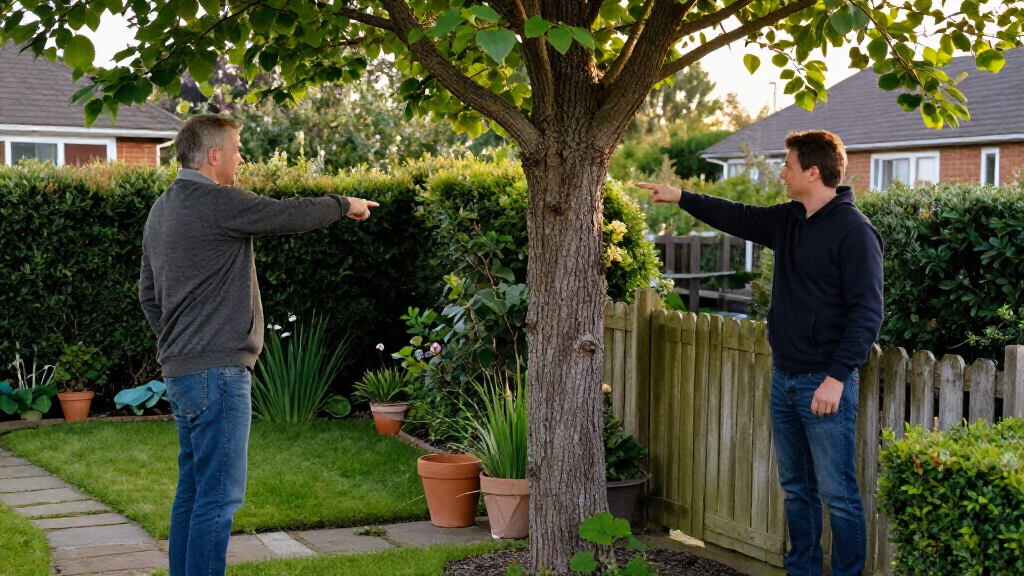
If a trunk or the main stems cross the boundary, the neighbours may need to agree how the tree or hedge is maintained. Bradley advises discussing significant pruning or removal together, particularly where the feature appears to sit on both properties. For encroaching branches, Gammall says a neighbour can generally prune growth back to the boundary on their own side, but should not cross onto the other property or cut beyond the boundary without permission. She also recommends talking to the tree’s owner before substantial work that could affect its health or stability.
Pruning Can Create Legal Risks
Working out responsibility before cutting can help prevent a garden dispute from becoming a property or legal problem. A tree’s visible branches do not by themselves establish who owns it, and the position of a fence may not match the legal boundary. The report’s practical point is to check the documents and discuss the issue before carrying out substantial or irreversible work.
There may also be restrictions even when a homeowner believes a tree is on their land. Ian Wilson, managing director and home insurance expert at Tiger.co.uk, says some trees are covered by a Tree Preservation Order (TPO). The report says pruning a protected tree without permission can bring serious consequences, with Wilson citing fines of up to £20,000. It also warns that disturbing or harming nesting birds is illegal under the Wildlife and Countryside Act 1981. The specific rules and circumstances should be checked with the relevant authority before work starts.
tree pruning hand saw for garden branches
As an affiliate, we earn on qualifying purchases.
As an affiliate, we earn on qualifying purchases.
The report frames tree ownership as similar to questions about who is responsible for a boundary fence: the answer depends on the property boundary and any relevant documents, not simply on a common assumption. It describes the so-called “left-hand rule”—the belief that a homeowner owns the left-hand boundary—as a widespread property myth, rather than a reliable way to determine ownership.
Its suggested starting point is to inspect the title documents through HM Land Registry, while recognising that boundary markings show general extent rather than an exact line on the ground. If those records do not resolve the issue, the tree’s trunk and main stems, older documents and a conversation with the neighbour may help clarify the situation. For possible TPOs or conservation-area restrictions, the report directs homeowners to their local council; an online checker may offer an indication, but the council should be contacted for confirmation.
“The place to start when trying to find out who owns a tree or hedge is to check your house deeds.”
— Lucie Bradley, gardening and greenhouse expert at Harvst Automatic Watering
As an affiliate, we earn on qualifying purchases.
When the Boundary Is Disputed
The supplied guidance does not identify a specific property dispute or provide a ruling on any individual boundary. It also does not give a publication date. In a particular case, ownership may remain unclear if deed plans, historic records and the position of the trunk do not align; the report does not set out a formal process for resolving such disagreements.
Its descriptions of boundary marks and encroaching growth are general guidance, not a determination of legal rights for every property. Whether a tree is protected, whether work needs permission and what action is permitted can depend on the location and circumstances. Homeowners should confirm details with their local council and seek appropriate property or legal advice if neighbours cannot agree.
As an affiliate, we earn on qualifying purchases.
Check Records Before Cutting
The next step for a homeowner concerned about a boundary tree or hedge is to review the property deeds and compare the documents with the feature’s position. If the boundary or responsibility is uncertain, speak with the neighbour before arranging major pruning or removal. Check with the local council for any Tree Preservation Order or conservation-area restrictions, and ask what permission may be needed before work begins.
For branches extending over a boundary, the report advises keeping any pruning to growth on the homeowner’s side and not entering the neighbour’s land without permission. Its guidance also calls for care around nesting birds. The supplied report does not announce a further official decision or timetable; any next steps will depend on the property records, local protections and whether the neighbours can reach an agreement.
tree protection order identification guide
As an affiliate, we earn on qualifying purchases.
As an affiliate, we earn on qualifying purchases.
Key Questions
Who generally owns a tree between two houses?
According to the guidance, a tree generally belongs to the owner of the land where its trunk or main stem stands. If it crosses the boundary, ownership and care may need to be discussed between neighbours.
How can I check where my property boundary is?
Start with your property deeds and Land Registry documents. The report says boundary lines show the general extent of a property, not a millimetre-precise position. A fence alone may not establish the legal boundary.
Can I cut branches that extend into my garden?
The report says a homeowner can generally prune encroaching growth back to the boundary on their side. Do not cross onto a neighbour’s land or cut beyond the boundary without permission, and discuss substantial work with the tree’s owner.
What should I check before pruning a tree?
Ask the local council whether the tree has a Tree Preservation Order or is in a conservation area, and confirm any permission requirements. The report also warns against disturbing or harming nesting birds.
Source: rss
Halloween Picks
halloween
As an affiliate, we earn on qualifying purchases.