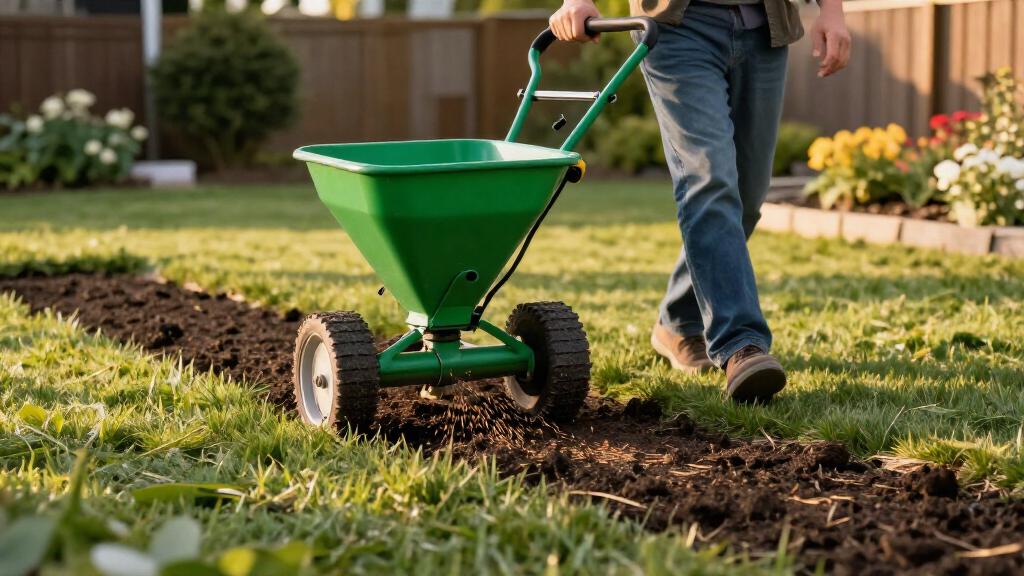

The best lawn seeder for most homeowners is the Yard Commander 50 lb Walk-Behind Broadcast Spreader, which offers a practical middle ground between small hand spreaders and large tow-behind equipment. For small patches and touch-ups, the Scotts Whirl is a simpler, lighter option; for large areas, the Agri-Fab 100 lb Tow-Behind Spiker Seeder combines seed delivery with soil contact. The main choice is between portability, capacity, coverage width, and whether you need seed placed on the surface or worked into the ground. A larger hopper can reduce refills, but it also means more equipment to store and maneuver. Read on for how all nine options compare and which type fits your lawn.

Get garden gear delivered free with Prime
- Fast, free delivery on millions of items
- Prime Video, Amazon Music and more included
- Member-only deals all year
Complete the kit


Key Takeaways
- Yard Commander is the strongest all-around fit for homeowners who want more capacity than a handheld spreader without stepping up to a tractor-mounted setup.
- Handheld models suit small jobs, not full-lawn efficiency. The Garden Guru, Chapin 8740A, Chapin TurfPro, and Scotts Whirl trade capacity and coverage for easy handling and storage.
- Large lawns change the value calculation. The Agri-Fab tow-behind model holds up to 100 pounds and adds spiking, while the Brinly combines spreading with aeration—features that matter more on expansive turf.
- Broadcast and drop spreading are not interchangeable. Broadcast models cover ground quickly but need careful boundary control; a drop-style setup favors more contained placement.
- Capacity alone does not determine the best choice. Terrain, storage space, towing equipment, seed type, and the accuracy needed near beds or walkways can matter more than hopper size.
| Garden Guru Handheld Seed Spreader, 1 L |  | Best Compact Handheld | Brand: Garden Guru | Product type: Handheld spreader | Capacity: 1 L | VIEW LATEST PRICE | See Our Full Breakdown |
| Chapin 8740A 64 oz All-Season Hand Shaker Spreader |  | Best for Small-Area Versatility | Capacity: 64 oz | Material: Poly | Lid openings: Three sizes: small, large, and wide | VIEW LATEST PRICE | See Our Full Breakdown |
| Chapin 84700G TurfPro 25 lb Handheld Bag Spreader |  | Best for Hard-to-Reach Lawn Areas | Brand: Chapin | Model: 84700G | Capacity: 25 lb | VIEW LATEST PRICE | See Our Full Breakdown |
| Agri-Fab Tow-Behind Spiker Seeder Drop Spreader, 100 lb Capacity, 32 in Working Width |  | Best for Large-Lawn Seeding and Aeration | Brand: Agri-Fab | Model: 45-05431 | Hopper capacity: 100 lb | VIEW LATEST PRICE | See Our Full Breakdown |
| Scotts Turf Builder EdgeGuard DLX Broadcast Spreader |  | Best for Ready-to-Use Lawn Coverage | Brand: Scotts | Model: 76232 | Type: Broadcast spreader | VIEW LATEST PRICE | See Our Full Breakdown |
| Scotts Whirl Hand-Powered Spreader |  | Best Compact Handheld Seeder | Type: Hand-powered spreader | Coverage: Up to 1,500 sq. ft. | Suitable materials: Grass seed, lawn fertilizer, salt, and ice melt | VIEW LATEST PRICE | See Our Full Breakdown |
| Brinly 40-Inch Tow-Behind Aerator Spreader with Weight Tray |  | Best for Aerating and Seeding Together | Working width: 40 in. | Hopper capacity: 100 lb. (1.74 cu. ft.) | Weight tray capacity: 75 lb. | VIEW LATEST PRICE | See Our Full Breakdown |
| Yard Commander 50 lb Walk-Behind Broadcast Spreader |  | Best for All-Season Walk-Behind Use | Hopper capacity: Up to 50 lb.; actual capacity depends on material | Spread radius: 10–12 ft. | Tires: 12-in. pneumatic tires with studded rubber and high-flotation design | VIEW LATEST PRICE | See Our Full Breakdown |
| VEVOR Walk-Behind Broadcast Spreader, 60 lb Capacity |  | Best for Adjustable Spreading Control | Capacity: 60 lb. | Spreading width: Up to 9.8 ft. | Adjustable settings: 18 | VIEW LATEST PRICE | See Our Full Breakdown |
More Details on Our Top Picks
Garden Guru Handheld Seed Spreader, 1 L
The Garden Guru Handheld Seed Spreader suits small patches, touch-ups, and spots where a wheeled spreader would be awkward. Its adjustable twist cap has multiple opening sizes, giving it more flexibility across different granules than a single-purpose seed shaker. The wide refill opening and comfortable handle also make quick, short jobs less fiddly. Compared with the Chapin 8740A, it offers a stated 1 L capacity rather than a 64 oz capacity, so the better fit depends on how often you want to refill and the materials you plan to spread. Its main limitation is scale: larger lawns will mean repeated trips to the container. A lifetime warranty adds reassurance, but this remains a light-duty handheld tool, not a substitute for a broadcast or tow-behind seeder.
Pros:- Multiple twist-cap openings accommodate different granule sizes
- Lightweight body and comfortable handle suit short, targeted jobs
- Wide refill opening makes loading simpler
- Lifetime warranty and 90-day satisfaction guarantee
Cons:- 1 L capacity is limited for larger lawns
- Handheld operation requires carrying and manually distributing material
Best for: Homeowners patching bare spots, overseeding small sections, or spreading granules around beds and tight lawn edges
Not ideal for: People seeding a large lawn in one session, since the 1 L capacity calls for frequent refills and handheld spreading takes time
- Brand:Garden Guru
- Product type:Handheld spreader
- Capacity:1 L
- Flow control:Adjustable twist cap with multiple opening sizes
- Suitable materials:Grass seed, fertilizer, salt, ice melt, and pool chemicals
- Warranty:Lifetime warranty
- Satisfaction guarantee:90 days
Our verdict“Choose this for small, precise lawn jobs and varied granules, but pick a higher-capacity spreader for broad coverage.”
Chapin 8740A 64 oz All-Season Hand Shaker Spreader
The Chapin 8740A is a straightforward pick for small lawns, paths, and seasonal jobs where one portable container can handle seed in warmer months and ice melt or salt in colder weather. Its three lid openings let you match the outlet to different pellet sizes, while the wide mouth simplifies filling. The large grip is designed for use with bare hands or gloves, a practical advantage over a compact handheld option such as the Garden Guru 1 L. That said, its shaker format calls for manual movement and is intended for small areas, not efficient full-lawn coverage. The Agri-Fab tow-behind spreader is a better match when a tractor is available and the job spans a large area; Chapin makes more sense when portability and easy storage matter more than speed.
Pros:- Three lid openings suit different seed and pellet sizes
- Wide-mouth bottle and screw-top lid simplify filling
- Large handle accommodates small and large hands, including gloved hands
- Portable design can be stored with product inside
Cons:- Designed for small areas and paths rather than large-scale spreading
- Manual shaker operation can be tiring or uneven over extended use
Best for: Homeowners who want one portable spreader for small lawn patches, walkways, and seasonal seed or ice-melt jobs
Not ideal for: People overseeding a broad lawn or seeking a consistent, high-volume application without repeated manual shaking
- Capacity:64 oz
- Material:Poly
- Lid openings:Three sizes: small, large, and wide
- Handle:Large grip designed for small and large hands, with or without gloves
- Intended materials:Seed, fertilizer, salt, ice melt, sand, and pelletized products
- Spreader type:Hand shaker spreader
Our verdict“Pick the Chapin 8740A for portable, year-round spreading on small areas, not for covering a whole lawn quickly.”
Chapin 84700G TurfPro 25 lb Handheld Bag Spreader
For narrow strips, lawn edges, and areas a wheeled spreader struggles to reach, the Chapin TurfPro 84700G offers a useful middle ground between a small shaker and a tractor attachment. Its 25 lb bag carries more material than the Garden Guru or Chapin 8740A handheld containers, while the adjustable gate gives the user control over flow. A padded shoulder strap distributes the carrying load, and the rear baffle helps keep material away from legs and clothing. The waterproof zippered bag and enclosed gears add protection in outdoor conditions. The tradeoff is that the weight rests on the operator, and 25 lb still may not be enough for large properties without refills. For wide, open lawns, the Scotts EdgeGuard DLX or Agri-Fab tow-behind is a more efficient format.
Pros:- 25 lb capacity holds more material than handheld shaker-style options
- Adjustable gate controls material flow
- Padded shoulder strap and rear baffle support more comfortable, contained spreading
- Waterproof zippered bag and enclosed gears protect the contents and mechanism
Cons:- Carrying a loaded bag can become tiring
- Capacity may still require refills on larger lawns
- Handheld bag format is less suited to broad, open areas than wheeled or tow-behind spreaders
Best for: Homeowners treating narrow lawn sections, edges, and hard-to-reach areas who need more capacity than a shaker spreader
Not ideal for: People who cannot comfortably carry a loaded bag or need to spread seed over a large, open lawn with minimal refilling
- Brand:Chapin
- Model:84700G
- Capacity:25 lb
- Type:Handheld bag spreader
- Adjustable flow:Yes
- Bag:Waterproof, zippered
- Gears:Enclosed
- Warranty:2-year limited
Our verdict“Choose the TurfPro for higher-capacity handheld work in awkward lawn areas, but favor a wheeled spreader for large open coverage.”
Agri-Fab Tow-Behind Spiker Seeder Drop Spreader, 100 lb Capacity, 32 in Working Width
The Agri-Fab 45-05431 is the clear choice here for large properties when the goal is to spread seed while working the soil in the same pass. Eight galvanized steel spike discs help create seed-to-soil contact, and its 100 lb hopper and 32 in working width can cover up to 17,500 sq ft, depending on material and application speed. Compared with the Scotts EdgeGuard DLX, this model is built for tractor-assisted coverage and adds spiking rather than relying on a walk-behind broadcast pattern. That capacity and combined function come with a substantial requirement: buyers need a lawn or garden tractor to tow it. Its coverage also varies with operating conditions, so the stated area is not a fixed result for every seed or setting. For small yards, the simpler Scotts spreader is easier to justify.
Pros:- Combines spreading and spiking to support seed-to-soil contact in one pass
- 100 lb hopper and 32 in working width suit larger coverage jobs
- Eight galvanized steel spike discs are designed for lawn aeration
- 10 in flat-free tires support transport across grass and uneven ground
Cons:- Requires a lawn or garden tractor for towing
- Coverage varies with material and application speed
- Large tow-behind format is excessive for small lawns and tight areas
Best for: Owners of large lawns with a compatible lawn or garden tractor who want to combine spreading and spiking
Not ideal for: Small-yard owners without a tractor, or anyone wanting a compact seeder for isolated patches and tight spaces
- Brand:Agri-Fab
- Model:45-05431
- Hopper capacity:100 lb
- Working width:32 in
- Coverage:Up to 17,500 sq ft, depending on material and application speed
- Spike discs:8 galvanized steel
- Tires:10 in flat-free
- Item weight:45.9 lb
- Warranty:3-year limited
Our verdict“Pick the Agri-Fab when you have a tractor and a large lawn to seed and spike together; skip it for small or tractor-free yards.”
Scotts Turf Builder EdgeGuard DLX Broadcast Spreader
The Scotts Turf Builder EdgeGuard DLX is a practical choice for homeowners who want a walk-behind broadcast spreader without assembly or an initial calibration step. Its EdgeGuard side shield helps keep seed and other granules off sidewalks, driveways, and nearby landscaping, addressing a common drawback of broadcast spreading. The curved hopper and dual-bladed agitator are designed to keep material flowing for more consistent coverage. Unlike the Agri-Fab tow-behind, it does not require a tractor or combine spreading with spiking; compared with the Chapin 84700G, it avoids carrying a loaded bag. Its stated coverage reaches up to 15,000 sq ft, though capacity may limit larger jobs, and settings are selected using the setting listed on each Scotts product. Buyers who need to seed and aerate together should look elsewhere.
Pros:- Pre-calibrated and requires no assembly
- EdgeGuard side shield helps reduce spread onto non-lawn areas
- Curved hopper and dual-bladed agitator support steady material flow
- Handles grass seed, fertilizer, granular weed killer, salt, and ice melt
Cons:- Coverage capacity may be limiting for larger properties
- Rate settings are selected using the setting listed on each Scotts product
- Broadcast spreading does not provide the spiking function of the Agri-Fab tow-behind
Best for: Homeowners with small-to-medium lawns who want a ready-to-use walk-behind spreader and help containing granules along edges
Not ideal for: Owners of very large lawns who need greater capacity, or buyers who want a seeder that also spikes or aerates the soil
- Brand:Scotts
- Model:76232
- Type:Broadcast spreader
- Coverage capacity:Up to 15,000 sq ft
- Compatible materials:Fertilizer, grass seed, granular weed killer, salt, and ice melt
- Assembly:No assembly required; pre-calibrated
- Features:EdgeGuard side shield, curved hopper, and dual-bladed agitator
Our verdict“Choose the EdgeGuard DLX for convenient walk-behind seeding with better edge control, but not for large lawns or combined aeration and seeding.”
Scotts Whirl Hand-Powered Spreader
For a small lawn or a few bare patches, the Scotts Whirl is easier to store and maneuver than the walk-behind Yard Commander 50 lb spreader. It handles grass seed as well as fertilizer, salt, and ice melt, so the same compact tool can serve across seasons. Its adjustable arm support is intended to make hand-spreading more comfortable, and the unit arrives fully assembled—useful when you want to get started without setup. The tradeoff is scale: coverage is limited to up to 1,500 sq. ft. per fill, and repeated hand operation can become tiring over a larger lawn. I’d choose this over the larger push models for small, targeted jobs, but not for broad reseeding where their bigger hoppers reduce refills.
Pros:- Compact handheld format suits small lawns and spot seeding.
- Adjustable arm support is designed to improve comfort while spreading.
- Works with grass seed, fertilizer, salt, and ice melt.
- Comes fully assembled.
Cons:- Covers up to 1,500 sq. ft. per fill, limiting its usefulness for larger lawns.
- Hand-powered operation can be tiring across extended spreading sessions.
Best for: Owners of small lawns, garden edges, or isolated bare patches who want one handheld spreader for seed and seasonal materials.
Not ideal for: People reseeding a large lawn or seeking to spread seed with minimal hand effort; its small coverage area means frequent refills and continued handheld operation.
- Type:Hand-powered spreader
- Coverage:Up to 1,500 sq. ft.
- Suitable materials:Grass seed, lawn fertilizer, salt, and ice melt
- Dimensions:13 × 8.7 × 8.5 in.
- Materials:Metal and plastic
- Handle material:Rubber
- Features:Adjustable arm support; smooth, even coverage
- Assembly:Fully assembled
Our verdict“Choose the Scotts Whirl for compact, occasional seeding on a small lawn; pick a walk-behind spreader for larger areas.”
Brinly 40-Inch Tow-Behind Aerator Spreader with Weight Tray
The Brinly earns a distinct place among these lawn seeders because it aerates while spreading, rather than simply broadcasting seed like the Yard Commander or VEVOR push models. Its 132 galvanized tine tips can reach up to 2 inches, while the 100-pound hopper supports larger jobs without constant refills. The weight tray accepts up to 75 pounds to help the tines work into compacted ground, making this a more task-focused choice for lawns that need both soil access and seed distribution. That capability brings real costs: the attachment weighs 77.8 pounds, requires assembly, and needs a compatible towing setup. I’d favor it over a standard broadcast spreader when combined aeration and spreading matter more than easy storage or quick setup.
Pros:- Aerates soil while spreading seed, fertilizer, or lime.
- 100-pound hopper helps reduce refills on larger jobs.
- Weight tray holds up to 75 pounds to support tine penetration.
- Transport wheels can be engaged to cross driveways and sidewalks.
Cons:- The 77.8-pound attachment is heavy to handle and store.
- Requires assembly and a compatible towing setup.
- Its 40-inch working width and attachment format are less suited to small or tightly landscaped yards.
Best for: Homeowners with a tow-capable lawn tractor who want to aerate and spread seed, fertilizer, or lime in the same pass.
Not ideal for: People without a compatible towing vehicle, those with very small lawns, or buyers who want a lightweight spreader that is ready to use without assembly.
- Working width:40 in.
- Hopper capacity:100 lb. (1.74 cu. ft.)
- Weight tray capacity:75 lb.
- Tine design:132 galvanized steel tine tips
- Aeration depth:Up to 2 in.
- Transport wheels:10-in. pneumatic
- Item weight:77.8 lb.
- Hitch:Universal hitch pin included
Our verdict“Choose the Brinly when you have a tow vehicle and want one pass to aerate and spread across a larger lawn.”
Yard Commander 50 lb Walk-Behind Broadcast Spreader
The Yard Commander is a strong fit for buyers who want a push spreader that can handle seed alongside fertilizer and ice melt. Its corrosion-resistant composite hopper, enclosed gear box, and removable grate address practical maintenance concerns: the hopper is designed for easier cleaning, while the grate helps limit clogs. Compared with the Scotts Whirl, it covers broader ground without handheld operation; compared with the VEVOR, its 12-inch pneumatic tires are larger, and a hopper cover is included. The tradeoff is that the stated 50-pound capacity depends on the material, so seed may not fill it to that amount. The cover is intended for light rain or snow, not full weather protection, and its walk-behind size takes more storage room than a handheld model.
Pros:- Corrosion-resistant composite hopper is designed for easy cleaning.
- Removable grate helps reduce clogs.
- Enclosed gear box protects the gears from the elements.
- 12-inch pneumatic tires are designed for varied terrain.
Cons:- Actual hopper capacity varies with the material being spread.
- The included cover is specified for light rain or snow, not more demanding weather.
- Larger walk-behind form is less convenient to store and maneuver than handheld options.
Best for: Homeowners who want a push spreader for routine lawn seeding and seasonal fertilizer or ice-melt applications across varied ground.
Not ideal for: People with very limited storage or small patch-seeding jobs; its walk-behind footprint is more tool than those tasks need.
- Hopper capacity:Up to 50 lb.; actual capacity depends on material
- Spread radius:10–12 ft.
- Tires:12-in. pneumatic tires with studded rubber and high-flotation design
- Hopper material:Corrosion-resistant composite
- Gear box:Fully enclosed
- Dimensions:40.9 × 21.3 × 36.4 in.
- Item weight:26.4 lb.
- Included accessory:Hopper cover
Our verdict“Choose the Yard Commander for versatile walk-behind spreading across a lawn, especially if you also use fertilizer or ice melt.”
VEVOR Walk-Behind Broadcast Spreader, 60 lb Capacity
For shoppers who want more control over application settings, the VEVOR stands out with 18 adjustable settings and a spreading width of up to 9.8 feet. That gives it a more adjustable approach than the Brinly, which is built around towing and aeration rather than walk-behind broadcasting. Its 60-pound hopper can mean fewer refills than the Scotts Whirl, and pneumatic tires are intended for grass, gravel, and snow. The compact build and tool-free assembly also make setup less involved than the Brinly’s assembly-dependent attachment. Its limits are practical: it still requires pushing, the 8-inch tires are smaller than the Yard Commander’s 12-inch tires, and compact storage still needs room for a 31.5-inch-long unit.
Pros:- 18 adjustable settings provide control over spreading.
- 60-pound hopper helps reduce refill interruptions.
- Pneumatic tires are suited to grass, gravel, and snow.
- Assembles without tools.
Cons:- Push operation requires the user to propel the spreader.
- Its 8-inch tires are smaller than the Yard Commander’s 12-inch tires.
- The 31.5-inch length still requires dedicated storage space.
Best for: Homeowners who want a walk-behind spreader with multiple application settings for lawns, small farms, or seasonal spreading on mixed surfaces.
Not ideal for: Buyers who need a tow-behind aerator-spreader, prefer a handheld tool for small patches, or lack room to store a walk-behind unit.
- Capacity:60 lb.
- Spreading width:Up to 9.8 ft.
- Adjustable settings:18
- Tires:8-in. pneumatic
- Frame material:Powder-coated steel
- Hopper material:Plastic
- Dimensions:31.5 × 17.72 × 29.53 in.
- Item weight:13.67 lb.
Our verdict“Choose the VEVOR if adjustable settings and a larger hopper matter more to you than tow-behind aeration or compact storage.”
How We Picked
I ranked these lawn seeders by how well their format and capabilities match common seeding jobs: patch repairs, small yards, routine home-lawn overseeding, and larger properties. I weighed capacity and working width against control, maneuverability, storage demands, and the amount of equipment needed to operate each model. A higher-capacity spreader ranks well only when its added output is useful for the buyer it targets.
The order also reflects meaningful tradeoffs. The Yard Commander leads as a versatile walk-behind choice; compact hand spreaders rank lower for whole-lawn work but remain sensible for small areas. Tow-behind options earn a place for broad coverage and added soil-contact functions, though they require compatible towing equipment and more room. I also considered whether a product’s design suits precise placement, broad distribution, or a mix of lawn-care tasks, rather than treating every spreader as a one-size-fits-all seeder.
Factors to Consider When Choosing Best Lawn Seeders
Choosing a lawn seeder starts with the work you expect it to do, not the biggest capacity figure on the label. I would match the spreader to lawn area, terrain, seed-placement needs, and storage before comparing convenience features. These factors can prevent overspending on equipment that is awkward to use—or buying a compact model that turns a larger job into repeated refills.
Match the Spreader to Lawn Size and Refill Tolerance
Estimate the area you plan to seed in one session, including whether you will overseed the whole lawn or treat isolated bare patches. Small hand spreaders are easy to store, but their limited capacity can mean repeated refills across a larger property. Walk-behind and tow-behind models reduce stops, though they take up more space and can be harder to maneuver around tight landscaping. A larger hopper is useful only if you can comfortably load and move it. For occasional repair work, a compact unit may be less hassle than storing a high-capacity spreader. For recurring full-lawn jobs, fewer refills may be worth the larger footprint.
Choose Broadcast or Drop Placement for the Area
Broadcast spreaders fling material outward, helping cover open turf quickly but sending seed beyond the wheel path. That wider pattern can create uneven edges beside sidewalks, garden beds, or neighboring property unless you plan a controlled route. Drop spreaders place material more directly beneath the hopper, which can help near boundaries but may require more passes across a wide lawn. Neither style automatically produces even results; walking speed, overlap, and a steady route matter. Before buying, check whether most of your lawn is open or broken up by obstacles. A broad pattern favors speed, while tighter placement can reduce cleanup around edges.
Check Whether You Need Seed Surface Contact or Soil Work
A standard spreader distributes seed; it does not necessarily prepare the soil or press seed into it. On compacted or thatchy ground, aeration or spiking may support better seed-to-soil contact, but those functions add weight and equipment complexity. Tow-behind aerator-spreader combinations can make sense when you already have a compatible towing machine and a sizeable lawn. They are a less natural fit for a small yard, narrow gates, or areas with many turns. Consider whether the ground needs preparation before treating a combination unit as a substitute for separate lawn-care steps. The right approach depends on soil condition and seed instructions, not just the spreader’s feature list.
Factor in Terrain, Turning Space, and Towing Equipment
A spreader that works well on a broad, level lawn may be cumbersome on slopes, tight corners, or uneven ground. Handheld models keep the operator in control but can become tiring during longer sessions, particularly when carrying a full hopper. Walk-behind units shift much of the load to the wheels, yet still need room to turn and push. Tow-behind models can cover large areas with less walking, but they depend on a suitable towing vehicle and a route that allows wide turns. Measure gates and storage access before choosing a wider machine. If your yard is divided into small sections, maneuverability may matter more than maximum capacity.
Plan for Calibration, Seed Type, and Application Rate
Spreader settings are not universal across seed blends, pellet sizes, or manufacturers. Following the seed label’s application rate and the spreader’s instructions helps limit patchy coverage and wasted seed. A wide broadcast pattern can hide missed strips until seedlings appear, so marking a route or using a measured overlap can improve consistency. Avoid filling the hopper with more material than you can comfortably manage, especially with hand-operated equipment. For a first use, a small test area can help you check flow before covering the whole lawn. Treat calibration as part of the job rather than assuming a dial setting guarantees an exact rate.
Balance Upfront Simplicity Against Long-Term Use
For one annual repair job, simple construction and easy storage may be more valuable than a large hopper or extra functions. Frequent overseeding across a large lawn can justify a more capable walk-behind or tow-behind model if it cuts repeated trips. Added features can also bring more parts to clean, store, and maintain, so consider whether you will use them regularly. After seeding, leftover material and residue should be handled according to the product instructions, and spreader components should be cleaned to reduce buildup. Check that the equipment can be stored dry and that any moving parts are accessible for routine care. Paying more makes sense when the extra capacity or soil-working function solves a recurring problem, not simply because the machine is larger.
Frequently Asked Questions
Which type of lawn seeder makes the most sense for a small yard?
A handheld spreader is usually the easiest fit for a small lawn, isolated bare spots, or a yard with narrow passages. Its smaller capacity is less of a drawback when the area is limited, and compact storage can matter more than fast coverage. If you plan to seed a larger area regularly, a walk-behind model may reduce refill stops and hand fatigue. Also check how close you need to spread beside beds and paving, since a broad broadcast pattern can send seed beyond the target area. Let the yard’s layout and frequency of use guide the choice.
Should I choose a broadcast spreader or a drop spreader for grass seed?
Choose a broadcast style when covering open lawn efficiently is your priority and you have room to manage the spreading pattern. Choose a drop style when more contained placement beneath the spreader is useful, such as near defined edges. Broadcast spreaders can distribute beyond the wheel path, so careful route planning helps limit seed on sidewalks or beds. Drop spreaders may take more passes across a wide area and can be less convenient around irregular obstacles. Check the product instructions and seed packaging, since spreader compatibility and application settings can vary.
Is a tow-behind lawn seeder worth it if I do not own a lawn tractor?
A tow-behind unit is generally a poor fit if you lack compatible towing equipment, because its size and weight are built around being pulled rather than carried or pushed. Buying one without a practical way to operate it can leave its larger capacity unused. A walk-behind spreader may be a better middle ground for a large lawn when you want more capacity without relying on a tractor. For small areas, a handheld model can be easier to store and bring out for occasional work. Consider the full operating setup, including turning space and storage, before choosing a tow-behind machine.
Does a seeder with aeration or spiking features replace separate lawn preparation?
Not in every situation. A combined spreader and aerator or spiker can add soil-contact work while distributing seed, but it does not mean every lawn is prepared equally or that the tool suits every soil condition. Compaction, thatch, and the type of seed all affect what preparation is appropriate. Read the equipment and seed instructions, and decide whether the added function addresses a real problem in your yard. If your lawn is small or requires precise work in separate patches, a dedicated preparation step may be easier to control.
How can I reduce uneven coverage when using a lawn seeder?
Start by following the seed package’s application rate and the spreader maker’s guidance for settings; a dial number should not be treated as universal across seed types. Use a steady walking pace and plan parallel passes with a consistent overlap. For broadcast models, account for material spreading beyond the path, especially along edges and near planting beds. A small trial area can show whether the seed flows as expected before you cover the lawn. Avoid changing pace or opening the flow control mid-pass, since those changes can create visible bands.
Conclusion
For the best overall balance, I recommend the Yard Commander 50 lb Walk-Behind Broadcast Spreader for homeowners who want useful capacity without moving to a tow-behind setup. The best value for occasional small-area work is a compact handheld option such as the Scotts Whirl, while the Garden Guru and Chapin hand spreaders suit buyers comparing simple, portable formats. For beginners, a hand-operated spreader is a manageable way to handle patching and modest jobs, though a walk-behind model may be easier for covering a larger lawn. For large properties or specialized soil-contact needs, the Agri-Fab tow-behind spiker seeder and Brinly aerator-spreader are the premium-style choices, provided you have towing equipment and room to use them. Choose by lawn size, placement control, and the equipment you already own—not by capacity alone.