
TL;DR
Garden-extension guidance points to a practical choice: save seeds from a mature, sound pumpkin only if you can dry and store them properly and accept uncertain results. If you need a particular variety or dependable traits, use fresh, identified seed for your main planting.
Gardeners deciding what to do with seeds from an opened pumpkin can treat home-saved seed as an experiment, rather than a reliable way to reproduce a particular pumpkin, according to guidance from U.S. cooperative extension services. Seeds from a mature, sound fruit may be saved when gardeners can accommodate uncertain results. Fresh, identified seed is the recommended option when the next harvest needs to meet specific expectations.

Get garden gear delivered free with Prime
- Fast, free delivery on millions of items
- Prime Video, Amazon Music and more included
- Member-only deals all year
The central distinction is between viability and being true to type. A seed may germinate, but that does not show that the resulting plant will produce pumpkins with the expected characteristics of the variety. Illinois Extension notes that a purchased pumpkin may come with little information about how it was grown; the fruit’s appearance or a variety name alone does not establish its pollination history.
Pollen does not change the pumpkin already harvested, but pollen from a compatible plant can affect the next generation grown from its seeds, according to South Dakota State University Extension. The source material cautions against assuming that any neighboring squash-family plant could have crossed with the pumpkin. Without reliable records, however, gardeners also cannot count on the offspring matching the parent fruit.
Before saving a batch, consider the intended harvest, the fruit’s condition, and available drying and growing space. Skip seeds from a pumpkin that is immature, rotting, moldy, or otherwise doubtful, and do not save seed from a plant known to have been diseased. A sound-looking purchased pumpkin is a useful starting point, but it does not prove that its seeds are disease-free. Missing information about variety, hybrid status, or pollination can be recorded as unknown; it is not, by itself, a reason to discard a suitable batch.
Pumpkin Seeds: Save or Buy Fresh?
Saved seeds can be an experiment, but germination does not guarantee pumpkins will match the parent. Choose fresh, identified seed when you need a dependable variety or harvest.
Choose for Your Harvest
Match the seed choice to how predictable your next crop needs to be.
- Try separately as an experiment.
- Expect traits to be uncertain without reliable variety and pollination records.
- Use only mature, sound fruit with no known disease in the parent plant.
- Use for your main planting when a particular variety, size, or cooking pumpkin matters.
- Better suited when you cannot accept unexpected traits.
Prepare Saved Seeds
Proper drying and storage take time and a cool, dry place.
Separate seeds from pulp, set aside damaged seeds, and rinse the rest.
Spread seeds on a screen in a cool, dry place; turn them during the first two days.
Put fully dry seeds in a labeled paper envelope in a cool, dark, dry location.
What the Pumpkin Can Tell You
Appearance and a variety name do not establish the pumpkin’s pollination history.
Fruit condition
Skip seeds from immature, rotting, moldy, or otherwise doubtful pumpkins.
Growing history
Store-bought pumpkins may have little information about variety, hybrid status, or pollination.
Next generation
Pollen can affect the plants grown from the seeds, so offspring may not match the parent fruit.
Choose Seed for Your Harvest
The decision affects what a gardener can reasonably expect from a limited number of planting spaces. If the goal is a particular cooking pumpkin, size, or variety, fresh, identified seed is the more suitable choice for the main planting. Saved seed may still be planted separately as a trial, provided the gardener can accept unexpected traits and clearly label the batch.
Saving seeds also takes time and a dry place to work. Rinsed seeds need to be spread out and allowed to dry completely before storage. The guidance gives drying periods of several weeks, so gardeners without suitable space or storage may choose to buy seed rather than store a batch that has not been properly dried. The choice depends on whether the uncertainty and preparation work fit the garden plan.
Products Worth Considering

CROWN SHADES 8 x 6 ft Portable Walk-In Greenhouse

Orbit B-hyve XR 8-Zone Indoor/Outdoor Smart Sprinkler Controller

EGO Power+ 56V Cordless Leaf Blower, 880 CFM, with Two 4.0Ah Batteries
As an affiliate, we earn on qualifying purchases.
What Seed History Can Tell You
Seed outcomes depend on information that may not be available for a pumpkin bought at a store or display. A grower who knows the variety and growing conditions may be able to provide useful details, while a display-bin pumpkin may have little traceable history. Even a stated variety is not a pollination record, and the fruit’s familiar shape does not reveal which plant supplied pollen.
Extension recommendations differ slightly on how long air-drying may take. North Carolina Cooperative Extension guidance specifies at least three weeks, while Illinois Extension describes about a month. These are planning estimates, not guarantees that a particular batch will be dry on a set day. The shared instruction is to wait until the seeds are completely dry before packaging them.
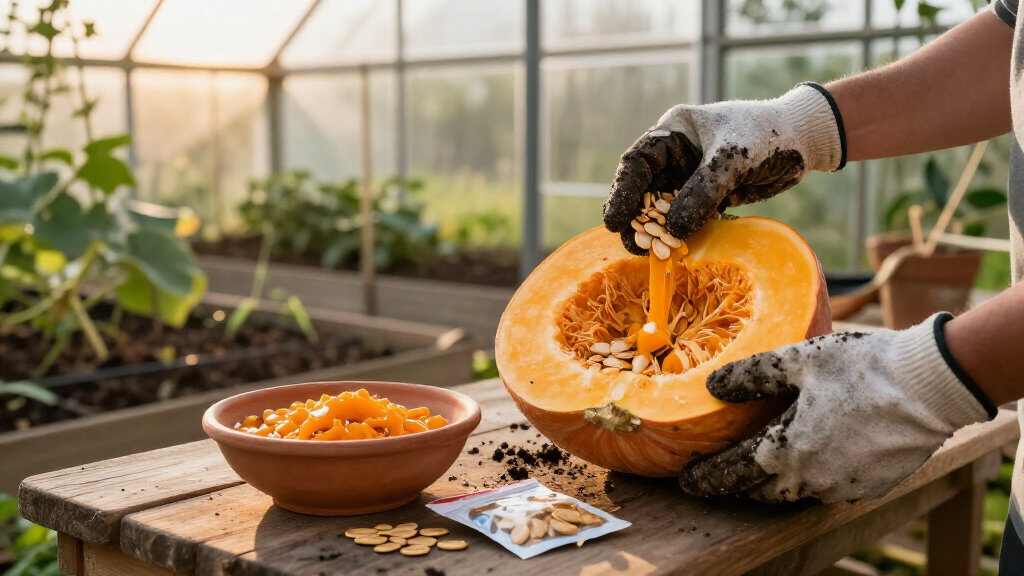
For a batch kept for planting, scoop out the seeds, separate them from stringy pulp, set aside broken or visibly damaged seeds, and rinse the rest in a colander. Spread them evenly on a screen in a cool, dry place and turn or stir them during the first two days so they do not remain stuck together. Once fully dry, place them in a labeled paper envelope and store them in a cool, dark, dry location.
“A purchased pumpkin may come with little information about how it was grown.”
— Illinois Extension
Unknown Parentage and Drying Time
For many purchased pumpkins, variety, hybrid status, pollination, and parent-plant health may be unknown. A named variety or orange appearance does not resolve those gaps. The supplied guidance also gives no universal cutoff for how many days a pumpkin can sit out, whether frost exposure rules out saving its seeds, or how much time since carving is acceptable. If the pumpkin’s condition is doubtful, the guidance recommends choosing a different source rather than relying on a specific elapsed time.
Drying time also varies: the cited extension guidance ranges from at least three weeks to about a month. Neither period guarantees that seeds in every setting are ready for storage. Gardeners must check that the batch is completely dry; the material does not provide a single test or date that applies to all conditions.
Label, Store, Then Reassess
Gardeners who keep a suitable batch should label it clearly as an experiment, record what is known, and mark missing details as unknown. After several weeks of drying, store only completely dry seeds in a paper envelope in a cool, dark, dry place. Recheck the batch and available garden space before sowing.
For the next planting, reserve the main garden space for fresh, identified seed if a particular harvest is required. A saved batch can be tried separately if there is room for an unpredictable result. The guidance also says there is no seed-saving reason to hold a suitable mature pumpkin until Thanksgiving; it can be processed now.
Key Questions
Will saved pumpkin seeds grow the same kind of pumpkin?
Not necessarily. A seed may germinate without producing a pumpkin that matches the expected characteristics of the variety. Without reliable variety and pollination records, treat the result as uncertain.
Should I save seeds from a store-bought pumpkin?
You can save them as an experiment if the pumpkin is mature and sound, there is no known disease in the parent plant, and you can dry and store the seeds properly. A store-bought pumpkin may have little growing or pollination history available.
How long should pumpkin seeds dry before storage?
Allow several weeks and store the seeds only when they are completely dry. North Carolina Cooperative Extension specifies at least three weeks, while Illinois Extension describes about a month; these are planning guides rather than fixed guarantees.
When is fresh, identified seed the better choice?
Choose fresh, identified seed for the main planting if you need a particular variety, size, or cooking pumpkin, or if you cannot accept unexpected traits from saved seed.
Source: planetnatural.com